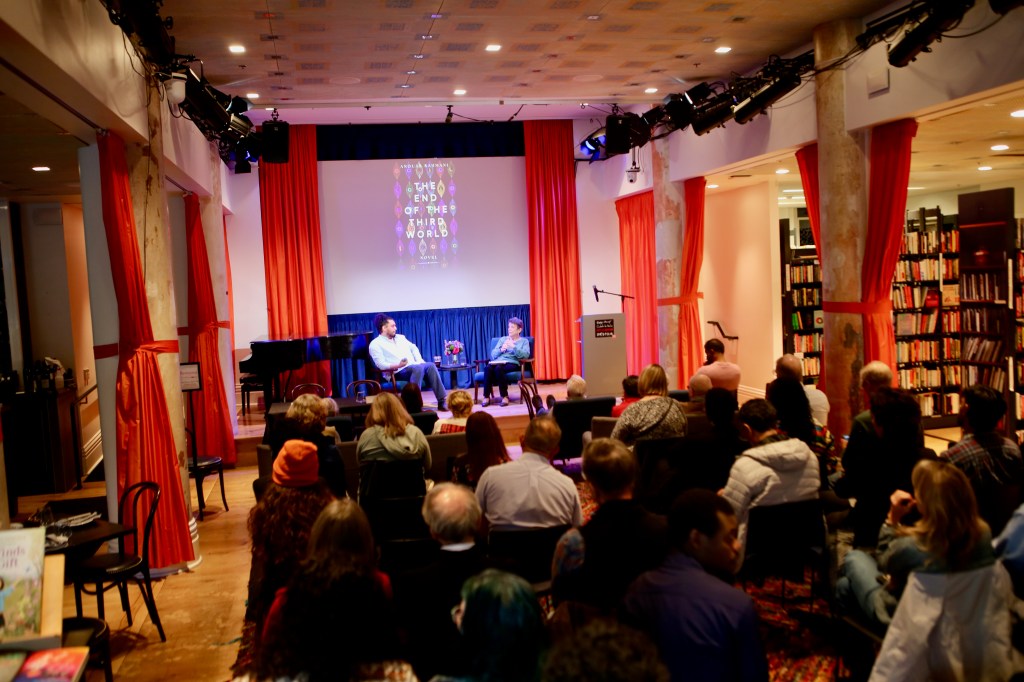
End of the Third World is a sprawling, multi-layered novel that examines the foundations of patriarchal systems and questions the global order through the lens of a worldwide epidemic known as the Patriarchy Virus. The virus is said to attack women’s wombs, triggering panic across the globe and pushing governments toward permanent lockdowns, persecution, and the targeting of LGBTQ+ people, immigrants, minorities, and other marginalized communities. As fear spreads, the figure of the “woman” is transformed into a universal scapegoat. The term no longer refers only to those born female or those who transition into women; it expands to include LGBTQ+ people, dark-skinned communities, immigrants, refugees, minorities, and anyone placed at the bottom of social hierarchies.
Yet despite the global chaos unfolding outside, the novel approaches the epidemic mostly through news reports and distant accounts. The real story is far more intimate: it follows Elizabeth, a woman in her forties who suffers from a severe skin sensitivity to sunlight, and her supposedly “progressive” and “religious” husband, Andrew. Their relationship begins to unravel when Andrew learns that Elizabeth is pregnant. Having long rejected the idea of fatherhood, he reacts with rage and hostility. What begins as a marital conflict over pregnancy and abortion soon evolves into a philosophical struggle about freedom, parenthood, bodily autonomy, and existence itself.
Everything changes when Elizabeth discovers that Andrew murdered his father as a child and hid his severed head inside a flowerpot. Suddenly, she finds herself trapped between a hypocritical and increasingly violent husband, the buried head of his father, and another head growing inside her own body. The conflict consumes her to such an extent that the Patriarchy Virus itself becomes almost irrelevant. The small patriarchal system suffocating her inside the house proves far more terrifying than the one ravaging the outside world. For a woman whose life is already constrained by her inability to face sunlight, what happens beneath her own roof becomes far more dangerous than anything occurring beyond it.
Attempting to survive and regain her husband’s trust, Elizabeth decides to rebury his father’s skull inside the flowerpot and water it as a gesture of reconciliation. But something strange begins to happen. A gigantic tree emerges from the buried head, which has somehow transformed into a seed. As the conflict intensifies, the tree grows relentlessly, invading the house and gradually infiltrating the minds of those who live there. It produces fruits with human faces that do nothing but moan and sigh. The tree feeds on Andrew’s vanity and desires, while simultaneously exploiting Elizabeth’s maternal instincts. Unconsciously, she begins breastfeeding these fruits before eventually consuming them herself.
Other stories branch out and intertwine with the central narrative. Through Elizabeth’s memoirs and reflections emerge tales of patriarchal oppression and transformation: a man whose head turns into a breast, a woman who was once a fish during the Falklands War, an Irish man whose father convinced him that sunlight was a murderous monster, and many others. Together, these stories form a fragmented universe exploring power, identity, trauma, and resistance.
The novel was originally conceived and partially written in Arabic in Algeria beginning in 2019. It underwent substantial transformation after the COVID-19 pandemic and the resurgence of authoritarian tendencies across many parts of the world. Later, while pursuing a Master’s degree in Applied Translation at Carnegie Mellon University under the supervision of Professor Kenya Dworkin, I translated the novel into English and composed several sections directly in English, integrating them into the manuscript.
I could have written this novel better. I could have refined it further and offered readers a more polished work. However, years of political repression in Algeria, psychological struggles, anxiety, and the wounds of exile profoundly shaped both my life and this manuscript. I am fully aware that the novel is imperfect, often excessive, and at times unnecessarily long. Yet I no longer possess the energy required to endlessly revise it, nor do I wish to erase this chapter of my literary journey.
For that reason, I have decided to publish the novel online free of charge and make it available to readers everywhere. I hope it finds its own path in the world.
More than anything, End of the Third World is a novel of questions. It raises questions that belong to the age we are living through—questions about power, fear, identity, freedom, and the recurring return of patriarchal structures in new forms. Its ideas deserve discussion as much as they deserve reading, and I hope these questions will continue to spark conversations about the patriarchal virus that, in one form or another, keeps returning to haunt the world.
Anouar Rahmani
 Anouar Rahmani's Official Website
Leave a comment