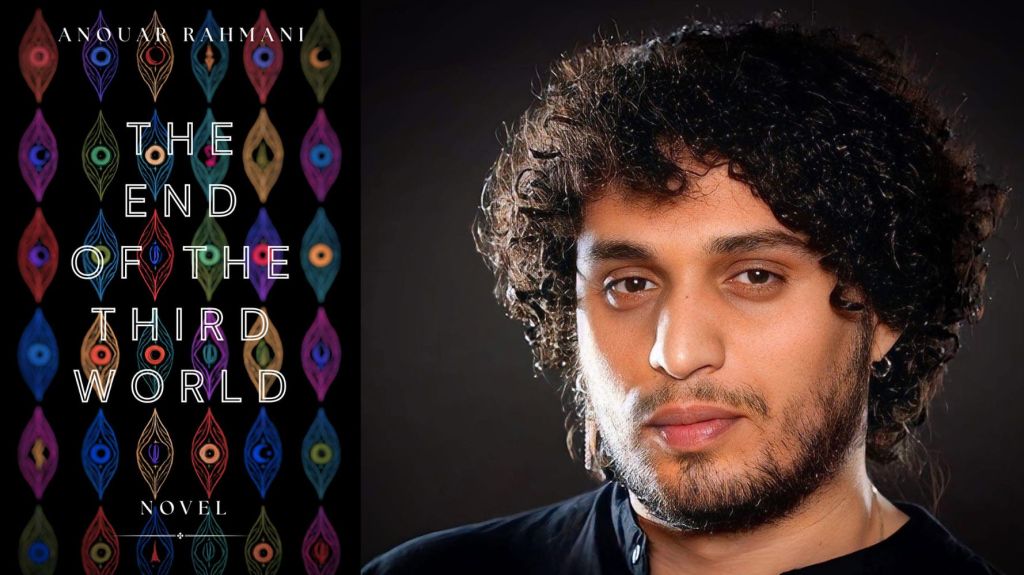
The End of The Third World.
The Patriarchy Virus
Anouar Rahmani
Email: anouarrahmaninovelist@gmail.com
phone number: 4126670203
To all the wokeists in the world…Viva ‘wokeism’
Anouar Rahmani
“We revolt simply, because, for so many reasons, we can no longer breathe…”
My dear compatriot, Frantz Fanon.
“All I want to say is that they don’t really care about us…”
Michael Jackson.
Warning: this novel is full of violence, sexual violence, abuse, crimes, and madness, and contains some very sensitive scenes that discuss some unspoken issues and crimes such as rape, pedophilia, homicide, racism, and the world order.
The end:
The next morning, all the women died, the transgenders, the gays, the bisexuals, the Asexual people, the non-sexually identified people, the intersex people…
Then the poor people died, the dark-skinned people, the people of the Third World, the immigrants, the refugees, and most developing and underdeveloped countries collapsed.
And only assholes were left in the world.
Breaking news:
The World Health Organization announces a new epidemic sweeping the world: the patriarchal virus:
It attacks women’s wombs, causes hallucinations and death, and there is no information about how it is transmitted from one person to another, or how it can affect mental functions.
0 (Prologue)
They gendered hierarchy. They gendered the classes. They emptied people of their consciousness and individual identity to manipulate them and rule them, to terminate what was once called ‘self-awareness’. They gendered hierarchy to theorize the class as ‘The Gender’ and imposed classism as the only way for a society to exist.
Everything is falling apart. Identities are shrinking to social statuses, political organizations are turning into mercenary forces, and the legislators are sinking into parental lobbying hegemony. Marginalization is no longer a tool of oppression; it’s a gender cruelty, a position that’s preordained and rooted in one’s identity.
Everything is falling apart. Something is consuming time around that time. Time itself doesn’t seem like time anymore. Something was invading the air; the tree on one side was devouring the house from within, while the virus on the other side leaped from one person to another like wildfire. Everyone is now considered a woman—except for the assholes, who remained men, just as they always were. “Woman” had become a title assigned to all ‘usual’ victims of the patriarchal system, regardless of biological sex. And the man—only the man—the misogynist, the sexist, the homophobe, the transphobe, the racist, the extremist—remained a man in the legal systems.
“Female” had transformed from a gender into a social class. The whole world had come to agree; being female had nothing to do with anatomy between the thighs, as the most ignorant traditionalists used to claim. Ironically, even those same traditionalists now embraced this new definition—one rooted in social status. A man is whoever is privileged by the system, while a woman is whoever is beneath it.
I saw them on TV, Instagram Reels, Facebook, and TikTok. They were capturing women, LGBTQI people, non-binary individuals, immigrants, dark-skinned people, neurodivergent people—locking them in cages, stripping them of their rights, altering their genders on ID cards ‘WOMAN’. The rights they once had have now become privileges reserved for men. Some were shot, others murdered, and many persecuted. Those who dared to speak out were tortured, silenced, and censored—all in the name of “stability.” And ‘protection methods.’
Regimes across the world imposed hierarchies, even within homes. They sabotaged every concept of human rights, placing legal guardianship over anyone classified as a woman—whether ‘woman’, cisgender, trans, queer, or marginalized by race, nationality, or legal status.
The Patriarchy Virus is no longer just a virus. It had returned to its original form: an ideology, a culture, an unspoken religion above all others. It became a sacred excuse to dominate, to control—control as a virtue, as a way to “protect” people from ‘themselves’. But now, it was obvious: this wasn’t about a health crisis. It was about belief—an ancient faith passed from generation to generation, asserting that the only way humans can coexist is through division and class. Bullshit.
Hospitals were crowded with ‘women’, and clerics in all religions sang of divine punishment. Some of them linked this virus to equality, others to women’s freedom. It set up guillotines and gallows to kill women, considering them a scourge that must be ended. For example, France did not spare its repressive laws against women who freely chose to wear the hijab and even intensified them, and Iran intensified its punishment against those who removed it; the same patriarchy everywhere. Women were suppressed in every country according to their ideology or religion. Everyone agreed that women were the main problem. India, Russia, Brazil, Colombia, Algeria, Saudi Arabia, and other countries suddenly decided to place women under surveillance and subject them to all kinds of investigation as if they were primarily responsible for the spread of this virus and not its victims. As for some fake scientists, they claimed that the virus arises spontaneously inside Lesbians, and myths spread, and lies arose to extinguish the flame of the question: How did this virus come about?
When the patriarchal virus was announced, I was sitting on the couch reading a book about patriarchal systems. By chance, a line in the book caught her attention: the state, society, religions, and history are different expressions of the same evil, patriarchal face. The angry face was staring at her blankly. She could see it there, eyes fixed on her. At that time, she was sitting in the light of the television: several deaths around the world, generally of women. They were falling to the ground in a hysterical state of chaos and panic. In London, shops selling women’s supplies were closed, and at JFK Airport in New York, women passengers were detained in giant animal cages and prevented from roaming around. Many airports around the world have banned women from using their services, and airlines have canceled tickets for all women. In Germany, many women were laid off from their jobs for fear of the spread of the virus. For the first time, news channels paid attention to doctors’ opinions as they had never done before. The state of panic had reached its peak, and all that remained in the apparent world were the males, the male TV journalists, the male interviewers, the male politicians, so many males that it was too vulgar to be accepted by the eye.
The virus today is what determines gender, a virus that was said to attack women’s wombs, a dialectic that has been scientifically proven in a way that cannot be refuted, but what has undermined it and made the matter even more strange despite its validity is that many people are infected with this virus: females without a womb, males with homosexual or bisexual tendencies, or as some like to call them, abnormal tendencies, as well as transsexuals. Larger cases have also been recorded among non-white communities, the poor, the semi-middle classes, and third-world countries, and therefore, they are all called women today.
This paradox left scientists astonished. It perpetuated the opinions of clerics who considered this virus to be a celestial being coming from the Kingdom of God to punish humans for their equality, for their freedom and their equal rights, for the decline of religious extremism and racism, which were falsely and slanderously said to be a divine system, and for the rights of sexual and religious minorities, intellectual and expressive freedoms, and the freedom to criticize the sacred things, as well as the spread of atheism and secular and democratic systems. Therefore, with the spread of the virus, Muslims persecuted Christians on their land, Christians persecuted Jews, Hindus persecuted Muslims, Buddhists persecuted Hindus, and everyone persecuted everyone else, in a state of collective oppression in the name of God, each with his God against the other’s God, each claiming the Godship of his God through the exclusion of the rest of the Gods. When the world did not unite under one God as each God’s followers wished, and no God prevailed among them, religious and civil wars raged, their flames intensified, and chaos prevailed in the world. All of this, according to them, had happened because of ‘women,’ not because of their Gods.
Women: this word no longer carries the sexual and gender connotations it once did. Still, it has become a moral group that contains within it all those who can be infected with the patriarchal virus. In other words, Woman no longer means ‘women’. Today, homosexuals are women, the poor are women, minorities are women, oppressed communities are women, and the people of third-world countries are women. The term “women” has become a term that carries in its meaning all third classes, all threatened classes, and all victims of patriarchal systems-the real virus.
National identification cards were changed to protect people, governments issued new cards, and the term “woman” officially became a term that gathered under its cover everyone who could have been infected with the patriarchal virus. Women (women, trans people, gay, bisexual, gender non-identifying, dark-skinned people, people of color, the poor, semi-middle classes, minorities, and many others), and the circle expanded every day to accommodate other components. For extreme right-wing political purposes, migrants and refugees are also classified as women. As for men, especially white, rich, and heterosexual men, they enjoyed immunity from both viruses: the patriarchal virus and the patriarchal system alike.
Rich businessmen, who benefit from rentier systems and utilitarian exploitative systems, claimed that the cause of the spread of the virus was the ‘Woke virus’ – a historical lie promoted by those who benefit from divisive, substitutionary and segregational systems that benefit from the state of social discrimination -, with the slogan of divide and rule, the rich classes worked to perpetuate ethnic discrimination between peoples to protect the feudal systems that gave birth to them, to protect their interests and their families’, and above all to protect the patriarchal, classist system that empowered them over others. “Woke virus?” somebody said that, well, the only virus that we knew is the patriarchal system virus that has ruled humans since the beginning of culture and civilization. Today, it takes on a new guise, in the form of a real virus, to serve the interests of global mafias, ruling families, exploitative businessmen, and feudal classes that do not say their names. As for those dictatorial regimes, they chose to expand the circle of women to include political opponents, journalists, writers, and artists. These are also women, even if they are not, as women are simply everything that lies at the bottom of the pecking order in patriarchal regimes. By granting all these people the title of woman, the brutality of patriarchal societies increased, baring their fangs and revealing them. Social punishment crystallized as a collective state of hatred against women, with all the insults this word carries in the patriarchal society.
I watched all of this with a scrutinizing eye, fearful that she too would be infected with this dangerous, life-threatening virus. Being a woman increased her risk of contracting the virus. For a reason known only to the political system, her identification card, which had the word woman on it, was replaced with another that carried the same word, but in a larger size and clearer font.
On television, newspapers, news sites, social network platforms, universities, churches, mosques, political speeches, coffees, bars, streets, and markets, everywhere people speak about women. A collective obsession that has gripped humanity. It wasn’t new, but it was becoming clearer. Women have become the greatest evil, the arch enemy of the patriarchy, women as they always have been, and with them the other lower classes in the patriarchy.
But just an hour before I started writing this, my husband decided to lock me in my room, following the regime’s “precautionary” guidelines to contain the outbreak. It was violent. The monster emerged in his eyes. He dragged me and locked the door behind me. He imprisoned me for no crime—except that I was a “woman.”
He said it was a measure to stop the virus. A way to preserve humanity. But despite all his contradictions, I never imagined Andrew would treat me this way.
I no longer understood him. He had surrendered to the system, claiming it was to ensure humanity’s continuity. But in truth, he wanted to preserve his control over me—the guardianship of the ‘white’ man over every structure he put ‘beneath’ him. Even though he had long adopted progressive rhetoric and defended women’s rights and those of minorities, in the end, he exploited the pandemic to dismantle everything he once claimed to believe in. Like all scum of the Earth, he gave in to his male instinct, to the elite layers etched into his brain. Because patriarchy is not just an ideology—it’s a set of experiences that devour a person from within.
– The world is collapsing. This is the end.
– The end? Don’t be so dramatic. These are just precautions. Everything will be fine, believe me.
– It won’t end because of the virus. It will end because of patriarchy—a system that’s been here for thousands of years.
– These ideas are what made you sick. Your thoughts are the real virus threatening your existence.
– No. You are the one threatening my existence. Are you imprisoning me in the name of love—or in the name of the system? Are you trying to protect me, or protect your control over me? You “men” want to subjugate us. Anyone the regime considers a “woman.” You make no distinctions. Anyone who falls below your sexual hierarchy is “female.” This virus was made for us—to drag us backward, to undo what we’ve built, to steal our rights. Women aren’t the only ones imprisoned now. Queer people, immigrants, HIV-positive people, dark-skinned people, men who’ve joined our fight—none of us are allowed to speak anymore. No one can criticize the regime. It’s a coup against equality and freedom. Death to the new world order.
– These are naïve ideas. Conspiracies like this belong to some trashy YouTube channels…
– No. What you want is to erase us from public space. To enslave us again after we’ve fought for our equality. You want to reclaim what we’ve won over centuries. But today I’m not just a woman. I’m a WOMAN. Capitalized. And a ‘Woman’ is no longer a gender. It’s a rank. A sexual class. We’re all women today, and we will fight to destroy this foolish hierarchy.
– You’re overreacting. I locked you here to protect you—from the virus. You’ve been deprived of sunlight all your life. I don’t want you deprived of breath, too.
– Breath? Between four walls?
– The outside world is dangerous. I don’t want to lose you.
– The world is not dangerous—it’s exposed. The mask has fallen. Since the dawn of civilization, we’ve lived in a room. This room is nothing but a smaller model of the greater patriarchal structure. But I’ll write, Andrew. I’ll write to open all the doors. There’s nothing left to hide. All rooms in the world are one room. The world is a prison with an open sky. It doesn’t matter how far you stretch your legs if your mind is confined. Suffering will awaken people. Suffocation alone is enough to break all doors. We will fight for our right to breathe…
Then I looked at the house tree, which had managed to climb up and reach my window. And just like Eve, I, too, ate the fruit.
Aborting the father
My story with the talking skull…
(Western civilization killed the father, but continued searching for him)
The first stage: recalling random memories and hallucinations.
1
-What do you believe in, Elizabeth?
– I believe in forgiveness. Nothing is without forgiveness.
– Forgiveness?
– To laugh no matter how painful your sorrows are. Laughter is forgiveness…
-Do you forgive yourself, Elizabeth?
-Sometimes, when I laugh…
I spoke with the mammoth yesterday when I opened the window and found it waiting for me on my balcony. The elephant was giant, and I don’t know how he managed to get into that tiny place. There was a frog on his head. There were also four wolves and a purple bird hovering around the site and chirping.
It didn’t surprise me. I expected something like this to happen that night. I’ve had enough marijuana and whiskey.
The Mammoth raised its trunk. He asked me sarcastically:
-How’s Andrew’s left hand?
-Fine, he uses it sometimes to masturbate.
-He seems to have been violent with you lately.
-I forgave him
-Don’t you think that forgiveness sometimes kills the soul?
-No, not when you are born without a soul.
-The bird landed on my head and said:
-God, there is so much pain inside this skull; how can you laugh?
-Some people cry when they are in pain, others laugh.
Everyone dissipated when Andrew entered the balcony naked, scratching his pubic hair with one hand, and in the other, a fruit from the human tree. hugged me, and said:
-Did I hurt you?
I laughed.
***
Sorrows do not hurt if we laugh, so I laugh a lot and mock, sometimes even at myself. I only want to forget. I tried to ignore the sadness that was eating me from within, to apply the golden rule of childhood: The closet monster won’t come if I close my eyes and fall asleep, and the ferocious guard dogs won’t bark at me if I don’t look them in the eye.
The only thing that drives me to life is my little daughter Elena, who hardly does anything except with me. The poor child thinks I am her only lifeline in this lonely world, and she does not know that I am a torn, burning rope, which cannot help rescuing drowning people. …
I may have sinned when I decided to give her life. Today, she would have been free as cosmic atoms in a galaxy, swallowed by a black hole, and expelled by another one. I liberated the spark of the first flame that created her, that burned me. I don’t know what I was thinking then; I could have aborted her before it was too late, cast her into the inanimate world before she could breathe awareness, and the instinct of survival would take hold of her, but…
I am genuinely a criminal; I have suffered in this miserable social life. I should have kept my ‘eggs’ or had a hysterectomy to enjoy ‘free’ sex forever without fear of involving another being in the matter. Children are not the fruit of love. They are the fruit of the deception of our genes that want to pass themselves on to another generation; they know that our bodies are doomed to weakness and death. How did this trick fall on me?
She clings to me as if she is constantly terrified of everything. I do not know the reason for her excessive fear, and I can’t find a suitable logical explanation for that. Still, I understand it. To wake up with lungs that do not stop breathing, that rise and fall mechanically, and inside a rib cage is enough for anxiety and fear.
The lung rises and falls, fills with air, and empties until your sense of it ceases. When you go through life and its preoccupations, you lose your sense of hearing. The sound of breathing becomes dissipated, like the mechanical engine of a car. Its noise stops as soon as it takes off. When we get used to breathing, we forget it…
This is what you realize in the first cry when the air ventures to turn towards the airway of your bronchial tubes for the first time, and then you know, as the first speck of consciousness in you, when you are still a blank page, that if you stop breathing one day, the very life in you will stop too. Your selfish instincts will be set in motion for the first time. Only then do you understand that you are subject to death, and that is why a person opens his arms and takes a long inhale whenever he feels that he can do so, and he calls that feeling ‘relief’, and by that, he means relief from death.
My name is the same as the wife of the Prophet Zachary, Elizabeth, and God destined me to have a child when I was forty, after years of rebellion against childbearing. My husband and I chose not to contribute to the accumulation of people on the planet, so we used to use birth control pills and condoms every time we were interested in each other. Elena’s sperm somehow leaked from the condom and crept into my guts, looking for her ‘egg’. One egg was waiting there inside of me to fuse into something won’t be an egg anymore; something with a brain, with an ego and with a lot of selfishness, an egg that will turn into memories, dreams and nightmares, an egg that will be consumed into the brutal capitalist world where billions of eggs are fried, boiled and consciously consumed, erased and indoctrinated with ideologies, religions and politics every day and all the fucking time.
When I ‘forced’ her in, I felt a needle-stick in my heart, a point of emptiness sewn into a small universe, the first moment of the big bang, a bright something made of light. When God’s hand touched the first fragment of the universe, the quarks and their antiquarks collided, causing the atoms to spread and multiply; my womb turned into a new universe.
2
During my pregnancy, I was thinking a lot. I was confused and did not understand myself yet, looking at my belly growing up every month, I felt like my right for a space was completely denied. I felt crowded, full of living beings; something was living off me like a parasite, feeding off my body and arguing with me about its right to stay. I didn’t understand myself. Did I want to have a child or have an abortion? Or did I want both?
I hesitated a lot about giving ‘it’ life. I used to enter abortion clinics at night and think. I would register my name and then wait for my turn. When the time came for that, I would run away crying and continue running in the street while I was in surgical clothes. I remained in this state until I had almost visited all the available clinics in the city, and so the new universe inside me kept expanding. Black holes were devouring my thoughts to throw me into another dimension, in a spiral hole outside the space-time field. Zachary was calling on his Lord in Jerusalem, and God was fulfilling his aspirations after his gray hair and giving me instead what I did not want: a human fetus.
Whenever I approached the abortion clinics, a dry halo of light enveloped me and pined me away from the entrance door. Then, my poles were dissonant with their counterparts on the ground, making me fly loosely away from the place without my will. At that time, the fetus clung to my nerves and tightened the placenta, and when I tried to throw it into the infinite world, it clung to my forearms and spinal cord and manipulated its electrical circuits. Every point in my body prevented me from having an abortion. I felt like God in His kingdom was in my womb, sitting, squatting, and chewing a reed. Drunkenness sometimes, and sometimes he played the flute, and the fetus came out of its bottle, dancing and twisting, confronting God and merging with Him. At that time, I felt a strange love for this being that passed through the darkness of my womb like a bat, communicating with me with my sounds and its blows on the wall of the uterus that contained her. I was no longer human at that time; I had become a roof, and I had a duty to protect the tiles from storms and earthquakes.
I advocated abortion a lot, as the relationship between the mother and the fetus is semi-legal, a free lease of the womb, and the landlord has the right to evict the tenant if he does not want him. Women own their wombs, and neither law nor morality can stick their hands inside women’s guts. But I was weak and didn’t know if I really wanted to abort or not. For the first time in my life, I understood that strange look drawn on the eyes of possible mothers who had undergone abortions. When a woman carries a fetus in her womb, nature clothes her, and she becomes Nature herself, and Nature cannot easily neglect her right to continue in life.
Contrary to what I expected, everything inside me pushed me to give birth: my heartbeat that changed, my different behavior, my turbulent mood, and my swollen belly that I always contemplated in the mirror. Everything asked me to keep the fetus and become a mother, but nothing that was left wanted an abortion, and this nothing was logical as well.
a little longer than nine months, maybe nine centuries or more. Time was passing slowly, and gloom gripped me. My husband turned into an angry monster, breaking plates and cups daily. I understood then that his decision not to have children was not for those philosophical reasons that he used to discuss with me every day before sticking his tongue into my vagina and licking it like a dog. I thought he carried the books and volumes of philosophy in his head, but I was disappointed in him. His head was a dick.
He was a good conversationalist, choosing his words brilliantly before delivering long sentences full of academic terminology. Still, in the end, I figured out that his tongue was only good at licking. He wasn’t really the philosophical bogeyman he pretended to be. My philosopher husband was only evading his fatherhood responsibility, evading his semen. This was evident from his disgusting behavior. I was looking for my old husband, but I found no trace of him, and the philosophical principles we had chosen as our beliefs no longer had anything to do with us. It was not about childbearing; it was about respect. I felt he was forcibly extending his arm into my gut, trying to pull this branch growing inside me as if I were nothing but a tree in his imagination. It was hard for me to believe that Andrew, this leftist fighter who supports the feminists, smashed dishes in my face because I refused an abortion. I felt his image had fallen before my eyes and shattered like glass. He should have realized that I am not a tree.
I told him about this contradiction, which shook me from the inside, but he could not bear the pressure as if he were carrying the fetus in his bowels. He became irritable and explosive. He yells at me over and over all day long for the slightest reason.
– You are deceitful. You broke the contract. We promised not to have children.
-But you know, Andrew, I did not decide to be pregnant. It happened against my will.
-Then abort him; you have no other excuse.
-But I’m in the fifth month, do you think it’s easy?
-You could have aborted him with a pill at the beginning of your pregnancy, but you chose to make our lives like this!
-It’s changed now, Andrew. I want to have a baby.
-What about me? Did you think about me? If I want this baby or not.
He yelled at me: “Abort my fucking sperm.”
He used to break everything around him, repeating: “Deceitful, deceitful, deceitful.”
When he used to repeat this word, I remembered those stories he used to tell me about his married female colleagues at work and how they used to deceive their husbands with their colleagues, and he called them whores. He was always talking about the graceful women flirting with him and about how faithful he was to me.
3
Andrew is religious and a hypocrite at the same time. He does not remove the cross from his neck except for extreme necessity, and he is always present at Sunday Mass. He used to talk about honor, chastity, and how husbands should be faithful in bed. I would ask him: “Can we be faithful out of bed?”
He never entered the house without smelling of semen. Even on the days when he came back from church, I could see those yellow spots of dried semen on the hem of his pants.
We should always be faithful in bed, he said. Still, he never specified whether we should be faithful if we were struck by golden opportunities for fucking standing or sitting rather than lying down or other positions invented by porn sites. He may not have had his dick in another vagina, but I was sure he enjoyed rubbing against other bodies and was content to ejaculate in his underwear afterward.
He swore to me once that he had never deceived me, and I told him then: “Andrew, a man has two testicles; God has wisdom in that!”
God created two testicles for a man because he knew that he was a deceiver by nature. If a man were loyal to one partner, God would give him one testicle. A man has two testicles, one for women and one for men. If your husband does not deceive you with another woman, you should pay close attention to his friend who plays bowling with him.
– My love, you know that I am religious and wear a cross. I cannot commit adultery; God forbids that!
-Andrew, didn’t you notice that all the porn stars wear crosses? Some of them tattoo it, too.
Jesus chose Mary Magdalene for himself, Muhammad married dozens of women, and Abraham lived with the slave girls, so how could Andrew be chaste? When he used to call me a cheater or whatever, I used to ask him, “Isn’t abortion forbidden in Christianity?” He would sip his saliva and cough, then say, “Didn’t God abort His own Son on the cross?” I used to reply to him, “God did not abort anyone on the cross; man is the one who crucified God.” Then he would respond to me while rubbing the hair of his head angrily, “But God did not interfere, so God approves of abortion.”
Andrew was full of contradictions: religious in some things, an atheist in others, right-wing in some things, left-wing in others. He always described himself as a left-winger, but the only left I could notice in him was in his writing with the left hand when signing contracts and checks or even on records and Mobile mail; he used to do this to deceive others with his intelligence, and for that, he always chose an eye-catching pen, so that everyone would always ask him in the same routine tone stemming from initially ignoring, “So you are a lefty, sir?” His nostrils enlarged then, and he would reply loudly for everyone to hear: “Yes, I am.” Leftist and I write with my left hand too, and I think you know that those who write with their left are smarter than those who write with their right, and we are few in this world, aren’t we?” Then he used to laugh.
My husband was making this up in a fake way. He wasn’t really lefty because I was glimpsing him in the toilet when he was wiping his ass with toilet paper using his right hand. That was the only moment of honesty in his life; in the bathroom alone, I could see my husband drop his accent of pride and false plays of wit. I told him once that Einstein was right-handed; he didn’t speak to me two days after that. He had long practiced writing with his left hand, and he wasn’t going to allow me to refute the thesis he had made, which he considers one of his life’s achievements. And on the sidelines, another piece of information about my brilliant husband: he does not close the toilet door on himself while he relieves himself. He only did this when a guest visited us at home, which leftists usually do.
My husband is religious and leftist at the same time. Believe it or not, it does not matter. He lives in a terrible state of psychological persecution. He does not know what he wants and is unsure of his ideas. All he likes is to appear in an elitist outfit, especially since he is a political science professor at the university. He got a PhD, not for himself but for the sake of others.
His mother told me that he had lived a difficult childhood with his father, who used to force him to smoke despite his asthma. He tried to force him to play rugby and learn mechanics; he used to tell him that he should be a man.
Andrew told me that when he reached adolescence, his father used to bring him ‘prostitutes’ and force him to have sex in front of him to ensure he was heterosexual and not gay. Therefore, he watched him during intercourse, gave him orders and lessons, and when he failed to get a boner, his father used to yell at him: “Get up, go on, do your work, come on, put it in. Do you want to be a fag?”
To make sure Andrew was not a ‘homosexual’. He used to check his testicles and his penis and measure them from time to time. His father was a real shit.
4
Homosexuality is the origin of sexual desire. I argued about that with Andrew a lot during pregnancy. Science may not agree with me, but I will keep my opinion as it is, living beings desire what is similar to them, lions desire lions, cats desire cats, humans desire humans…
“It is obvious, we desire what resembles us, and sometimes we desire what even resembles us in sex. Our practice of heterosexuality is the original anomaly, the first sin. “
Andrew didn’t agree: “It’s not true, I am 100% straight.”
We both envied homosexual couples; they can’t have children by mistake, if they have children, it’s because they really want them, they simply adopt them, and if they want children of their own, gay men would ‘rent’ a womb, and if they are women, I guess, they will simply fool a man. Homosexual couples are much better parents; they will never ask themselves if they did the right thing by having a child, they are one hundred percent sure of their decision, and they will never regret it.
Heterosexuality is the original sin, and that’s why I am pregnant now…
It took God to create a heterosexual couple, Adam and Eve, to invent the first sin. The heterosexuals are not for paradise; they are for the earth, to colonize it, to multiply in it, to destroy, and to end it. They are the fruit of the heavenly sin. We deceive our nature with the lust of the opposite sex, to desire out of curiosity a sexual organ that doesn’t resemble what we have grown up seeing in us, because the heterosexual never reconciles with his genitals, he lacks tolerance for his body, hates it, and looks for something different as a tool of self-tolerance, deviating from the first nature – the sin that has never occurred in heaven, the sin of the earth, the sin of logic and reality, the forbidden sexual desire – homosexuality.
We practice heterosexuality to give birth, and we subdue the homosexuality that is within us; we bury it so that we do not lose our social status, our class. Heterosexuality is the original anomality, the need for reproduction, the economic and social need that created it in the first place, and therefore is an invention. Everything that results from need is an invention; that’s absolute. Even air existed before life, but nature invented the need to breathe it to adapt to the planet’s atmospheric conditions. That’s why we invented love and marriage, to add some forgery to our fake life. Andrew deceives me and I’m deceiving him too and we’re both cheating on each other, we cheat by breeding and we’re both deceiving our daughter, and she’s also fooling us into her need for parenthood.
Before Andrew became a man, when he was formed inside his mother’s womb, he was also a female, his testicles were ovaries that went down after he uttered his supposedly ‘male’ chromosomes, and his penis that came out of them was only a passage inside the vagina, the head of his dick was only a clitoris, he was a female. All men are transgenders by nature, females distorted by fate for the sake of reproduction, and therefore every heterosexual act is a deformed homosexual act in general.
Today, with the outbreak of the patriarchal virus in the world, the world has begun to understand its truth. They needed this for their masks to fall against their will. Therefore, the world is moving towards savagery, because the human system that emerged from the root of the first sin, the sin of Adam and Eve, is a system based originally on deception.
God deceived Adam when he created him without his will, and because Adam was a man, he was necessarily female at the beginning of creation. God made him male without consulting him, then Adam and God deceived Eve when God created her from Adam’s rib, they both degraded her as female from being the origin to merely a part of a man’s body, then Satan deceived them when he tempted them to disobey God, then Adam and Eve deceived God when they ate from the forbidden tree, then God deceived them again by forcing then into exile from heaven to earth.
Men subdued women because women are the origin, and the heterosexuals subdued homosexuals because homosexuality is the origin, Cisgenders subdued the transgenders because the transgenders are the origin of creation, and the rich subdued the poor. The lack of possession of wealth is the origin because wealth is an economic invention, and the rulers subdued the people because the people are the origin. The groups subdued individuals because the individual is the origin; the colonizers subdued the colonized because the colonized are the origin in the colonized lands; and human beings subdued the rest of the living beings in nature because nature is the origin. And therefore, we’re all afraid of the origins.
Revolution is the act of returning to the origin, it’s not progressive to embrace the roots, it’s a rebellion inside ourselves that we reject what was afterwards invented, inside us, there is the origin, where no political, religious, or social or individual ideologies cancel the truth, the origine of all origins, that we are what we hate about ourselves, and therefore I repeat: homosexuality is the origin. Females are the origin. Transgenders are the origin. No wealth is the origin, the colonized is the origin, the individual is the origin, and nature is the origin.
And what’s my origin? My origin is what I was before getting pregnant.
5
Andrew fries an egg every night before he goes to bed. He fried eggs while I watched my body transform into something I didn’t understand. In the mirror, my belly was expanding in a circular motion. I hate to say it was expanding in my body, it was actually expanding in the mirror, where I was standing and looking at myself, but in my body, it was just a possibility, maybe it existed, and maybe it didn’t, in line with my thoughts about abortion. Most of the time, I would deny that it was on my belly, I wouldn’t even say inside my belly, I wouldn’t even say it was my belly. It was swelling, as if it was going to burst, and the veins on its surface made it look like a large dinosaur egg. “Is it possible that a female is the same as the egg, just an egg?” “Woman is the human’s egg?”
I wondered if it was worth calling it a belly back then when it was bigger than an actual belly. Round, convex, with my belly button sticking out a little and appearing on the surface, and the fetus tapping its feet on its corners, kicking me lightly to remind me of its presence. His presence was convincing, but the belly may not have been mine. I never thought about it: “I will never let myself be an egg…”
The sound of eggs being fried was driving me crazy. He was frying them carelessly. He fried them as if they had fallen with the rain; he fried them without any regard for the hen whose vagina had widened to lay them on the floor. Every evening, he would eat the eggs, eat them greedily, add spices, bastard, lots of spices.
I saw myself as an egg, just an egg. He would hit me on the edge of the pan, break me; I would crack and then explode. The yolk would come out first; the white would come out transparent and be called white because it becomes white when it is fried. It doesn’t matter if it was something else, another color, before. Just like an egg, I am consumed, consumed by my husband, society, and now this thing I’m carrying. I think I am more precisely the white of an egg; it doesn’t matter what I was before getting pregnant, before getting fried; what matters more is what I am now.
I’ve always seen women in movies, rejoicing in their ‘pregnant bellies’, their faces reddened with happiness, jumping for joy, some even exercising during pregnancy. I didn’t believe them. This belly looks so monstrous, it looks like a spider’s belly, it looks like a monster, “What if there’s no fetus in my belly, maybe it’s a bunch of snakes rolling around,” “Oh my God, can it be snakes?”
It’s not fair for the female to carry the fetus alone; it would have been more appropriate for my husband to carry half and for me to carry the other half. The lower half of the fetus would be formed in my belly and the upper half in my husband’s, then we glue the two halves together through love, but if there is no love between us, the baby is never glued and is not formed, and this is better for the child so that they do not have a bad childhood. How could this idea have escaped God’s mind?” But instead, I alone carry this fetus, my belly alone expands, and then my vaginal opening expands… My vaginal opening expands, really expands, like I’ve seen in a birth video, and the head, the whole body with all its limbs, comes out of my vagina. And if I give birth to this fetus, the man who carelessly fries eggs in the kitchen will be called a parent, well, this vagina is the only parent that I recognize…
If what I’m carrying is already a person and I don’t have the right to abort it, then why doesn’t the state issue an identification card for it? Why doesn’t anyone recognize it as a full person? Why don’t people use the pronoun ‘they’ when they talk about a pregnant woman? Why do they ignore the person in the belly? Like a customer in a taxi, they ignore its existence: So, they don’t double the rights. They were supposed to give a pregnant woman the rights of two people, to eat, to sleep, and the extra benefit of doubt. A pregnant woman is supposed to carry two identification cards and two passports. She is supposed to take two vacations a year instead of one and two weekends.
How many barns and egg factories are there in the world, collecting eggs in cartons and selling them cheaply, making mayonnaise and applying it as a face mask, and using them in many industries to make hair keratin and even flu vaccines? Chickens live their entire lives as egg producers, whether in traditional barns or in factories where they do not move except to eat or lay eggs, and their bodies remain stuck in a cage until they die, or are electrocuted and eaten as fried chicken, chicken wings, chicken burgers, chicken breasts, and chicken sausages. No one cares about chickens, and absolutely, no one cares about an egg.
“Am I an egg?”
6
When we stopped looking at each other’s faces, I knew we didn’t love each other anymore. Andrew was boring as hell; everything he cared about was his success in life and how to write more academic articles in which he pretends to be the savior of the world, the hero of the left wing, the radical feminist. But I knew his truth; he is a hypocrite, that’s all. The Western left wing is just the left side of the right.
At first, I believed him, but now I don’t. What else can I do when I have seen his hands getting long to kill the baby in my gut? What if I wanted to keep the baby, it’s not his baby anymore, the moment he took his cock out of my vagina he had to know that he owned nothing inside of me anymore. He slipped it onto me, he took it out, that’s it. The baby is absolutely mine. Everything he owns in this baby is ‘that’ little spermatozoid, nothing more; the rest is my flesh, my blood, my nutrients, my oxygen, my womb. I am literally making this baby out of my cells, my bones, my hormones, my time.
The bees kill the males after the mating process, spiders eat them all starting from the head, and the anglerfish– and no wonder why it’s called ‘Ang(e)le-rfish’– seizes the opportunity, when the male gets attached to her body to gradually absorb him and turn him into merely a reproductive organ.
I wish I could devour him, but I bet he is not that tasty.
He used to sit in the living room, sometimes in his bathing suit, sometimes in one of his strange, colorful, polka-dot pajamas. He wears flip-flops and sticks out his big toe, and moves it while crossing one foot over the other. He would read those large volumes in his library while wearing his glasses. He would turn the pages and smoke, cigarette after cigarette, extinguishing them in the cactus pot next to him. Sometimes, he would drink some beer and water the cactus with some of it. When he did this, the living room would turn into a cheap bar in one of the poor suburbs, worn, dirty, and evilly untidy. The only thing that broke the brutality of that painting was an itch that came over his ass while he read. Only then would he get up, almost getting up, rubbing it vigorously without taking his eyes off the book, and sitting down again in his place.
Sometimes, I would catch him talking to the cactus in the living room. I did not understand the significance of its presence among us at all. Sometimes, he would read books to it as if it were listening to him, and sometimes he would complain to it about his life, and I would catch it, like, answering, or I would imagine that. I was not quite sure of what I was seeing. And when he was not there, I would try to talk to it too, but to no avail. I would sit in front of the cactus and ask it about anything that came to my mind, but it didn’t answer. Andrew and the cactus have a special relationship, a silent linguistic one, and an intimate friendship. They were quite similar. They both drank and smoked and kept some life and some death inside of them. They were both filled with thorns and strangeness.
I stopped looking at Andrew’s face when we both reached the age of forty. Slowly, I started losing faith in his face since he received his doctorate. After discussing his thesis entitled “The New Western Left, The Quiet Face of Resistance,” all that remained of his face were faint features that were getting duller day by day. With time, his face began to fade more, but his chin was wrinkling day after day, and this was what kept me from reaching the rest of his face; his chin was hiding all his features…
I’m sure his chin has become triangular. When he was talking to me, I could see the lower part of his face, and sometimes I would accidentally catch a glimpse of his lips moving, quickly or slowly, and some light splashes of his saliva were flying here, there, and everywhere. My relationship with him after the age of forty became like Tom’s in the famous cartoon Tom and Jerry, with that woman we could only see in her black stockings and blue skirt that concealed several multi-colored skirts underneath. My relationship with him was limited to the lower side of him, which contained his neck and the rest of the organs and entrails underneath, including his flaccid penis. As for his face, it became suspiciously mysterious. I tried more than once to catch a glimpse of him, even if I was unaware, but to no avail. Most of the time, he covered it with a book or a newspaper. Andrew was a bookworm and perhaps had dark circles.
I used to try to look at him while he was speaking, but it was as if the murmurs of his voice were creating strange ripples across his face, erasing it and making it unrecognizable. Also, his glasses, with two small rectangles, swallowed his face and then concave it so that it alone became visible. His features were erased, as if someone had erased his face without realizing it, when he discussed his thesis about that camouflaged Western left, that left, which is nothing but another right.
Let’s ignore his face.
Andrew was a mythical being. I would not have believed in his existence if I had not lived with him all these years. It was suspicious when he pretended to have poor eyesight to get glasses to conform to the stereotypical image of an intellectual in people’s minds: A pale person wearing only wide trousers, combing his hair back, smoking, drinking coffee, and wearing glasses.
He was something I couldn’t consider to be fully alive, despite all the pheromones he was putting into the air; there was something dead inside of him. Andrew was just thin, transparent threads linked together in psychological knots. The outlines of his body, face, and everything in him were made as if they had been drawn with a pencil. And when he tried to underestimate me or my freedom, I wanted to grab the thread and pull it so that his entire face fell into my hands, a thin, long thread. Andrew was hiding behind his erased features, books, and newspapers, and his psychological complexes, as if he were a ghost; Andrew was just a thread.
Despite all the negatives of my marriage to him, I do not deny that I was in love with him. I loved him, and for this reason, there was tranquility for most of the years of our marriage, as well as a boring routine. Until the day of confession came, it was a quiet night, and Andrew was talking to his cactus. And in a sudden moment, something fell to the ground, something heavy, so heavy that Andrew grabbed his head with both hands. The cactus pot fell to the ground, crumbling into small pieces, and the dirt in the living room carpet. The wood-burning stove was burning, and its orange light was spreading across the tiles in the room. A spherical object emerged from the pot, having been hidden inside it the whole time. The thing was rolling on the ground, its sides alternating in the firelight. Silence prevailed, and the crackle of the wood became louder in my ears. I tried to identify this spherical thing.
Golden ball? Perhaps, but it is a ball of a weird shape, yellowish-white, swollen at the top and less swollen at the bottom, and with several holes. A punctured but solid ball fell onto the ground and rolled, leaving behind colorful dirt. Things were moving from the sides. It fell into the ground by accident. Maybe it was a coincidence. It was perhaps empty; everything around the ball turned into swirls and circles of thoughts, air, and smells. Andrew’s face melted into his shoulder. I saw his left arm curling and sliding on the ground. It was curling as if it had no bones, falling, sliding, expanding, and filling the place with infinite weight. The place was heavy; I felt my feet being dragged down. The bottom was empty, with darkness and a dim light in the far middle. I froze. Scattered shapes inside neat shapes. Circles inside triangles. Triangles inside angry faces. Everything has happened. I saw Andrew’s thoughts in color. It happened by chance; nothing happens by chance anymore. The thing was ponceinside a cactus, and Andrew used to spend
-I was expecting this.
-It’s a coincidence, Elizabeth!
-What coincidence is this?
Coincidence means that everything is spherical because every point on the ball is the beginning of the ball by coincidence, and just like coincidence.
The spherical object rolled until time stopped. Time is also a coincidence. Every second is the beginning of time, just like a ball. At that time, Andrew was dividing, fragmenting, and reuniting again. He was trying to reconstitute himself in the form of another human being, to disavow something he had committed. My questions were hovering around his head, piercing it, dissipating the trembling silence in his mouth. He shouted at the top of his voice: “There is nothing inside that damned head.”
He closed his eyes and did not open them again, and a random eye was moving in the middle of his forehead. I was looking at it, searching for something inside it, but I did not find it. I searched for myself as well and did not find it. Everything around us was dissipating by chance. Everything around us was gradually turning into nothing, by coincidence.
I kept contemplating it and looking at Andrew’s erased face, hoping to find an answer to my question: “What is this damned thing?”
7
It was a skull. Yes, a skull, a human skull, a human severed head. It was difficult for me to realize that at first, but soon the questions hovering in my head dissipated, and I realized that the spherical thing that had fallen by accident, as my husband said, was a skull. Some pieces of facial flesh and decomposed internal organs were still attached to it. It had a face on it. Decomposed and corroded flesh, I was terrified and began to wonder slowly while swallowing my saliva.
-What is this, Andrew?
-Let me explain to you
-Explain to me what? This is a human head.
-No!
-How could it not?! It’s a decomposing human head.
-It’s not what you think.
-Who is he? Whose head is this?
-It’s my head!
-Your head?
-It was inside my head. …
-It’s my head, I swear to you, it’s my head.
-Andrew, I’m tired of your lies. Tell me now, whose head is this?
-It’s my head, another head that was inside my head. I took it off and buried it there.
I shouted at him: Whose head is this talking to?
-Okay, I’ll tell you everything, but no…
-Unconditionally, speak now, or I will call the police.
Andrew picked the head up from the floor, sat down on the sofa, and placed it on his lap. He started rubbing some of the remaining hairs and shaking off the dirt as if he were petting his pet, then he started telling his story:
-I was sixteen at the time, and I remember it well. I heard my father talking to himself as usual in the parking garage where he worked below our house. He was looking for a screwdriver. He was cursing and screaming. I went down the stairs and stood at the door between our house and the garage. I looked at him from afar. He glanced at me. He called me:
“Andrew, find the big screwdriver.”
I immediately carried out his order and went looking for him. He returned to the car he was working on, and I searched the garage shelves for his screwdriver until I found it. I picked it up and walked towards it. I was watching him as he was squatting on the ground, trying to fix something in an old red Cadillac. A few meters separated me from him, but it was a long distance of questions and thoughts. I hated him, Elizabeth. I hated him so much that I would lose control of my bladder every time I heard his voice. I headed towards him, carrying within me a deep, heavy, and painful hatred to an unimaginable extent. He didn’t notice me. He was talking to the car and sometimes cursing at it. I held the screwdriver in my palm and pressed it as if I were squeezing it, and the red and yellow colors mixed in my fingers under the pressure. I wanted to smash his head so that the nightmare I was living would end, but I hesitated. I relaxed my hand, and I regretted it. He called me again, turned his head towards me, and without realizing it, I raised the screwdriver high and hit him on the forehead. I felt it breaking into the bones of his skull and crushing them. My father fell to the ground, blood pouring from his head. He tried to grab me by the ankles, then he died, his eyes fixed on the back wheel of the car. I didn’t understand it and stood there looking at his body. I contemplate his death. The death of the boogeyman. I thought my nightmares were over. I didn’t know what to do then. I did not regret it. I was afraid. Afraid of everything. I heard my mother talking behind me; I didn’t understand what she said. She stood behind me, there, and I did not turn to her, but I imagined her with her neck extended, contemplating my father’s soul as it left for heaven. She quietly pulled the screwdriver from my hand, then put her hand on my shoulder, and we remained looking at my father’s body together.
My father is dead; I killed him.
For the first time, we were at the top, and my father was at the bottom. We are not used to this arrangement. My father has always been in control, and we are the submissive. He was lying beneath our feet. We kicked him and spat on him. I killed him. I killed my father because I hated his regime, I hated his lifestyle, I hated his screaming and his dictatorship. I didn’t want to have sex with any more of his cocks. I’m tired of seeing him breathe; my father had to die.
I turned my face towards my mother and found her smiling, but she did not say anything. We did not say anything. We sometimes stood looking at each other, at other times at the corpse. My mother tapped me on the shoulder and then motioned for me to leave with her eyes. But I stayed at the door to see the whole scene. She threw the screwdriver onto the floor, then put on gloves, grabbed another of the same size, and hit him on the head again. His head was a party of colors and holes. The rhythm of her blow to his head was resonant as if she had struck him a thousand times with one blow, killing him again, and that was his second death. I killed him as he should have died. Then she threw the new screwdriver onto the floor and picked up the one she had hit him with. She turned around and found me there, staring at her. She came towards me but did not say a word. Then she looked at me for a moment and said, crying happily, “Thank you!” I did not answer her, then she added: “No problem, do not be afraid, I will protect you. Now I will call the police, but you will go to your room. If the police ask you any questions, do not answer at all.” “And remain silent.” She climbed the stairs toward my room, but I heard her talking to the police on the phone while crying: “Please, come quickly. I found my husband dead in the garage. Someone killed him. Save us. We are afraid.”
The sight of my father drowning in his blood kept floating around in my thoughts. I killed my father. I couldn’t believe I did that. My father is part of the past and will never come back. As for my stubborn breathing that did not aspire to the grace of breathing, it began to sum up my shock, and the breathing became like my father’s, heavy on my chest, crouching there, rising and falling as if it had never existed.
The police came and opened an investigation into the case. My mother had hidden the murder tool and the gloves. She looked sad and afraid while talking to them. She was a brilliant actress in those moments. They took my father’s body to the morgue and learned that he had died from a severe blow to the head with a screwdriver. They took what they thought was the murder weapon and found no fingerprints on it. At first, they were suspicious of my mother, as there was no clear evidence to prove that the killer was someone from outside the house. The investigator asked me about any information I knew and whether my father had quarreled with my mother in the last days before his death, but I did not answer him. I didn’t say a word about what happened to anyone. My mother trusted me, so she never refused to have me interrogated. After a few days, I was diagnosed with post-traumatic stress disorder, and he never interrogated me again. According to what we were told, the report on my father’s murder was closed due to a lack of evidence a few days after his death. I remember that night well. My mother made two cups of warm chocolate, and we enjoyed drinking them while watching a funny movie together. My mother looked at me proudly and laughed as if a mountain had been lifted from her shoulders.
My father’s murder was enough to restore her freedom and dignity.
However, unlike my mother, I felt that killing my father was not enough. Something was burning inside me. A fire that was difficult for me to extinguish. I felt that my father’s head was still inside mine, even though his skull was larger than mine. My head was splitting open to accommodate it. His voice was speaking to me, his screams, his thoughts. His words were disturbing me, and I didn’t know how to make them go away. I had to kill his thoughts, too. I tried that with myself. I remember that I used to masturbate a lot to forget, but my father was nesting inside my head, crouching inside me, not moving a muscle except to torture me. There he was, squatting inside my balls, lurking for sperm before they could touch the light. I could hear him there repeating: “Come on, fuck her, fuck her, do you want to be gay, to be a fag?” “Come on, show me your cock. Why isn’t it getting bigger? Are you gay?” “You should drink beer and burp, don’t care what people say, let it get erect.” Your penis must be erect; it must be erect, your penis must stand, it must be proud, your penis must be proud, let it express itself, especially on buses, where the man inside you grows. You are a man; you are a penis. On the buses, on the buses, on the buses…
I can still hear him repeating: “You are a man…” My father said it and repeated it without stopping, inside my balls, inside my head, and in the foreskin of my penis. He was growing into a stone god, a masculine god, who wrinkled with every erection of his penis as if his head were a balloon inflating with air. You are a man… He said it; then he vomited the matches with which he started the fire inside me. Be a man, on your jumping cock, be a man so as not to…
His intentions are no longer valid; I have killed him. He had to die, the death of the father, the death of the regime, so that a small dictator would not remain in my world. I smashed his head so I could see the system more closely. For meningeal fluid to flow on the horizon, to quench my thirst for his death, the death of the father.
But his death was not enough, so…
I anxiously awaited his funeral. I was afraid. I never ruled out that he would rise again to punish me for his murder. He would have done it; I knew him to be a mean person. I am not tempted to see him dead and gasping for breath. It may be nothing but a cunning deception to camouflage his cunning plan to punish me.
When they opened his coffin for the first time in the church, his face spread into my eyeballs. I looked at him carefully, and I was afraid. I no longer know whether I killed him or not. They dressed him in classic clothes and a yellow tie. I don’t know why it was yellow, but it was tempting me to pee on him. As for me, I was wearing another classic suit and forgot to lift the zipper, as if I was ready to…
I tried my best to keep his voice out of my head, but to no avail. My mother and the priest read his eulogy, and we loaded his coffin onto the back of a car and walked to the village cemetery where we lived. The neighbors were talking to my mother and asking God for patience and strength for her, and she was crying in her black dress, wiping her tears with the tip of a handkerchief.
In the cemetery, I saw the graves shaking as if they were not there. My father’s coffin was lowered into the grave. I heard the priest muttering about heaven, but God was not stupid to put that fool there. As soon as his body reached the bottom of the grave, my mother threw a rose at him and asked me to do the same. I held the rose in my hand and refused to throw it into his grave. No one at the funeral understood why I said no. My mother insisted, but I did not obey her this time. I bit the rose, spat it on the ground, and immediately left the place towards our house, which was not far from the cemetery. My mother ran after me and surrendered at the entrance to the cemetery, and those present returned her to her husband’s grave. She was crying bitterly as if she loved him. I was angry. I heard them say behind me, “The poor guy is angry because his father was killed. He can’t accept the idea of his death.”
Their voice faded, and my anger increased. He didn’t have to be given a respectful burial either. It had to be thrown in a landfill. I was jealous of his body.
I accepted the idea of my father’s death, but what I did not accept was that he would be buried so quickly without me healing my love for him. Therefore, I decided to pull him from his grave to interview him for the first time. I wanted him to hear me.
It was on a moonlit night. I took one of my father’s old cars while my mother was sleeping, carried an ax, and headed towards the cemetery. I didn’t feel an ounce of fear. I entered it as if I were entering my room. I had an enemy in the grave that I had to pull out, and so did I. I dug his grave deep until I reached the coffin. I knew that when he hit the ax with his forelock. It was difficult for me to pull him; his body was heavy, but I did it. I pulled my father out of the coffin first; then, I tried to push him out of the grave over and over again. As soon as I succeeded, the rain suddenly fell. I got wet. I started dragging his body on the ground until I reached the car, put him in the back seat, got in, and headed, I don’t know where.
I didn’t know where I was going. I was driving the car for the first time without any documents, and I did not know if the gasoline would be enough for this trip. A trip to a place I don’t know, with a dead man behind me. Sometimes, my eyes would wander and fall on the interior mirror of the car, and I would see his pale face. I would tell him: “You will hear me this time. You will hear me against your will.”
The car stopped in a mountainous place, between dense trees. I found a hut there, but it was deserted. I made sure of that first. I stormed into the house and found no one there. From the look of the dust that covered it and the spider webs that inhabited it, I understood that the hut had not been touched by anyone for a long time. I returned to the car and dragged my father, dragging him with difficulty until I got him into the cabin and sat him on the sofa. Then I sat opposite him. I stared at him for a while. I couldn’t believe he was dead. I didn’t say anything at all. He looked scary, but he wasn’t as scary as he was when he was alive. I spoke to him: “You are not frightening me. You should know this: you are not scary anymore. It is just that you were breathing, and you can no longer do so. Come on, tell me, where is your power? Where is your strength? You are no longer able to do anything now. I hate you. I did not say this to you before, but I say it to you now. You are the worst father in the world, the worst ever.”
I parked the car in the garage, went back to my room, and went to sleep naked. Only nudity was enough to make me rid myself of all the negative feelings that followed my killing of my father. I felt that I took revenge for all the anger that my father planted inside me, I took revenge for the bottles of beer that he made me drink against my will and for my lungs that were exhausted by the cigarettes of fake manhood, everything that was coming out of my chest, I uprooted that big cock that my father planted inside me. Early in the morning, I found the police at home talking to my mother or the neighbors staring at me. They told her that someone had stolen my father’s body and that perhaps he was the killer. They said they tried to trace the car’s path, but the trail had disappeared due to the rain. They told her that they would put us under guard to make sure that the killer would not harm our family. My mother did not understand what she heard. Who could hate her husband so much to drag him from the grave? She said after she closed the door, looking angry: “I felt this. He was cheating on me with a whore.” I heard that and understood that I would not be able to visit my father in the same car, so that night, I had to devise a way to visit my father. I had promised to bring him his cigarettes. I went out the back window of the house, overlooking the trees, and walked hidden among them until I was so far away that no one knew me. I found a motorcycle parked behind one of the houses. I stole it. Fortunately for me, the gas tank was full. I rolled it at first so as not to wake the family; then, I rode it toward the same place. I was in the wrong direction at first, but soon found the right direction. On my way there, I was about to collide with a lumber truck, but fortunately, I changed direction and passed it
It was raining, and I walked among the trees and crept into the hut again:
-Dad, where are you?
I knew that my father was where I had left him, but a feeling inside me was calling me to treat him as a living being. I tried to turn on the lights, but the electricity in the hut was off. I started talking to my father while searching the hut’s drawers for a candle or a portable lamp: “I brought you your cigarettes as I promised…” Wait a little, I will look for a lamp and come back to you… I didn’t hear you well; you say you want dinner, but Father, you…
-Hey, I found a candle.
I found a candle in the kitchen drawer, with matches in front of it. I lit them and walked towards my father.
-Happy New Year, beautiful. Happy New Year, beautiful. Happy New Year, Daddy. Happy New Year, Beautiful
She laughed, then addressed him:
-Yes, yes… It’s okay… I know it’s not your birthday, but…
Then he was silent for a while, and I spoke to him, laughing again, making fun of him:
But it’s your death anniversary…
My father’s deafening silence made me angry. He had to say something, he had to respond, or at least make me laugh. I did not understand how such a talkative and arrogant father could remain silent in this way. His death was only a passing event. I knew in my inner decisions that my father would not give up life completely when he died. Death for such a stiff-headed father needs to be repeated thousands of times for it to be counted as a final death.
Oh, I forgot, here are your cigarettes.
His face was blue, and two pieces of cotton were blocking his nostrils. His eyes were staring at the ceiling. She grabbed a cigarette and put it in his mouth. I went back to my place and sat down while the cigarette fell from his mouth, and he also fell on his side. I leaned him back and put the cigarette back in his mouth.
-What can you do now? You’re dead, Dad. You had to die, just like all human beings, you had to die. Believe me, I comforted you.
I shed two years or less, and I was generous in that and said to him:
-Dad, you are a bad, evil father. You were forcing me to be a copy of you. Look at yourself now; I forced you to enjoy me. Only death could make you human. You are better now. You listen to me. I killed you, Father, and you deserved this death… What did you say? Do you mean you don’t deserve your death?
My father didn’t say a word, but I had to make an excuse to slap him. I got up and slapped him while addressing him angrily:
-But…you…deserve…death.
Then I put the cigarette back in his mouth and went back to my seat, sighing:
-Well, you deserved this? Do you remember the day you found the back seats of your favorite car wet with urine? It wasn’t the cat that did it; it was me. You know, I wanted to light your cigarette, but you’re dead, and you can’t smoke… You smell bad; you need some cleaning.
I got up, opened the zipper of my pants, took out my penis, and urinated on his face. I was pissing and laughing until I emptied my bladder on his face. I felt like I was pouring all his thoughts onto his face, those outdated masculine thoughts that he had inserted into me, all those bad memories that had to come back to him in this humiliating way.
Father, you have mocked me with your thoughts, you have mocked me with your masculinity and your arrogant fatherhood. Watch me urinate on your face.
When I finished, I zipped up my pants and said to my father:
-This was some perfume to get rid of your bad smell.
I knew he was dead, but I didn’t trust him very much. I waited for him to say something or do something, but he didn’t move. I wished he had revolted against me so I could kill him again. I killed him quickly and did not have enough time to enjoy his death. I had to kill him slowly. The second killing is the real killing. As for the first murder, it is only a passing event.
-Good. We have made up our minds now. I smashed your head and killed you, violated your grave, stole your body, and urinated on you. There is no problem between us now, one-on-one, Bingooo.
When I told him this, I knew that I was lying about my own decisions. Nothing in the world could erase my hatred for my father. I had to erase it first inside myself, and then inside all fathers. I had to erase the father from history to get even with him. This is what the West did, Elizabeth. Just like me, the father was killed in the collective imagination, in the political and legal system here, little by little, and everything in the West seemed like an eternal process of revenge, the process of killing the father and everything related to it. But he remained there on the horizon, and we craved him just as I craved him. Murder is a sexual behavior. It is forbidden sex. The process of stabbing, suffocating, or crushing is a sexual act. Penetration is a lustful act, whether it is with a penis or a dagger, whether it is with semen or blood, whether it is with love or hatred. Murder and fucking are both sexual acts for the pleasure of using the other body. Murder is desire and lust. Therefore, the killing did not work in putting the murdered in the world of oblivion, and it also did not work in making the West forget its patriarchal system…
I thought carefully, then looked at him coldly and bid him farewell.
-From now on, you will be my friend. You don’t have to be scared to see me. I will come back and bring you your newspaper and some beer. I know you have missed it.
I continued like this: visit after visit, dancing with him sometimes, listening to music, sitting on his lap and telling him stories, telling him jokes, and laughing and giggling. I made him the father I had hoped for. I even cooked for him and ate with him at the same table. At the end of each meeting, I would urinate on his face until it became a routine that I did without feeling that I was doing it for revenge. The house became smelly, the smell of its decomposition and the urine that I was pouring on it, so the idea came to me to buy him a bouquet of roses and put them in his mouth, and so I did. That day, I brought an automatic camera, and I started taking pictures of him, sometimes with the roses in his hand, other times with them in his mouth. His mouth looked terrible; he was funny. I took some pictures with him. Those were the most beautiful pictures of me ever. Believe me, I was smiling.
I cannot deny that the appearance of my dead father with flowers in his mouth made me laugh sometimes. My mother, who was often wandering around looking for an answer to take her to my father’s body, did not understand why I was laughing suddenly without warning. When I had one of those laughing attacks, she would look at me sadly, perhaps thinking that I cared about my father’s death or about killing him. She felt sorry for me every time I laughed.
The city’s residents linked my father’s death to the presence of a serial killer, and after his body went missing, some said that the serial killer was a cannibal. My mother believed the story, even though she knew I was the killer, and the idea of a cannibal might have frightened her. The police were investigating the secret of the disappearance of my father’s body. The matter was no longer just a murder; it became related to a danger to the city’s residents and to public opinion, but I did everything necessary to prevent the secret from becoming clear or being revealed.
I continued to visit my father on the same motorcycle.
Everything seemed normal. Every night, I visited my father, entertaining him, entertaining me. I made him a promise that I would never leave him alone as long as I lived. But all of a sudden, I was overcome by a strange desire that I had not expected. Lust grew inside me every time I saw my father decompose. I was afraid he would suddenly disappear before I was satisfied with him. Despite his death, he was present with his silence, his corpse, and his decaying looks. Sometimes, I caught a glimpse of him swatting flies with his hand. Something in him was alive, and it was starting to take effect.
-Bravo, you finally did it, you survived…
A voice was suddenly speaking to me. I tried to pay close attention. Perhaps I was hallucinating.
Bravo, my dear son, you killed me…
I saw my father there, talking to me and applauding me:
-You killed me, violated my grave, urinated on me, and masturbated on my face. What are you going to do next? Are you going to fuck me too?
I rubbed my eyes to think I was dreaming, but it was real, my father was talking to me, what a shock! I did not know what I should do. I wanted to escape, but I was powerless, so I started talking to him as well:
-Forgive me, father. Please forgive me. I did not kill you to kill you but to end the regime you imposed on me. I am, perhaps, a little remorseful…
-Regret is of no use now, my son. Come and sit on my lap and hug me…
I went towards my father and sat on his lap while crying, and then he extended his hand and hugged me. And I slept there on his lap happily after I brought him back to life with my sperm. I woke up one morning, and I knew my mother was worried. I said goodbye to my father, who returned to being an idol as he was, and he did not respond. I got on the motorcycle and headed home late. I found the police in the house, and my mother collapsed, crying, crossing her arms over her chest. I stopped, threw the motorcycle, and ran toward my mother:
-Mom, mom…
My mother turned to me, and her crying increased.
-Andrew, where have you been?
-I’m walking around…
She hugged me to her chest and said, “I thought the cannibal had hunted you.”
-Catch me?
Policeman: “Okay, ma’am, your son is fine, we will go now.”
The policeman went on his way after my answer convinced him, but it did not convince my mother. As soon as we entered the house and locked the door, she started screaming at me:
-Where were you? Whose motorcycle is this? How could you do this to me?
-I didn’t do anything, Mom, I’m just trying to forget…
-Forget what
-What happened?
-Do not be afraid, my son, they will find the killer (she said that while patting me on the head).
My mother thought for a moment, while denying the bitter truth, that I was my father’s killer and that she had participated with me in blurring the traces of the crime, or perhaps she had forgotten the truth or had been too lazy to believe it. As for me, I have gotten rid of regret. My father, whom I killed, is no longer dead as he was. He started talking and dancing after I abused him and threw my liquid on his face.
I returned to my father more than once after that, and I used to dance with him, sing to him, admonish him, and tell him my trivial stories. And he was happy about his death, smiling from time to time. I always imagined he was sometimes winking, but perhaps that was only imagination. However, he also sang and danced, and before I returned home, I always masturbated on his face to ensure that he would survive. He was happy and never complained about it. I did this until my father’s smell became unbearable, and the hut was filled with flies.
I remember well the day I decided to cut off my father’s head. It wasn’t frivolous or for fun. I heard voices for the first time near the hut, and I was afraid that I would be discovered. There was no longer a need for that body; all that was useful in it was his voice. And one’s voice is one’s head. I brought a nearby cactus pot and emptied it of its soil. Then I stood towards my father and shouted to him: “Dad, I want to chop off your head.” My father smiled and shook his head in agreement. I knew in my innermost being that my father was nothing but a corpse without a soul. Therefore, I knew that even if I cut off his head, he would know how to prove his existence again. As if it were a curse, the dead cannot die again, for death is eternal life; it is the nihilistic form of it, like someone who uses his lungs without breathing or like someone who sees in the dark. Death, per se, expresses life more than life itself.
I stood tall in front of my father. I grabbed the axe. I caught it well. I squeezed the handle with my hand, and my veins appeared hardened against the dermis. I raised the axe high, high, hi.gh I raised it. I would have hesitated had my father not smiled again. I got erect, and my dick got erect too. Suddenly, as if I had not intended to do it, it seemed to be against someone’s will. You could see me doing it as if it wasn’t me. The axe cut into my father’s neck, but it seemed as solid as a tree trunk. The axe stuck to his neck, I pulled it again and struck a second blow, knowing what I was doing this time. That was the real hit. As soon as I did that, my father’s head and the remaining parts of his neck flew with it. He flew in the air, shouting happily: “Waahooo!”
I tossed him like a baseball. And he was happy with that ‘shot’. I ran towards the head and left the body lying on the couch, headless. I held my father’s head in my hands and asked,im: “Are you okay?” My father replied: “It felt great. Can you cut off my head again?” I replied: “Don’t be silly, you don’t have another body.” He urged me: “What about my ears? Please, my ears… my ears, my ears, my ears, please, my ears,” I replied: “I don’t have enough time, Father. Right now, I must hide you. I will put you in a pot, and I will throw your body on the road along with your old driver’s license that I brought from your garage.” My father smiled, and I began to bury his head in the pot. I put him there while he was singing Mongo Jerry’s “Mighty Man” while I covered him with dirt, and then his voice started to get fainter little by little until it gradually began to tremble inside my head as if my head were a pot, and I turned on a radio inside it. My head almost exploded from the noise my father made in his annoying voice. I immersed the pot in dirt, with my father’s head in it. Then, I dragged his body with both of my arms. I pulled him out of the door of the house, exhausted. I was pulling him by his arms. When I got to the slope of the road, I threw it there. He rolled until he stopped in front of the wheels of the cars. I went back to where I came from and grabbed the cactus pot with my father’s head in it. On the way home, I had my head inside me as if it was broadcasting its voice inside me from the bottom of the pot. My father never stopped singing.
Since then, my father has been singing. He sings inside my head while it is under the cactus that I have changed more than once. He sings like he’s at a great death party. Only beer was enough to make him shut up. I used to give him some drops of it when he sang a lot. My father was a scoundrel. I had never heard him sing in my entire life. He was hoarding this unique talent inside his head, and when I cut him off, songs poured out of him and exploded inside my head. I’ve always wanted to cut off my head, too, to experience the happiness of eternal singing.
I came home and brought these pots with me. I brought my father home. My father’s head became my pet. The next day, the police called my mother to identify the headless and bloated body. My mother was told that they had found him lying on the road. My mother screamed as hard as she could. She was in denial, as if she had completely forgotten her crime. My mother was able to identify my father’s body by his small testicles. I told everyone about this after that, and at his second funeral, I said, sadly, perhaps, or to blame him: “They cut off his head, and I only recognized him by his M&Ms.” People were hiding their laughter while pretending to be sad.
At my father’s second funeral, we buried him with his head cut off. The police do not know the perpetrator to this day. I cried, too, like everyone else, while my father was singing inside my head. I threw a rose on my father’s body, then returned home with my mother. I sat in front of the cactus pot, and my father laughed mockingly at himself, and I laughed back at him. I sang with him, and our voices blended inside my head. And since then, I have not known which of the two voices is mine. Since that day, my father has been my best friend, and the cactus pot has accompanied me wherever I go. Because of the stubborn death we gave life to, we always continued to sing.
8
We kept gazing at each other. For a moment, I thought he would cut off my head too. My fear of him was greater than just fear for my fate; I was also afraid of his condition deteriorating further.
All this time, he was sitting and talking to a ‘head’, smoking with it, and giving it beer.
He hid his crime not by concealing it, but by erasing it. He made himself revive his father after his death, thus turning the murder upside down, as if the crime had never happened. He was looking at me, the head on his knee, petting it as if it were a cat. I asked myself: “What am I doing here now? I must escape…” I said that and repeated it as if I were asking myself for real: “I must run away.”
I was confused; if I had heard this story from someone else, I would definitely have run away, but I didn’t escape from this “person” at the moment when I really should have. I talked to myself again: “Come on, Elizabeth, you must escape now, come on, he is a killer…” But I didn’t escape; I wondered to myself, “Is it like I won’t escape now?” I didn’t understand why I couldn’t escape then. I don’t think love alone was the reason for my inability to escape, leaving me anxious in my place as if someone had nailed me there. I was at a pivotal moment in my life, a moment to understand myself, to understand me as I had never understood myself before. My heartbeats were calming down, little by little; I examined the head well: “Okay, it’s just a head!” It’s not a big deal…” Heads! Many of them have passed in my life; the only scary thing about this head is that it doesn’t move, it has no body or limbs, but it rolls like any other spherical object, and if movement is a sign of life, then it’s alive. As Andrew said he was talking, I didn’t hear him, but that’s not necessary now; the most important thing is that he is talking and someone is listening to it, and that’s all one needs to talk. I looked at them together, who was really the father of the other, the decaying head or the head formed above it; I could see Andrew’s features clear and distinct after all these years of gradual erasure; the picture is now clearer, my husband is a killer…
I got up and brought the broom, as if I had never heard his story, as if he had never confided a secret to me, and I started sweeping the dust off the floor. He kept gazing at me as if he didn’t understand my behavior. I realized then that even if I escaped, it might increase my chances of dying. He will surely kill me, so I decided to be a new partner in his murder, to be his new mother. He asked me, “What are you doing?” I replied, “Nothing, I’m cleaning up this mess you made.” As if he wasn’t sure of what he heard, he asked me, “And what about the head?” I asked him, “Which head?” He lifted it high with both hands and said, “My father’s head…” I examined the head closely and saw his decayed lips and his tilted mouth that seemed to be smiling. I answered him, “We will bury it again.” At that moment, Andrew started laughing, laughing as if he was making the sky hear him, as if the sky hadn’t heard him.
He stood in front of me, accompanied by his father’s skull, holding it with both hands and approaching me. I stood contemplating him as he walked towards me. As if he was trying to confirm my feelings, he nodded his head,d waiting for my response to ensure that he would never kill me. I had to keep my face free from any emotional expression that might show I was scared. Fear is a sign of rejection, and what I should have done was to suppress the gestures of my face so they wouldn’t escape on their own; my face had to show me as someone who had accepted the crime as a routine, a simple crime: All there is, a child had aborted his father, it happens a lot… Many people throw their parents in nursing homes, but at least Andrew buried his father in a pot and maintained his connection with him all this time. He is a loyal son.
“He didn’t kill him…” I said that to myself, trying to gather my strength so that the thought wouldn’t defeat me, “He didn’t kill him, he brought him to life…” “He killed him with an innocence he didn’t yet understand the meaning of killin..” “He killed him to protect himself.. Andrew is good; he never killed his father…” I was talking to myself and struggling with it, hoping to find peace in this situation. He approached me and brought the skull closer to me as if asking me to carry it for him. Acceptance means that I accept the severed head as a living being, as a person, or as if I were holding a newborn fetus. I saw that in Andrew’s eyes. He was telling me with his gaze without moving his lips: “Don’t disappoint me, accept this head…”
The problem wasn’t in the heart; it was in the idea it contained. If it were the head of someone unrelated to me or my husband, a head I found lying—let’s say—in the street, I would have passed by it without a second thought. Corpses are everywhere anyway, and we don’t need to treat them as things out of the ordinary. If fear were to be a necessary occurrence in front of corpses, we would have to fear complete corpses, not severed parts of them, and in this case, the corpse was nothing but a severed head. Fear had to be severed, too.
And why should I alone care about the dead in this world? No one cares about the dead at all. Migrants die every day, drowning in the sea as they try to reach Europe. They call them “illegals” and leave them to the sea to wash them up on the shores. Those corpses are not frightening, not because they are corpses, but because the salt of the sea has decomposed them enough to appear faceless. It is the features that frighten; a face without features is nothing but abstract death. What is the difference between a corpse whose face has been eaten by salt and polished stones? Nothing, both are faceless. It does not matter what those corpses lived through before drowning; when they drown, their life stories will shrink like water shrinks the skin on the palm and the sole of the foot. Their stories will decompose in the salt, and no one will know anything about them except that they drowned after boarding illegal migration boats and died while trying to be ‘Europeans’. In this simplicity, their lives are summarized, and their deaths are reduced to the waves of the sea; everyone knows they exist, but no one tries to count how many waves reach the shore. Corpses are like waves; all that remains of them is the sea foam.
“No one in the world cares about murder crimes; humans kill humans every day in wars and conflicts, so why should I care now?” I asked myself, trying to convince it not to escape, but I have nothing to do with that head and no good reason to carry it. I raised my hand involuntarily, without any conscious conviction, as the nerve impulse commanded my arms to rise; they rose as if I were not the one lifting them. I held the head with both hands and saw Andrew’s face resting; he was assured, after a long struggle, that I had accepted his killing of his father. Finally, he surrendered to the idea that I was his life partner.
“What do I do with this head now?” I said to myself. Andrew asked me the same question: “What will you do with it?” I answered him: “I told you beforehand, we will bury it in the pot again.” he looked at me, surprised and happy at the same time: “So we will bury it?” I answered: “Yes, in the pot…” I searched for the pot with my eyes on the floor and my head in my hands. I was trying to hide my hands’ trembling as I held the skull. I was moving my head at a unique turning angle, pretending that I was looking for the pot, but, in reality, I was trying to preempt his gaze so that he would notice my moving head before he noticed my trembling hands holding his father’s head. He said to me mockingly, “It has broken…” and started to pick it up from the ground, “but don’t worry, I have an empty pot there, I will bring it.”
He went to bring the pot, and I sat on the couch catching my breath, which quickly escaped me again as I contemplated that head: “I wonder if it will talk to me too,” “I wonder if I will get some deadly bacteria after touching this decaying head?” I couldn’t believe I was holding a dead human head.
Andrew returned with the pot, which was much larger than the first pot; it was enough for a houseplant. He brought the pot, went to get a bag of soil, emptied some into the new pot, then asked me to place the head inside it. I was eager to get rid of it, and as I was about to place it in the pot, I lied to Andrew, telling him I could hear it singing. He believed me and responded happily: “Oh, really, you can hear it singing too?” I didn’t answer him. Andrew started singing, and I mimicked him, pretending I could hear what he was hearing, too.
9
I started watering the pot every day, not for any reason other than to convince Andrew that I was his partner in ‘crime’. Andrew made me deal with two heads, one in my gut, the other in a pot. He looked at me with pride, and I smiled every time he spotted me, as if I was doing what I was supposed to do, watering his father’s head. Our relationship improved a lot after that; he became calmer, as if we really loved each other. Andrew became active and talkative, telling me stories about his father’s heart. How did it help him with his college homework?? He even told me that his father encouraged him to meet me, that we should’ve gotten married, that I was free enough to be his wife, and that he “now” realizes he made the right decision.
He said I was free enough to be his wife. Free enough to know about a murder and not care about it.
All of a sudden, Andrew decided to castrate our dog. I didn’t understand why he did that back then, when I was pregnant, but I understand it now. He simply decided to take revenge for his testicles, his manhood, by abusing and dismembering animal and human organs, to erase something inside of him. It was all for the ‘erase’. The impulse to erase and strip things of their meaning is a philosophical impulse that can lead to criminal acts.
The dog’s testicles, the father’s head, and maybe other organs, I don’t know. He seemed obsessed with defiling bodies.
How could he have hidden this from me all this time? Was I so stupid as to believe that my husband was talking to a cactus? My husband is a murderer; I wouldn’t have understood this if he hadn’t had that head rolling on the floor in front of me. My husband was not only a murderer, but he was also a brilliant one. Can anyone understand this? To kill out of revenge for nothing other than an exhausting childhood. I was looking into his eyes when he was caressing that head in his lap as he told me his story. The story of a professional killer, a killer who knew how to undo his crime with a greater crime: to revive his father after killing him in the most horrific ways. I was listening to him in fear, aware of the extent of the suffering that caused him to commit that deed in his childhood. He was petting that head as if it were his actual pet. Could I consider him a murderer while I was aware that his consciousness had canceled the crime by reviving the father in his imagination, since the two extremes cannot be combined in one meaning, whether he is a murderer or a reviver, as one must necessarily cancel the other?
Life is an act of revenge, an act that is similar to murder except in the breathing. The dead cannot breathe air, but they can certainly exhale it. Through their death, they can make someone feel guilty, upset another person’s feelings, and pass through things, through memories, and into forgetfulness, as light usually does, searching for something to break it, change its direction, and scatter it to an endless end. Death is the light that keeps wandering through one universe to create itself in another.
As for the life that was inside my womb, it was a form of extremism for Andrew to create life in death with his sperm, just as he did with the image of ‘the father’ in his imagination. Transforming into a father is transforming into a monster that cannot live except through his death, and by this, he is nothing but a murderer in another form. By encouraging me to have an abortion, Andrew was searching for something to save him from the crime he had committed. He felt meaningless; he was trying to defend his right to forget the first crime that made him what he is. He was floundering within himself and his thoughts, seeking meaning not for anything else but for the meaning of meaning itself.
My life with Andrew was no longer the normal life that I had previously lived with him (of course, with all his strangeness). I do not deny my fear, but a lot of sympathy also found its way into my thoughts and feelings. I could not judge someone who had murdered, but not for the sake of a crime. I lived with a criminal, but I had nowhere to run to, and it wasn’t easy to leave him. I felt like I was somewhere stuck inside my head: his head, the head that rolled in front of me, the head that was growing inside my gut, and many heads sticking out in many places around me, behind me, behind the visible heads, the hidden heads, and the big head in the sky.
Here he is now, placing his hand in my belly to feel the fetus growing inside me. I could see a hidden question in his eyes: “Is this life inside this woman similar to the life I stored inside the pot?” Or perhaps another question: “Will my head end up inside another cactus when this child growing inside of her kills me?” he was happily angry and afraid.
Stubborn questions about abortion were aborting me, too. I was not yet sure whether I wanted to keep the thing. Just like Andrew, I was looking for something to castrate, to blame, something, more abstract than just a dog—motherhood.
When Andrew castrated the dog, it was not bold enough to accept that the problem stemmed primarily from his testicles and those large testicles inside his head that he inherited from the society around him, and not the dog’s. Still, he blamed everything around him except those ‘bells’ that he carried under him.
After the dog’s testicles, it was my turn, for him, maybe, my uterus and ovaries were the main problems left that caused this ‘thing’ growing inside me; for a long time, he has been blaming me for my biology. When I went silent, my dog’s testicles appeared to him as a valid reason for all his nightmares about the idea of fatherhood. Uprooting is the most extreme idea: uprooting fresh meat, uprooting plants from their roots on the ground, uprooting cancerous tumors, uprooting testicles and sexual organs, uprooting ideas, uprooting paternity, uprooting as an idea, building, destroying, and rebuilding, uprooting as a type of brutality, based on instincts and thoughts; every uprooting is violent.
Uprooting the dog’s testicles was not the end of this obsession. Andrew was trying to uproot all things. The dog alone was no longer enough, and so he had to think about uprooting the legal system that allowed the crime in his mind. He talked about castration every day, trying to place the weight of what he considered a crime in his subconscious mind on the shoulders of the state.
In the end, the state is the collective expression of the crime. Only the state can empty people of their consciences. The state, for him, should be the Christ who crucifies himself for the sake of his children, sacrificing for them by bearing their sins. Who is blaming the Germans today for the Holocaust of the Jews, as long as there is a country called Germany that bears their burden? Who is blaming the Americans for the extermination of the indigenous population as long as countries in America bear this burden? Who can blame the French for their crimes in Africa, as long as there is a country called France that deserves to be blamed? The state bears the sins of its individuals, erases them, and forgives them. The collective burden of guilt loses its meaning. Andrew found the country the easiest vehicle for inner forgiveness and for a wider, collective uprooting.
-This country does not want to learn. They keep giving birth, and giving birth as if they were rats.
– rats?
-They give birth; the rats give birth a lot, and therefore, we kill them. Look at the birds; they do not give birth a lot, but we respect and appreciate them.
-Birds give birth a lot, Andrew.
-But they give birth in the trunks of trees, where we do not see them. A population of birds can fill a single tree, and they have the whole sky to give birth without appearing as if they are many. As for rats, those multiplying rodents, they are obsessed with childbirth, just like humans. They give birth everywhere in the world. Sewer drains and old toilet pipes.
-Isn’t it extreme to describe humans as rats, Andrew?
– Our state does not learn lessons. Look at China. They are smart. They have restricted births with a one-child policy. They have tactically reduced the horror of the crime. They will develop. They will lead the world because they do not give birth to many assholes as we do here…
-What is the dog’s fault?
He scratched his balls, looked at me with malice, and left.
10
As I was watering Andrew’s father’s head, I wondered why I didn’t kill my father too; I could have been watering two heads instead of one. One out of fear, the other one for fun.
I have also been thinking about my nine months of pregnancy, watering a little head inside the pot sounds like watering a little fetus inside my womb. Just like now, back then, I was not sure I did the right thing by giving birth to a child. I remember during that time. I used to wake up at the sound of my confused thoughts and the angry face of my husband, who had no longer hugged me or been close to me since I became pregnant. He said that he would not have sex with his wife and child at the same time, which was ridiculous. He was saying that he could not imagine himself having sex with me while I was pregnant. It made him feel sick.
As for me, as if I were pregnant by chance, I sometimes ignored the presence of another being in my womb, and therefore, I have not conducted any medical examination for myself since the beginning of pregnancy. Even when I reached the ninth month, I did not know the sex of the fetus yet. To be frank, I never expected that I would be able to go through nine months of pregnancy without aborting the fetus and without being curious to know its gender. Perhaps by not examining myself during pregnancy, I wanted something to go wrong, and the fetus would die spontaneously without my intervention.
How did it happen?
It was a coincidence. A small hole in the condom, no more than a quarter of a millimeter in diameter, cost me this dangerous mistake: the birth of a living being doomed to death. Nine months passed, and the specter of miscarriage still bothered me until labor began. Sharp pains began to devour my stomach from the sides and edges. My pelvis was… Trembling and shaking, and contractions starting from the end of my spine and gradually rising to my abdomen, and then dissipating into the sky. I felt as if my pain was gathering itself and concentrating in my navel and then emanating throughout my body like a large ball of lead, growing larger as the labor increased, covering all the openings in my body, even the pores. Strange things were coming out of my vagina as if my body was releasing all its fluids at once. I felt dryness in my eyes. However, I suppressed my pain and started walking slowly, looking for my husband in the hallway while holding my belly as if I was afraid it would slip and roll into the corner. He looked at me. I was distracted for a while, and I asked him in a withdrawn voice, “Andrew, call an ambulance.” He approached me a little, then took two steps back and said to me angrily, “I can’t believe you did it.” Then he ran outside and left me to struggle with the pain of childbirth. His mother came to me with easy steps and then said to me: “It is no longer time for the ambulance. Follow me to the bathroom. You will give birth at home.” She preceded me there and filled the bathtub with water, then asked me to enter it, and there the fetus began flowing out of me into this miserable hole that… It is called the Earth.
I was born the same way, in water…
I opened my legs and started trying to pour this sin. I was screaming, “I was also trying to scream in my mother’s womb as I was trying to get out of that rubber hole that was expanding to fit my head.” Just as my vagina was expanding to pull my fetus out of my inner being, when I was getting born, “I was giving birth.” My memories intersected with each other to make me live the two moments, the moment of the birth of this fetus and my birth forty years ago. I do not know why time mixed with itself and chose this circle to hover in, but I was giving birth. I was breaking a philosophy that had troubled me for years. It was nature. She defeated me again and passed herself and her genes through me, and I was compliant again. “My mother was pushing me hard. I could feel her contractions on that bag of water that was carrying me. I turned upside down.” I could feel the fetus also turning inside me. “And my head began to slide slowly,” sliding. The fetus’s head was tickling the entrails’ fluff. My pain decreased and increased in a painful game of pain. I knelt more while pushing. “My mother was pushing me hard, too,” and the fetus came out of my womb, and the water around me began to gradually turn red. My husband’s mother quickly pulled him out of the water and cut the umbilical cord. I sank into the tub, tired as I had fallen from my mother’s womb one day. Then I started crying, “After my first cry,” After my fetus’s first cry, my husband’s mother congratulated me: “Congratulations, it’s a baby girl,” and placed her on my chest. My mother placed me on her chest and was happy that I had come to this world, but I do not remember that I was happy either way. I looked at my daughter’s face with love and regret, and I named her Elina.
When my mother held me in her hands, I saw her crying. Perhaps it would seem strange if I said that I remember the smallest details at that time. I remember her trembling mouth and swollen cheeks. I saw a hot tear gradually falling from her right eye onto my head, and its surface reflected the face of the world around me. Not even me. Then she smiled and named me Elizabeth, after the Queen of Britain, whose picture my family used to hang in the living room.
My family was keener on the British royal throne than the royal family itself. Despite the poverty in which we lived to some extent, I never saw my father complain; according to him, the ministers were the cause of any misfortune, and the queen no longer governed anything and had little authority. Therefore, my father was opposed to the democratic system and demanded an absolute monarchy. For my father, the royal family had in its genes the ability to rule, and thanks to this family, by inheriting this divine gift, all roads in the world lead to London, and all the peoples of the world speak English today.
My father, a simple employee, was not saying this out of love and loyalty to the royal family, but rather because he was from an aristocratic lineage that had lost its wealth to gambling. In the distant past, our great-grandfather worked in the royal palace as an advisor and thus earned great wealth. His history was mentioned with pride among the family and in all generations, even though he was known for stealing and plundering, until that stupid grandfather, who wasted all our looted wealth on casinos, came by naming me Elizabeth. My mother thought she would please her husband, who loved the queen, and make her daughter the queen of the house.
Returning from a two-week business trip, my father behaved oppositely. He was not happy about naming me Elizabeth. According to him, there was only one Elizabeth in Britain, and we should not compare ourselves to the royal lineage. He despised himself and viewed everyone outside the royal family as inferior. He was a slave by choice to the monarchy, and he started shouting: “How did you name this despicable citizen after Queen Elizabeth?” How dare you? How?” Then he left angrily. What was strange at that time was that my father did not try to change my name, but rather kept it and modified it a little while after, and started calling me “Elise.”
My father was very attached to me. He played with me, shared his time with me, and kissed me from time to time. I also became attached to him, unlike my mother, who did not pay much attention to me, as if I were a bag of garbage that she had taken out of her womb and passed. What mattered to her was my father. My mother was stuck at home, staying there all the time and only going out when necessary. She had no personality– a woman from the Middle Ages. She was devoting her life to her husband, his comfort, and his happiness. She only saw me as a tool to preserve her husband, so she cried happily when I was born because she thought she would be finally happy, and he would never cheat on her again…well, now, I wish they both died.
11
As I watered the head hidden in the dirt, I noticed some plants beginning to grow. I didn’t pay much attention at the time; I thought they were harmful weeds. But day by day, I noticed that a plant was growing in an “unnatural” way. It was growing rapidly. I didn’t want to uproot it; perhaps Andrew would like it, and it would be a sign of my care for his father’s head and evidence that I watered it every day.
I didn’t want to change anything in my behavior; I had to act every day in the same way so that I wouldn’t end up as a head in a pot. Sometimes I would ask myself: “If I end up headfirst in a pot, what will I sing to Andrew?” Maybe I won’t sing; maybe I will curse him a lot. How can I sing when I am separated from my body, and my head is treated like a plant? I will never sing for that idiot. I looked at him and found him staring at me; I smiled at him; he smiled back, and I continued watering the head.
The plant grew taller; maybe it was a climbing plant, but its rapid growth was concerning. Strange, there wasn’t enough light in the house to allow it to photosynthesize. Maybe it was a ‘night’ plant; I told myself that over and over, for every time I got up, I found it bigger. So I decided not to sleep and to observe its growth myself. I sat in front of it on the chair; my husband said nothing; maybe he was happy to see me sitting with his father. It became an obsession.
“Is it possible that it grew from the father’s head buried in the dirt?” I wondered to myself. Maybe the father’s head turned into a seed, split in half, took root, and produced this plant. A plant can’t grow this fast unless it grew from a human brain, from its memories, thoughts, consciousness, and subconscious mind. I guarded it carefully; I wanted to catch a glimpse of it growing, at what exact hour, minute, or second, for perhaps it had a specific routine in its growth. I fell asleep, and when I woke up, I found that it had already grown, but this time something unexpected happened: It had bloomed. At first glance, I was happy to see the blooming flowers; there were four in vibrant colors: white, purple, black, and some pink. Then I caught myself and realized that they might be ‘human’ flowers, “What, human flowers?”
Unfortunately, I missed the time of its growth; I tried to repeat the process, hoping to catch it as it grew, but with repeated attempts, I realized it only grows while I am asleep.
“Perhaps it is the attention that makes it grow, not the water,” I told myself, so I instructed not to water the plant again, to see if it would continue to grow or not. I took great care of it without watering it: “What beautiful flowers…” “You are so beautiful, dear plant,” “I love you so much…” Indeed, the more I overwatered, the more the plant grew and bloomed. And as it grew larger, its trunk became rough. It looked like a small bush. I was afraid it would grow more, so I paid less attention to it, but Andrew was very intrigued by the tree, so he took more care of it, and it continued to grow.
“This plant will take over the house…” I told Andrew that while I was angry.
-Don’t worry, just a plant… What did you prepare for dinner today?
-Sushi…
I was filled with anger; I wanted to make sure whether it was really coming out of that head or from something else. If it were a parasitic plant, I would uproot it and keep the head, so it would pass peacefully and wouldn’t bother my husband. But if it was indeed a ‘human’ tree – I told myself – I would be facing a strange case, but the likelihood of this happening was very low, as it is unreasonable for there to be human trees in the world of trees at all. Human trees that think, get angry, feel happy, love, hate, and perhaps… kill.
The opportunity was favorable when Andrew was not at home. I intended to dig in the pot. I dug with both my hands, with my bare hands. I wet the soil to make it easier to knead and then take it out. I started digging, and my heart was beating fast. A wave of adrenaline took over me and made me act strangely, digging a little and scratching my nose a bit, gathering my hair, and then letting it go. I dug and dug until the seed began to appear. I continued digging. Some features of a decaying face, a split in tw,o began to manifest themselves to me. I continued digging; it couldn’t possibly be that the tree came from that head. I had to dig more; maybe another seed took advantage of the presence of a human head and nested in front of it to consume its mineral salts. Humans, compared to other beings, are well-nourished, and therefore their bodies are very rich in nutrients and vitamins, and perhaps this is the reason that made that shrub grow so quickly. I continued digging. I dug around the head to look for the seed, but the shrub was indeed coming out of the head; the head had turned into a seed.
My face turned pale from the horror of the situation, and I stepped back, thinking, “Did Andrew’s father turn into a tree?” I didn’t know what I was supposed to do at that moment. I returned to the pot and began to cover the soil around the head. I did that quickly, to hide that split, frightening, suspicious head.
When I was sure the head was indeed a seed, I tried to avoid the plant as much as possible and to distract Andrew so he wouldn’t notice it, allowing it to grow more. I wanted that tree to die. I wanted to kill the tree.
12
On my second birthday, my family discovered that I had ‘maybe’ what is called ‘xeroderma pigmentosum’. My family found out about this by chance. I used to suffer from skin ulcers from time to time and some rashes and skin redness, but no one thought that I was suffering from this malignant condition. On my birthday, while I was blowing out the candles, our neighbor, the doctor, noticed and asked my family to take care of me.
My father has changed. He started treating everyone with anger. I remember that he quarreled with my mother because of me. He said to her, “You are the reason. If I had not married you, I would not have passed on your stupid genes to my daughter. I should not have married a dog like you.” My mother was just crying and accepting all of my father’s insults. She has cold blood. In the end, she was nothing but a despicable British citizen and was not of the royal lineage or the nobility. My father did not know that for this disease to occur in my body, it was necessary to have this genetic information in both spouses, and this means that my father was carrying the same stupid genome. What caused me this disease, but my living behavior has changed. I no longer go out into the street unless I wear special clothing, glasses, and gloves,s and cover my entire face. Because the weather in Britain is not very sunny, this helped me cope with the disease.
At first, I thought it was a game or a temporary thing that would end. Still, in the end, I realized that something unusual was happening to me. I had to get used to it because it would be routine. I .t would have to lie, I had to say goodbye to the er, that mythical yellow planet there, there…
The sun has set for the last time in my life, and I, like night butterflies and bats, have become the mistress of darkness. In reality, darkness was not the desolate, evil form that films and cartoons portrayed to us. Darkness was a shelter that embraced those exiled from the world of day and sun. The night and its darkness were more tender than all the early morning lights. Darkness was a gentle companion.
I noticed black dots appearing on my skin, increasing day by day. My appearance became strange (as my mother used to say), and when I would go out with my mother, completely covered in an astronaut-like outfit and sometimes wearing a regular mask, neighborhood kids would call me ‘alien’, and others would call me ‘James Bond’. I never understood what my relationship was with this movie character, other than the glasses I sometimes wore. Still, this name kept growing and spreading among the neighborhood kids until everyone started calling me James Bond. Even the adults were not ashamed to call me the same name. When I rarely went out with my mother for something or a routine medical examination every three months, the children would hide everywhere and call me: “James Bond, don’t kill us, James Bond, what is the next case?” “James Bond Zero Zero Seven…” I did not understand at the time the reason that was driving them to bully me in this horrific way. Still, when I heard a father asking his son to avoid talking to me or approaching me for fear of infection. At the same time, he called me the same name.
Everything went well until the age of five, when the last memory of the sun was burned into my memory, and after that, I forgot its appearance completely. I was sleeping peacefully when a man approached my room and quietly opened the door, letting out a mall growl. I opened my eyes in an involuntary reaction while I was covered. In my bed, I listened to his quiet steps as he approached my bed little by little. I thought he was the monster in the closet, so I tried to fall asleep quickly and closed my eyes tightly, hoping he would leave, but he sat on the edge of the bed and turned on the dim night lamp. I sweated in fear and closed my eyes tighter so that the closet monster would leave me in peace, but it did not. He removed the cover from my face and then began to call me quietly, “Elise, Elise, my love.” It turned out that he was my father. I quickly got up, hugged him, and said to him, “I thought you were the closet monster.” He hugged me, too, and then said to me, “I have come to make you my queen, Queen Elizabeth.” I looked at him in surprise. He was drunk.
I did not understand what happened. It was a big question point hovering around my head. What was my father doing to me? I took off all my clothes and looked at myself in the mirror. I was waiting for the moment I would truly become a queen. I was waiting for those damned points to disappear from my body so I could go out and play. With my imaginary friends, and let everyone stop calling me James Bond, but nothing happened. There were only question points. The moles on my body were moving in a spiral as they tried to read and understand what happened around them, or they wanted to wash me away from this damned incident that…hurts. My father never stopped doing this. Every night, he began to roll into my room to do the same thing. The night turned into a predatory bird that fed on the waste of the day, ate me, and destroyed what was left of my soul.
Each night was more impudent than the one before. Because I had gotten used to it, I did not show any significant emotion. He felt that I had yielded to his vile whims, so he no longer put his hand on my mouth to prevent me from speaking. Or screaming, yet I could feel the palm of his hand lying over my mouth, and if he was not there, I could feel his strong grip and the weight of his rough bones, so I never uttered a word. I wanted to disappear, and after a bitter struggle between my father and my weak body that did not resist, I was crying in fear as I… I was silent: “You will soon become a queen, my dear.” And as usual, he warned me: “Don’t let anyone know about this, especially your mother.” But he never stopped doing that. He promised me I would become a queen like Queen Elizabeth, but it never happened, no matter how patient I was, so I wanted to tell my mother what was happening to me. I wanted it to stop.
I remember that she was in the kitchen. I went to her hesitantly for fear of my father and his warnings. I kept repeating: “Mama, mama, mama.” and she repeated: “Mmm, aha, um, aha.” Then she shouted at me: “What do you want?” I was silent for a while, then said it all at once: “My father visits me every night and gets naked, and I do as well. He touches me everywhere and puts his thing in my mouth.” She turned towards me and said in shock, “What are you saying? Was this a nightmare?” I answered. “He visits me every night and tells me that I will become queen after what he does to me. Is this true?” Her eyes filled with tears. I went towards her and asked, “Mama, why are you crying?” She did not answer me but contented herself with some muttering as if she was saying: “You… deceiver.” ..or something similar to this.
My father suddenly entered the house and called me for the first time by my full name: “Elizabeth, my little queen, I brought you some toys.” My mother wiped away her tears, went to my father, and kissed him on the mouth as if nothing had happened. Then the rest of the day passed peacefully, as if I were nothing. I understood from that that what my father did was a normal thing that fathers do to their children. I went to my room as usual and waited for me to transform into a real queen, and I waited for those dark spots that were covering me to disappear.
That night, my father came as usual, and he found me waiting for him, full of happiness, because I thought it was a ritual I needed to become a queen, and for the black spots covering me to disappear so that I could finally see the sun. I waited for him to play with me as usual, but this time he put his hand on my mouth again to prevent me from screaming and forced his thing into me. I felt the pain gnawing at me and destroying me. Then I saw my mother standing in front of the door of the room, placing her hand on her mouth and crying silently. I opened my eyes as if I begged her to help me, but she did not. She put her finger on her lips, telling me to be silent, and then she left, and my father continued what he was doing to me. He exhausted me, then he left me lying on my bed, saying to me, “I love you, my little queen.”
My father made me lose my soul. He extinguished the little sun that I had woven in my imagination to replace the sun in the sky. No one can imagine the pain that has been inside me and consumed me until now. I understood then that the closet monster was a gentle lamb in the face of human evil. The closet monster did not harm sleeping children. He did not wake them from their sleep to harass and rape them, so I got rid of my fear of him, and he became my friend. From that moment on, my father became an example of the false love that social beings pass on to us; my father is the real monster. I am glad he didn’t turn into a tree.
13
I wanted to get rid of the tree, just like my mom did with me, when I asked for her help.
She woke me up in the morning, dressed me quickly, and took me in her car hours away from home until we arrived in the capital, London. That was the first time in my life I had seen such a big city. My mother was only looking at the road and was not answering my questions. She was rigid and motionless, as if someone had replaced her with a dried-up pumpkin. I thought that this trip was part of their plan, Father to make me a queen, Queen Elizabeth, so I did not care much, and I just watched the foggy city with its black cars. Her red double-decker buses, I was naïve.
She stopped and got out of her car in front of a children’s orphanage. Then she got me out. She knelt and started talking to me: “Elizabeth, I will leave you here. Here, you will live and become queen quietly away from us so that we, too, will be a family quietly away from you. The idea of having you was the ugliest thing I have ever done in my entire life.” Then she sipped her saliva and said again: “You are the ugliest thing that has ever happened in my entire life, Elizabeth. Do not ever think that I did this to save you from my husband, but rather to save him from you.” “When you grow up and become a real female, you will understand how a female feels when another female shares her husband with her. I hate you, Elizabeth. I hate you, and that is why I am throwing you here today, you and this ugly disease of yours that has turned my life into a bad omen for everyone. Then she handed me a piece of paper and said to me in a voice: “Now take this paper and give it to the first person you see in front of you, you, and never return home because we don’t want you. Tell them that you only know your name, Elizabeth. Don’t let them know the truth because I will kill you if you come back. Do you understand me?” Then she stood up and said to me. “Now you will go to your new life, and I will return to my husband’s embrace so that he and I can live in peace.” Then she got into her car and said to me with all contempt: “Goodbye, James Bond…”
I did not understand anything, and I no longer felt the presence of my skull somewhere, above my neck or somewhere else. My head ceased to exist as if it were an empty object in a parallel dimension. It vanished, dispersing like those dark dots on my body, but I was shattered into small pieces like dust of light. Transparent, lost, I remained crouched in my place, contemplating my mother’s car as it fled away from the place, away from me, away from being my mother. I was listening to her words as they echoed in my ears for a long time, like the rattle of night insects, then suddenly I was interrupted by a sharp whistle in my ears, some dizziness, and a red truck. A woman quickly passed in front of me. Then, I regained my breath and understood what was happening to me. My mother had thrown me away. She threw me like a menstrual pad. She threw me away from our house and then disappeared after that. She disappeared as the sun disappeared from my life, with a sarcastic smile, without any prior notice. She also nicknamed me. Bully like everyone, “James Bond”.
Everyone abandoned me. God also abandoned me as if I were a vile mosquito whose death no one cared about. No one cared about my life. Even that woman who should have loved me, at least as an inevitable identification with the maternal instinct, disbelieved in her instinct and threw me from above. I stood in front of the orphanage’s glass door and hesitated to enter. I was afraid and shocked at the same time. I couldn’t believe that I was living this. I was waiting to wake up from the nightmare to continue my life normally with my imaginary friends, but that was it. It seemed real, even the pain was real, too. I waited there for a long time, without anyone caring about me, when one of the workers there came up to me and asked,e “Hey, can you remove the mask from your face so I can see your beautiful face, my child?” I held my mask tightly to prevent her from taking it, and I quickly handed her the paper. She took it from me and read it, and her face turned red. Then she quickly picked me up, took me into the orphanage, made me sit in the guest hall, and said to me, “Stay here, I will come back.” I was overcome with curiosity and could not stay in my place. I walked to the door of the guest room and looked around. I found her talking in an angry tone to one of the workers there. I turned my face to the other side and found a brown child of my age holding his cheek with the palm of his hand. He stared at me in astonishment, then smiled. I took off my mask for a while, and he said hi and waved; I did the same. Then, a woman who worked there took him to a place that I had not known until then, inside the orphanage, and she dragged him. He kept looking behind him, staring at me, and I crouched down and stared at him as well. As if I had just discovered something strange, a possible friendship that I had never experienced in my life, I kept looking at him and the toy pickup truck he was holding in his hand, and then he disappeared into the hallway. I returned to my place and sat, happy with this beautiful discovery, for the first time, a child looked at my dotted face and my mask without fear. Without bullying me, without calling me an alien or James Bond.
The worker came to me again and took me to the director’s office while I was still wearing my mask. I entered her office, and she was chewing gum and talking to herself. She was moving a pen between her fingers, and a stubborn fly was hovering over her face. I remained contemplating the worker’s smiling face for a long time, as well as the smiling face of the elder director, looking at her dyed-red hair, watching a stray fly, and taking in some details of the office. She finally addressed me: “Hello, my little one. Welcome. Can you take off the mask so I can see your face?” I refused, but with her insistence, she took it off for a moment and then put it back quickly. She said to me, “Your eyes are beautiful.” Then she continued to look at me as if she was waiting for me to say thank you. Then she sighed and said to the worker: “It is strange that it is not written in the letter that she is deaf, but only that she suffers from skin pigmentation.” Then I said to her shyly in a weak tone of voice: “Thank you.” She looked at me and said to me: “Well, you’re not deaf!” Then, she directly asked the worker to take me to the playing room and to call the police. When I heard the word “police,” I became very frightened, as the police usually only come to criminals and evil people. I was wondering, “Am I evil?” A criminal? Maybe I did something bad that the police should have known about and punished me for. I remember thinking about all the possibilities, and then, for a moment, I remembered what my father used to tell me: “Don’t tell anyone, especially your mother.” It occurred to me then that this was my crime. When I told my mother what my father was doing to me, everything changed in my life. My mother threw me in the orphanage, and here I am, on the verge of a police investigation. An investigation would have seemed easy at first, as I suffer from a rare disease. Usually, someone like me has an identification card issued by the Ministry of Health, but it seems my parents did not register me. One way or another, my family quickly erased any sign of me being alive, and to this day, I still don’t know how they got away with their crime.
When the police came, I refused to talk to them. I was terrified. One of the investigating officers offered me a piece of a donut and said to me, “My little girl, do not be afraid. We are not here to punish you. We just want to know your family so that we can take you back to them. What is your name?” After I ate the donut, I put the mask back on. I answered him: “My name is Elise.” He asked me again: “And what is your full name?” I answered: “Queen Elizabeth.”The investigator laughed and asked me again: “And what city are you from, my little queen? From here? From London?” I kept staring at him in amazement. He simplified his question: “Where do you live?” I answered him naively: “In our house.” He looked at me for a while and then said to me: “Okay, my little girl, it’s okay.” Then he left, and after a few minutes, I found a worker who took me inside the orphanage, to my new world. She showed me my bed and the room where I would be sleeping with some friends. Then she took me to the playroom, where there were many children, and she wanted to leave me there, but I refused to let go of her hand. I was not used to such social noise, especially since everyone was looking at me with amazement. She said to me, “Do not be afraid, these will be your friends.” I asked her in a low voice: “The boy who was in the hallway?” She asked me, “Which boy?” I did not answer her. She asked me again: “Oh, you mean Aryan?” I did not know. His name, but I shook my head yes. She asked me, “How do you know Aryan?” I replied: “I know him. He is my friend.” She took me to him, and he was in a room alone, playing alone. She opened the door, took me into the room, and said to him, “Aryan, I brought your friend.” He looked at me with a long smile. But he did not say a word. The worker said to me, “Okay, I will leave you with your friend.” She left me there and left. I remained crouched for a long time, and he was smiling. Then he continued playing as if I were not there. I walked quietly towards him and asked him: “Aryan, is that your name?” He answered me: “Yes, that is my name, and what is your name?” I answered him: “Queen Elizabeth.” He answered me with a beautiful name: “Queen.” Then he asked me to play together and did not ask about my mask, and when I took it off in front of him, he did not even ask about the
14
The tree has grown a lot, more than I could handle. Its branches stretched across the walls. I sometimes glimpsed dead birds underneath and their broken nests on the floor. Strangely enough, I never saw birds building their nests in the tree, and all the windows of the house are locked. The chance that a bird will enter my house is non-existent, but the chance that a bird will enter the house carrying the nest it built and then die near the tree after throwing it to the ground is not just non-existent; it is a form of fantasy. At first, the corpses of dead birds on the ground scared me, then I got used to them as a very normal part of my life. Who really cares about birds? I used to carry the corpses of those birds and throw them in the garbage. There were a lot of birds in my garbage bags; they looked beautiful and ugly at the same time. I hope the cleaners don’t check them.
And strange fruits also came out of the tree. The fruits are a bit like mangoes but bear the features of human faces, faces that resemble people from my memories sometimes. The faces emerged from them in a way that suggested they were faces, but they were not perfect. These faces seemed to struggle to look at the fruits’ surfaces. Maybe they were all the same faces, or maybe they were faces of different people, or maybe they seemed to me in the form of faces, but they were not. Andrew said that those faces are the masks that people wear when they look out for their interests, a good explanation, but for me, I saw them as real faces, and the masks, in any case, are just other real faces as well. A human tree emerges from the head of a human being, dead birds on the ground and broken nests, a murderous husband talking to his father’s soul, what a wonderful life.
I decided to try one of those fruits; perhaps it was delicious, and I forgot the bitterness of the days. Curiosity for their taste was feeding me from within. How do fruits with facial features taste? I approached the tree and stretched out my hand toward its branch, and it came down to encourage me to pick the fruit. The tree wanted me to eat its fruit. Scared. I hesitated, then I went back to stretch out my hand, and the fruit stretched out to approach the palm of my hand. I touched it gently. I groped it, and when I tried to get my hand back, I couldn’t. It was stuck there. I tried, but the fruit was stubborn. Her facial features showed some emotion; she wanted me to pick it badly, so I did. I picked the fruit with a face and held it with both hands. She looked at it, and the face was smiling. I wasn’t sure where to start biting. I pondered it carefully, and fear raged inside me; perhaps if I ate it, I too would turn into a fruit with a face, but I scolded my magical mind and dared to pounce on it. I started eating the nose first; it tasted very sweet and acidic, a mixture of watermelon and mango, and its pulp was red and orange. I passed the nose inside my mouth, I flipped it around to taste it well, trying to understand the meaning behind the fruits of this human tree. I ate the mouth, then the eyes, then the rest of the face, and the more I bit into the fruit, the more it grew as if I hadn’t eaten it. An hour passed, and I was still biting, and my memory got stronger and stronger the more I ate, and I started remembering things that I thought I had forgotten.
When Andrew came home, I told him that I had eaten fruit from the tree. I did not expect that he would be angry; he told me:
-How dare you eat those fruits? H? Haven’t you seen that they have faces?T? They are not ordinary fruits; they are people.
-But you said they weren’t faces, they were masks.
-Yes, but under the masks, there are always faces.
-I have eaten only one fruit.
-But it’s a person.
– Not a person, don’t worry, I am sure it’s not a person!
-Maybe it was a brother of mine, or a sister, I don’t know, didn’t they come out of my father’s head…
-Make sure that it is only a fruit, and its taste is similar to watermelon and mango together. Humantaste is very different; their taste is bitter, especially when they talk…
15
When I was a child at the orphanage, I used to like watermelon a lot, and so did Aryan. What we both didn’t like were people. We were both introverted children. And that’s how he became my first friend. He arrived in Britain at age 2 and was first adopted by an English family. When he arrived at the airport, his companion found no one to hand him over to. The couple died in a traffic accident on their way to the airport. The companion left him in the orphanage and did not return him to India, and the Indian embassy did not intervene to secure his return. Thus, he found himself in this new world, knowing nothing about his past or his other country.
He was never able to integrate with the rest of the children and was usually isolated alone so as not to harm others or himself. Despite the large number of therapeutic sessions with the psychiatrist, Arian was unable to overcome his psychological repressions. Something inside him was bothering him that he perhaps could not say in English. Through Ariane, I forgot my family and the misery and psychological torment I was experiencing with them. Ariane made me a true queen, and when he called me “Queen,” he thought that was my name, and I was happy about that. To my father, I was half Elizabeth, even when spelled; He called me Elise.
Since I arrived in this orphanage, I have not cried, not a single tear. Here, I did not have to watch the children playing from our window with sun-resistant glass to pretend to play with them. The friends here were not TV stars, but they were just like me, real, and for Aryan’s sake, I got over the friendship complex, and it was a great discovery for me. The orphanage was much better than the hell I was living in. At least here, no one calls me James Bond, and that meant a lot to me.
Aryan is an important part of my memories because I remember him well. I can reveal to you that now I cannot fully embody the features of my father and mother, but I can remember the smallest details of Aryan. I remember his beautiful, moist black hair, the crystal glasses he was wearing, his brown skin, and his black mole. The big one on his neck and his small hands, and I still have the sombrero hat he bought me on my first birthday at the orphanage.
I held him by the hand, and we lived part of our childhood in innocent happiness. After two years together in the orphanage, one of the families decided to adopt Aryan, who was seven years old. This was happy news for him and sad news for me. I would have lost my best friend. A well-off family suffering from infertility wanted to adopt this child. They wanted him at Aryan’s age so that he would not disturb them at night with his crying. They got what they wanted. He was very happy, like any child in the orphanage, when he found a family to adopt him. I was astonished by such behavior. The orphanage, to me, was much better than the so-called family. Aryan was packing his clothes and shoes into his small bag, and he put on his winter hat, coat, and shoes. Sleep the whole night waiting for his new family. He wanted to try saying, “Mama and Daddy.” I did not sleep either. I cried for him that night, but I did not want to show this to him. I understood that he was happy, and this alone was enough to buy my silence. He spoke to me at all. He passed in front of me as if he did not see me and waited in the waiting room for hours. When he almost lost hope, his new family came and received him from the orphanage administration. Aryan left, and I returned alone again.
It was like a new lesson for me. Because of Aryan, I had a social need that I did not have before. Thus, I tried to get rid of my fears and overcome them, and I found myself, despite my masks, among dozens of new friends. With time, I learned how to manage the friendship relationship without harming myself. All the children there were wounded; some point in their souls was broken into smaller points, a piece of their heart was broken, and they were waiting for someone to pick their pieces up. They looked like me.
Aryan’s joy did not last long. Approximately six months after his adoption, the adoptive family decided to return him to the orphanage. The reason was that the wife had finally become pregnant. As soon as they were sure of the pregnancy, they took Aryan to the orphanage again. On the same night, they did not wait for the early morning to do so, as if Aryan was a heavy burden on them, as if they had borrowed him just to pass some time, or to train as if he were a toy or a doll, they brought him into the orphanage, and they were happy, joy dripping from their faces, I went down to The hallway after I saw them from the window with sun-protected glass in my room that had been previously allocated to Ariane and me, and I started watching them. Ariane was very sad. His eyes were full of tears, and his face showed severe pain. As for the woman, she was very happy as she returned him to the orphanage, paying no attention to the child in her arms. She said to the receptionist while smiling: “Good evening, ma’am. We have come to return this child to the orphanage. We no longer want him.” Her husband said proudly, “God blessed us. We will have a baby.”
The receptionist kept looking at them, looking at their yellow teeth and that dirty smile. Then she replied: “Are you kidding?” The woman replied: “No, not at all. God has given us what we wished for.” She replied: “I mean, are you serious?” The woman replied: “Yes, we no longer need this Bengali boy.” The worker replied: “Do you think the orphanage is a shoe store?” The man spoke angrily: “Please, ma’am, speak politely. We have come to return this Bengali to your orphanage. We will soon have our real child.” The worker asked him, “What do you mean by a real child?” He replied: “Our child, our genetics, carrying our DNA, with yellow hair and blue eyes… do you know what I mean?” The worker asked them: “If you didn’t want the child, why did you adopt him in the first place?” The woman replied: “The Bengali?” The worker replied: “He is not Bengali, ma’am, and stop using those words.” The husband responded angrily: ” Shut up and call the manager.” The worker replied, “The manager is not here now, and you cannot get rid of the responsibility of adoption so easily. There are complicated procedures for that,” she shouted. The woman said in her loudest voice at that time: “What do you mean? Should we adopt this brown creature against our will? We will have a real child, don’t you understand?” The worker threatened them with calling the police, so the woman began to shake off Ariane’s hand that was clinging to her to get rid of it, and she said to him: “Come on, let me go. Leave me, you filthy one.” And so, they left, leaving Aryan behind them, lying on the ground in the hallway, crying silent tears. The worker went to him and hugged him. I waited for him as well, and as soon as he approached me, I jumped on top of him and hugged him while crying. I missed him so much.
16
The first drops of milk poured from my breasts. I felt a tickling sensation of circular-like shapes emerging from my nipples like smoke, as if my chest were nothing but a daisy extending its nectar. My daughter was breastfeeding me greedily, I united with her, as if I were her and not me.
As for my husband, he was away from home for some days before I saw him lying on my bare chest, crying. He was putting his head on my breasts and crying like a little child. He said, “I’m sorry, so sorry, my love.” I accepted his apology, hugged him tightly, and said to him: “It’s okay, I too was under pressure. I also didn’t want to have children, but this happened against my will. Something inside me forced me to do this, and I don’t know what it is. He said, “I don’t want you to explain to me. I want you to tell me how much you love me.” I replied. “I love you more than you can imagine,” he said, and hugged me.
He grew curious and cautiously approached his daughter. At first, he looked at her from afar; over time, he began to stare at her up close, and she ended up burping on his shoulder. I was happy about that, as I noticed a new family before me.
My husband seemed happy, and I could feel his change, and serenity had returned to our house again. My husband went back to sleep with me, and I went back to hug him again, and everything went well, until one day.
On the morning of a normal rainy day, somewhat dark, as on all days in Britain, I opened the door to the market worker I had asked to bring some meat home. I grabbed the bag, tipped him, and went back to the kitchen, which opened onto the living room. My husband was in his pajamas, immersed in reading a book, as he usually did on holidays, in the dim orange light. Suddenly, he threw the book out of his hand and started looking at me. He seemed very happy. He took off his glasses and came walking towards me. I did not understand what he was doing. I said to myself, “Maybe he liked something about me. I began to contemplate myself, searching for this beautiful thing that He was suddenly impressed by, unusually. I touched my hair, which I had not styled for weeks, and looked at my outfit, which I had not styled for a long time. Even my clothes were ordinary house clothes, devoid of color. I did not know what he liked, and I was longing to hear that from him when he arrived near. He hugged me while he smelled my neck as if I had been away for a while, and he missed me. Then he held my face and started kissing me on my cheek, my forehead, my chin, my nose, my lips, and he repeated: “Thank you, thank you.” I did not know why he was thanking me, then he added, “Thank you for removing the uterus.”
-What? Don’t say you think I…
-Yes, it is wonderful. You are smart. You removed it, you asked them to send it to you in a bag so that…
-Cook it?
-To surprise me…
Leave me alone, you’re crazy.
-I am crazy in love with you, my love. This was the most beautiful surprise in my life on my birthday.
-Are you stupid
-Why, my dear?
-This is meat in the bag. I was going to prepare your birthday dinner this evening
-Isn’t it your womb, your uterus?
– Will I cook my uterus for dinner for you? Then who told you that uteruses are sent in bags to homes when they are removed? And then I did not leave the house for weeks after the removal procedure.
He turned away from me, furrowed his eyebrows, and then said, “I’m sorry, my love.”
-Go, stay away from me, please don’t talk to me. What is the benefit of all those books you’re reading?
Only then I understood that my husband had not changed. He was only trying to adapt to the new situation. That was all. The specter of childbirth still haunted him, and the monster of fatherhood still frightened him. People say that confrontation is the best way to treat our fears, but they are wrong. Sometimes, confronting fear can make thitominate us timid forever. It seemed that his problem was deep, deep in my womb. He wanted a woman without a womb, separated from the womb, and it seemed that my womb represented a major obstacle in his life. I’m sure he loved me; he loved ninety-five percent of me if the uterus and ovaries represented the remaining five percent.
17
I wasn’t expecting the fruits to speak. They emitted intermittent groans, as if gently reminding us of their presence, as if they refused to be forgotten. At first, it was terrifying. Then, gradually, it wasn’t. We got used to them—the groaning became part of the background, part of the house itself. And whenever their noise wore us down, we’d reach for one of the fruits, eat it, and everything would return to stillness, as if nothing had happened.
The house used to be drowned in a haunting silence. Now, something is pulsing through it, even if it’s just a groan. It has begun to feel like a real home—a house that resembles other houses, one that breathes, that holds life within it.
Getting used to the fruits’ groaning gradually made us lose the ability to truly listen to them. We could no longer tell their moans apart from the house’s breath. Months after the secret was unveiled and the birth took place, Andrew no longer frightened me. That alone gave me the courage to defy him—or to match his stubbornness—just like before.
Once he regained his trust in me and I became his partner in crime, he returned to being the gentle lamb he once was. There was nothing left to hide; we were now both criminals. I reburied his father’s head—as though I had killed him a second time—and that alone put me safely beyond Andrew’s harm.
The tree asserted its dominance over the house. Over time, we surrendered to its presence. It dissolved the childish rivalry between us and silently taught us that the tree was the quee, —the sovereign of this space. The knots between us loosened, and our relationship softened.
Sometimes the fruits would mimic our voices: if we laughed, they laughed; if we coughed, they coughed; and if we sighed, they followed with their own soft sigh. Sighing, above all, was the sound they repeated the most—as if the whole house sighed with us.
Fruits with human faces, with features that seemed to breathe, made us feel like we were living inside an endless play. Sometimes, in a mild state of drunkenness, Andrew and I would perform for them: we’d sing, act, laugh—and they’d echo our sounds, as if laughing with us. Andrew would bow to them, as if he were an actor on a theater’s stage.
Andrew changed a lot. He became obsessed with the tree—more than with anything else. I often saw him flaunting himself before it, showing off his acrobatic tricks, laughing with it when it laughed, dancing, babbling to it when drunk as though it were his only friend.
My daughter and the tree were growing almost simultaneously—though the tree, of course, was much faster. But my daughter wasn’t idle either. When I noticed her long fingers and toes, I knew she would grow tall.
The fruits were surprisingly helpful with breastfeeding. Every time I ate one, my breasts filled quickly with milk.
Breaking news:
The patriarchy virus spreads rapidly, and recent discoveries confirm its association with an increase in breast cancer cases.
The patriarchy virus kills 47,000 women around the world in a few weeks.
-The Patriarchy virus threatens the extinction of humans.
The breast that did it all
My story with the birds of India…
In the East, God was created, and women were oppressed in the service of the sacred, patriarchal system.
1
The Mammoth woke me up, spraying me with water. Horrified, I got up. The frog that was riding on his head laughed…
-“Wake up, Elizabeth. We want to take you for a walk,” the frog said.
-To where?
-To God.
-What are we going to do there?
-We will meet the dead.
– Why is that?
– To learn the biggest secret.
The frog opened his mouth, pulling me with his tongue. I entered what looked like a ‘strait’ between dreams and reality.
I saw souls being taken by death, happy and cheerful. I saw happy people there. One does not need to eat or drink if dead. In death, need comes to an end, and suffering and sorrows end with it.
The Mammoth chirped and: “Do you know how God punishes evil people, Elizabeth?”
-By burning them?
-No. With forgiveness…
-Forgiveness?
-Yes, Elizabeth. God scatters their souls on earth, and they become angels, trying to stand up to other evil people and turn them away from their evil.
-What if they can’t stop others from doing evil things? What happens? Do they get punished?
-They just cry…
***
Before Andrew decided to lock me in the room, I was cheating on him with another man. I was taking revenge. I knew it, not with certainty, but I knew—he was cheating on me too: with women, with men… and now, with a tree. I once caught him hugging its trunk, whispering things like, “I love you, baby…”
I blamed him in silence, with my eyes. I was still (somewhat) afraid to speak. I’d stare at him and think: “What a pathetic baby… so childish. Still stuck in adolescence, even at that fucking age.”
What did the tree have that I didn’t? Other than its fruits?
I was jealous of the tree—not out of love for Andrew, but out of love for myself. Who could have imagined I’d one day be cheated on… with a tree? A tree, you motherfucker. Even a tree. Men are capable of anything. They can’t control their desires. That’s why they have bells under their cocks—tiny alarms that ring when it’s time to fuck something.
A tree. A fucking green tree. Not even the color of a human being. Not even a mammal. No breasts. No pussy. No cock. Not even a mouth to do what it takes. And yet, I knew she would do something like this. That damn tree was trying to take everything from me. Despite her sweetness—her fruits—she was a bitch.
Me? I cheated on Andrew—with a mammal. You might not realize this, but humans are mammals too. “Mamma” in Latin means breast—just that. A boob. And if we had to invent a purely English word to replace “mammal,” it would be something like boobal or breastal. And yes, men have breasts too. They are breastal. They have mammary glands. They can breastfeed, just like women, but they just don’t.
A mammal crept back into my life. Slipped in like a thief. I met him in one of those empty alleyways, where I sometimes walk alone, to escape my marital and domestic misery.
Every night, I used to go out for a walk while leaving my daughter with her father and the ‘tree’. The fruit with faces made the house look so crowded, and I lost my sense of privacy there. I used to walk alone, taking advantage of the sunset. One day, as I was walking, I found the shadow of a man following me. He was chasing me, tirelessly, but all I saw was his shadow. From his shadow, he appeared to me to be a tall man, but his head was not a head I could easily imagine, and he was wearing the shadow of a hat somewhat like mine. This happened so often that I thought I would meet a ghost. But nothing scared me at night, as I was accustomed to the nightlife due to my skin condition. I said to myself, not caring about the situation: “If ghosts are living creatures, I will eat them; they must be part of the food chain.” But deep in my heart, I can’t deny that I was saying this out of a real fear of ghosts.
One day, while I was walking, as usual, he showed himself for the first time. He emerged erect as if he had just sprouted from the ground and scared the shit out of me. So I took out the eye spray and pointed it at his face.
Laughing, he said, “Don’t be afraid.” I looked at him carefully and, little by little, began to recognize him. He was a beautiful man in his forties, dark and tall, and was wearing shorts and a summer T-shirt despite the cold. Long, hirsute legs and a slim body. After I recognized him by his sombrero, I shouted at him: “Aryan…” He opened his arms and hugged me to him. And so Aryan had returned.
I do not hide that I had sex with him frequently after that. I used to sneak into his house and meet him without my husband knowing. I can’t play the victim all the time. Aryan had something he could offer me, something more than just sex: he gave me respect. Things with Ariane gradually developed from an innocent friendship into a love affair filled with ‘sex.’ He had searched for me for a long time. After twenty-five years of separation, he was able to find a way. He said he was guarding me all the time and had recently decided to venture back into my life.
My relationship with Aryan was not ordinary. He used to call me “Mama.” I thought to myself, “Is it that all men are weirdos or is it just my bad luck?”
He was obsessed with breasts. He hangs paintings of naked women and protruding breasts on his walls. Breasts here and breasts there. Breasts everywhere. Damn. I didn’t take it seriously. Perhaps he has some fetish that he developed over time. I didn’t try to interfere in his private affairs. At home, my husband Andrew did not notice that I was in love with another man, even though my body carried the scent of a stranger.
I did not feel remorse. I was sure Andrew was deceiving me, somehow. So, I felt like I had to take revenge. And I did.
Aryan confessed his love for me.
With him, I remembered my childhood in the orphanage, that desperate childhood. Aryan was like me in his sadness, in his story, and in his struggle to survive. He made me remember.
I was young when our friendship first developed; it was in the orphanage. There, I recognized myself. I looked at Elizabeth, who lived inside me with pride. I examined her freckles and her sensitivity towards the sun. Then, I kissed her to ease my conscience as darkness and night both came.
I do not hide that, as a child, I once tried to connect the freckles on my eroded skin with interlocking lines using a blue pen to cover my entire body. I tried that because I looked disjointed, divided into parts, shattered, with the same number of freckles spaced on my skin, and that was the only way to pull myself together, to put myself back together. Putting them together again into a single mass, I ended up like a zebra caught in a “spider’s” web, and I was somewhat similar to the space-time connections as Einstein had once imagined them.
They rippled within me like the ocean waves, and I was read for the first time as I wrote my existence. I headed toward revolution, that rebellious state against the self that is called surrender in the human dictionary: ‘Surrender is a revolutionary act, to drop your ego all at once and calm down so that your anger, emotions, recklessness, and longing for victory disappear. Everything in you falls, drop by drop, drop by drop, like a bird dropping its feathers for the last time before it dies, so that you are satisfied with reality as it is, even if it is a failure.
Surrender is a revolution because it is not normal to turn your back on your own lust for victory and the desire for revenge. When you surrender, you relax. You experience that comfort that the suicidal person feels at the last moment, when he regrets his decision to commit suicide, when everything has passed, that moment that knocks on your door to get you out of that moment. And because of all the moments that came before, and everything you loved and hated when you decided to die, at the last moment, you drink life with a concentrated taste that you’ve never tasted before, and you surrender.
Aryan shared with me my revolt against pain, my surrender to it. Aryan was the mirror in which I loved to look at myself. He resembled me with his stillness, his strangeness, his intense feelings, and his ideal way of imprisoning pain, confining it, and taking revenge on it. He was strong, with an immense ability to scream without making a sound, that scream that… One imagines him inside himself, and the entire universe listens to him. As the pain increased, his screams were like a shadow that grew on the wall, curling up on the ceiling, and then falling on heads like teardrops through the dim light of a chandelier.
The body-shaming in me was slowly fading inside me as we grew up (if I said inside me that would also mean that it is still there). He took ‘Queen Elizabeth’ with him to the world of ugly memories. My personality began to develop without photosynthesis occurring, and without the chlorophyll inside my body being anything but a bloody, violaceous liquid swimming in my plasma absurdly pulsing, passing through my dry veins without me taking notice, dyeing my internal passages with its color and whirling, as if my heart had stopped pumping; as if someone were inserting an anesthesia needle through me, to give me a life in which I felt nothing.
I couldn’t scream like Aryan, and my shadow wasn’t curled up on the ceiling like his. I didn’t have a body to have a shadow. I used to wear an astronaut suit (in the orphanage, they made me watch documentaries about astronauts and astronomy every week). I even believed that I was one of them, and that the darkness was a logical excuse for me to accompany them on their journey in the darkness of the universe.
When I went out for a walk with my fellow orphans on those weekly trips, I found it difficult to play with them and have fun, but I found great happiness in it. Especially when some children stood in front of me, looked at my face, then smiled for a long time, and kept having fun. This made me feel comfortable until I learned that the face mask I was wearing was reflecting their faces and that, in the end, I was nothing but a mirror to them. Only then did my concept of a smile change. I no longer differentiated between it and pain.
You may think I am exaggerating when I say this, but once a woman stood in front of me to fix her makeup. To that extent, I was just a nihilistic thing, having fun, and just as I had previously become accustomed to the character of James Bond, I was able to integrate into this new situation, where I became a mirror in which to reflect others’ faces. At least I got used to it, looking into the faces of others, those others who had always been unable to look at me.
Aryan was different. He could look behind the mask and, even deeper than that, into my soul. He could feel me, my sadness, my happiness, and my secrets that I did not reveal, as if he had learned to read souls, or carried that in his genes from his Indian culture, which… he belonged to biologically. I was not a mirror to him. I was always Elizabeth, even when he could not look directly at my features. Once, he even wanted a uniform like the one I wore. He wanted to become an astronaut, too, for my sake. He once told me he wanted to be as good as me. I asked him how that was, and he told me, “Good people don’t appear.” “Maybe they don’t even exist.” That’s how I responded to him, deep down. Aryan, with his repeated attempts to imitate me, was giving me a real chance to accept myself. For the first time, I thought I was somehow wonderful, to the point that someone wanted to be like me.
Our childhood passed together like two young flowers growing in one pot, and Ariane always let my roots drink up the water before his did. He was keen on my happiness. I don’t know why, but he behaved strangely towards me like those long embraces that koalas give each other. Aryan was my little guard who protected me from everything, even from myself. When I was looking at my ‘disfigured’ skin, Aryan was hugging me, putting his hands on my back, and pulling me strongly to him, and when I met him after all these years, he made me love my skin again.
It’s all because of skin that we love; all because of skin that we exist. Aren’t we just skin?
2
Months after I started cheating on Andrew, Aryan decided to tell me his story with a stutter, his story about his mother and losing her, the first story that made him who he is today. The first story is what makes us; the first pain is the first house we inhabit, the first house that inhabits us:
“All I remember of my mother are her breasts. They were brown and wrinkled, situated on a malnourished chest. My mother used to breastfeed me everywhere: at home, in the street, on the train. She was not ashamed to reach for her breast and take it out for me, anywhere. My need for her breast was greater than her ability to bear the shame of the society around her for showing her naked breast.
I cannot remember her face. Her features seemed blurry, as if they had dissolved in salt, scattered in the overcrowding that was erasing human features. What face could I remember from the horde of noisy faces that were here and there and everywhere? In India, in England, in the past, in the present. Figures with a sphere on top, light to dark brown, like shadows that moved continuously – wrinkles, rough hands, sometimes dirty nails, and poor, bare feet running in the clay or in tight shoes.
As for her breast, yes, I remember it well. It was different from those other things. Her nipple was large and brown, with many grainy nodes on it, and the nodes were darker than the nipple. The breast looked like it was made of clay, and it was thick: sagging as if something were pulling it towards the ground, but it was solid, strong, like a traditional plow (I am not exaggerating), as if my mother were made of wood, as if she were a tree. Her milk tasted kind of acidic. I saw it once before it entered my mouth when my mother squeezed it. She pressed with all her strength on her breast to force it to slant down. It was not white; it was bluish, like the sky.
My mother’s breast is all I remember about her because I used to breastfeed from it even at a post-breastfeeding age, as well. I had teeth, spoke little, and used to run, play, and climb tree trunks. I was probably five, and yet I continued to breastfeed because I felt an unusual bond drawing me to her breast. It was her only way to ensure that I had enough food…My mother’s breast is all I remember about her. My mother, in my memory, is just a breast, and I do not know if she is a Hindu, Muslim, Sikh, or Buddhist. Her breast is my religion. As long as the taste of her milk is in my mouth, that is the religion I need, the one absolute truth that deserves to be sacred.
After that, all I know is that the plane flew. I headed west, bidding farewell to the East, its fading civilization, and my mother’s breasts. Here, civilization failed me again. It separated me from that breast and did not give me its own breast. I was the son of a family, and I was fed from my mother’s breast, and here I became an orphan, searching for a new civilization and breasts…
I was lost in this new civilization to which I was cast against my will, and when I found you, I found myself again. I found the sunken path that I was looking for. You look like my mother, Elizabeth. Your features are hidden like hers, sad like hers, resistant like hers; you look like the day my mother breastfed me for the first time. “You are my mother, Elizabeth; you are my mother.”
There was a lot of chaos, pain, and screaming, and my father became a pimp for foreign tourists, bringing in children and minors for them to have sex with them and give him some money, which, in turn, he spent on prostitutes and alcohol. One day, one of those white masters liked me. My father refused at first, but the price offered was greater than his fatherhood: he had done it with many children before, and he could have fathered twenty other children to compensate for my future manhood if it was lost between the thighs of an elderly ‘white’ man.
I once saw my mother trying to defend me when he asked her to clean me up to prepare me for the tourist who would have sex with me. My mother refused to do so…
My Father heated a dagger on the fire and pressed it on my mother’s chest. I heard the dagger being extinguished on her breast, a searing sound, a noise that filled the space, and the chirping of a hungry bird that was in the cage behind her. A hole began to descend into her flesh, deeply, and there was the smell of burning.
My father’s eyes widened. Then my mother started screaming in pain while clutching her chest, and he started hitting her with a long stick that was behind him, just as he always hit our dog for no reason at all. He hit her because she refused to give her son to a sick, foreign, racist, and pedophile man so that he could violate my body and my sanctity.
Without my father’s consent, my mother carried me to the train station that night. She breastfed me for the last time. I saw her burning breast, the mark of a dagger on her trembling breast, and the skin worn away as if it had melted. She held the same breast, lightly pressed the wound despite her pain, and put it in my mouth as if she wanted me to breastfeed her pain or swallow it with the milk, so that I wouldn’t become a coward like my father when I grew up.
Her milk was a language that she did not want me to understand, but to absorb. I sucked her breast while standing and communicated with her through it, and my eyes, and I felt love. I told her: “Mama, I love you.” She smiled and took me to another city far from ours, whose name I had forgotten after a long trip on a rusty, corroded, empty train during a silent night.
She threw me into the orphanage. She threw me there, to a new place, and left. She left me alone to sleep in a room full of dozens of children like me, perhaps hundreds, crowding together, sleeping. After a few days, she began secretly visiting me so that the orphanage workers would not feel her presence and force her to take me back again. She wanted a better life for me, a life far away from my father. She used to call me by a secret name, a name that only we knew: “My little bird, little bird, where are you?” I remember the day I heard her voice again for the first time; I was in the orphanage’s yard playing with the children. Then, her voice calling me stopped me in my tracks. I recognized it. It was my mother. She used to call me that way when she wanted to breastfeed me. I used to run towards her, riding on her lap like baby kangaroos do to get into their mothers’ pouches.
While the rest of the children played and danced, holding each other’s hands and making circular motions, her voice possessed me, making me stand still for a moment and look at the sky, as if I were seeing her face in the clouds. Then, when I was certain that it was her voice, I started screaming like I used to scream when I was running towards her: “I am flying…I am flying.” And all the children laughed at me.
I thought of somewhere to catch a glimpse of her and started running through the orphanage’s corridors, looking for any hole in the wall through which to catch a glimpse of my mother’s face again. In the end, I found a small window opening, like a square toilet, at the top of the shed. I clung to the wall, climbed towards it, and saw my mother’s face again. One small square was enough for me to look at her while she was smiling at me. One small square was enough for me to look at the entire universe through it. We remained that way for a week, contemplating each other silently from a toilet window every time she called her bird, every time I flew, and that was enough to give me hope that I would hug her again.
She disappeared, her voice, her smiling mouth, within the faded voice. I waited for her. For three days, four days, a week, maybe, or more, I waited in that small square in the toilet for her to come back, despite all the waste accumulated at the bottom and its foul smell. However, I always waited for her there. Despite my young age and the weakness of my childish body, which did not stop breastfeeding except for some time, I was ready to climb all the walls, all the borders, all the pain just to see her face again.
She did not come back. Days passed, and she did not return until I heard the orphanage workers talking about a “crazy” woman who was always calling for a bird in front of the orphanage. A large truck ran over her on the road, and she died. I ran towards them and asked them in the stammering language of a small child: “Was her breast dark, long, and thin? A burned breast?” One of them asked me: “Why do you ask?” I replied: “I’m afraid it’s my mother.” They laughed all at once, and then one of them answered me: “All the women in the world have breasts, and the long, brunette ones are everywhere in India.” She smirked and then said again, “Relax, my little boy, it may be your mother, and then again, maybe not.” Then she started laughing for what seemed like no reason at all…
I started running around the orphanage yard and everywhere, and the workers’ laughter echoed in my head amid their giggles as I shouted, “Mother, mother. I’m flying, I’m flying,” without realizing why I was doing it.
For the last time, I hoped that she would hear me and call me again by my secret name, “the little Bird.” Then, I returned to the toilet again at the top of the shed, as usual. I went up to the small window again and started screaming from that hole: “My mother… my mother…. look at me. I am flying, your little bird is flying.” I searched for her on the street while I was at my place. There, one of the women seemed to me to look like her, but it was not her. I searched for a long time, for days, and then I understood, after losing hope, that I was no longer a bird but rather, like everyone else, just organic structures arranged on top of each other. The bird inside me died, and since then, I have not flown again. I lost my wings when that damned truck ran over my mother. It may have smashed her head. It may have crushed her breast. Maybe my mother was in a lot of pain at that time. I can’t stop imagining her dying. Every day, I imagine the scene to be more horrific than before. Maybe her breast flew into the sky and was eaten by an eagle, or perhaps her entrails protruded, came out on the ground, and became a feast for homeless dogs and cats, and maybe also humans and mice. I wish I had been there to see her death, to see the whole scene all at once. Look at me now, Elizabeth, I cannot stop imagining her death.
Imagination is pain, Elizabeth. Pain. It is so painful; imagination is more painful than memory.
Do you know, Elizabeth, that Aryan is not my real name, but rather the name that the people in India, where I was placed, gave me? I do not know myself.” All I remember is that I was a bird, and after that, I was nothing.”
“Don’t worry, Aryan, you will forget about it as time passes.”
“Time does not pass, Elizabeth. Time stands still. We are the ones that pass; we are the ones that move. And sometimes our passing is not an ordinary, memorable act, especially when the destinies of others are tied to us forever. My mother is gone, but I still cling to the image of her branded breast. I feel that I have lived longer than my age. These years that have passed were only a small part of what I truly lived, as if time were too brief to cover my feet on the bed, as if it had short sleeves or tight pants. Inside me is another/ Aryan who has lived for hundreds of years. He lived and died, and then lived to die, and lived again and again, infinitely, in an infinity that we usually symbolize with a horizontal eight that is nothing more than the shape of breasts. Infinity is a mother’s bust.
Infinity was also too small to describe the length of time that I lived through a renewing imaginary death. One scene is repeated a thousand times. My mother called me “My bird.. my bird.. my bird…” and I, screw me, did not respond to her. I did not fly for her, as usual, and so she kept calling me until the truck ran over her, a giant truck with long fangs and eyes; a truck that was probably filled with rocks or coal. It ran over her. It hit her at first, then her skull shook, and it crushed her to the ground. Her breast was ripped off and rolled onto the sidewalk, where the rodents began to devour it. This all happened because I did not respond to her. I am guilty, Elizabeth. I am guilty. I am the one who’s responsible for the truck crashing into her. I was the one who killed my mother. I was the one who should have died, not her. I was the one who was supposed to be a flying away bird, not her.
Or maybe if the toilet’s square hole on the wall had been bigger, I would have heard her and saved her life, but it was small, smaller than my face, even, and it had barbed wire; and the toilet was in the shed, in the shed, Elizabeth. Do you get that? My mother was far away, walking a long way to get closer to me so that I could barely see her face and some of its features, and the burn mark on her breast that, despite the distance, I could imagine was there. There is no doubt that the hole in the toilet shares the guilt of my mother’s death with me, right, Elizabeth? There is no doubt that if there had been other holes and windows in that glorious orphanage, in this fucking world, my mother would not have died.
The whole problem is with the holes, stupid holes in life, holes that are absurdly positioned here and there in places where we do not need them, on the moon, for example, or in graves; holes that swallow everything that passes in front of them like black holes. The whole problem is in the holes, believe me, and as if God were contemplating us from the hole of a toilet in his shed, he left us to die in vain and be placed in holes. Perhaps it was not that He wanted us to die, but that He could not prevent us from dying; he didn’t hear us when we were screaming his name: “My bird, my bird…” because the hole he uses to look at us is smaller than his face, because we were all born from a vagina’s passage that is smaller than our heads. It’s all about holes, all the pain, and the fears in the world are about falling into holes or getting out of them.
What I regret today is that I was not able to blame my father. We do not usually blame fathers in the East. The father is the first sanctity in our Eastern civilization. Fatherhood is a divine act that is greater than the entire East. We also exported it to you. Isn’t your God, “Jesus,” also an Easterner? A Middle Eastern Mizrahi Jew who you crucified for your sins, the alibi that pushed you to commit most of the genocides in the post-Christ world, the idea of being forever forgiven by a dead crucified God. Aren’t you his children? Isn’t he your Father, who is also in heaven? Fathers, like Jesus, are always in heaven, and we must always look at them while we are in the lowest position on the ground. We cannot blame them. Fathers are infallible; they only die on the cross, they only die for our sins. Otherwise, how can we commit sins if we don’t have fathers?
I erased my father’s hand and wrist from my memory, and his crime vanished, but I still remember the chirping of the hungry bird behind my mother, and I remember it well. I remember its feathers and the fear that struck me inside my chest when my mother’s breast was burned. But I could not remember her death, as she died in a frozen part of my imagination. Maybe if she had died once, I could have gotten over it, but her remaining in this state in my imagination, dying dozens of times a day in different ways, makes me experience the same feeling each and every day. My imagination is the reason for her death. I always killed her in my imagination, and I could not stop the truck. Before she ran over, even in that part of me that was controlled by “imagination,” perhaps something inside me wanted her to die…it wanted to kill her for a reason I didn’t know.
Perhaps this was the nature of our Eastern civilization, that the mother was always killed and crucified for the sake of male social permanence and continuity. What if Jesus were a woman? Maybe you have mistaken his gender. We crucify women for our manly lust and needs. Women’s breasts and bodies were abused to keep them cheap and lowly, to protect the sexual classism that males had established. What if Jesus were really a man? Then that explains why you sanctify him, because he is the first man ever to be crucified in the name of Patriarchy. Perhaps the entire East saw in women nothing more than breasts for breastfeeding, dwarfed women, in terms of breasts and reproductive sexual roles. At the same time, le the father was the inevitable result of the veneration of man in the Eastern mentality, and of the maximization of his ability to control. And that’s exactly what you inherited in the West. Don’t you blame Eve for Adam’s original sin, even though there is nothing in the Semitic cultures, the origin of the Abrahamic religions, that supports your claim. But you blame Eve anyway, because she had breasts or because she didn’t have a ‘penis’. Breasts are about giving and not taking. And that’s why women in history have always said their rights dried up.
It was with great shock that I received the tragedy of my mother’s death under the big wheels of the truck. Since then, my imagination has remained focused on her breasts. I used to draw her breast on the dirt everywhere and draw in front of it our hungry bird that had suffered for her. I imagined him perched on her breast, praying for it as if it were perched on a withered branch. I imagined the myriad colors dyeing that battered breast and drawing her other parts on it, but I could not cry, as if the tears could not come out. They were holding back at the rear of my skull, forming there, boiling, burning, and gathering into an acid that slowly dissolved my entity. I was able to remember, but all I was really doing was imagining, slowly imagining the scene and repeating it differently each time, a million times, and my imagination sickened, chained to my mother as if I, myself, was tied to her breast; as if it was nothing but a breast separated from the rest of the body, and rooted in My mind and my nerves, and I entirely became a ‘Breast’. And now, all I know of my memory is my imagination; I imagine to remember, and then I remember what I imagined.
I am a breast, Elizabeth, like these breasts of yours. I am a breast separated from my mother. I flew into the sky and fell onto a cold sidewalk. Rodents gathered around me and devoured me. My head was the nipple, and in its duct seeped blueish, white, transparent fluids; imagination and its memory to make me drown in one scene and hold onto her in it. My head was the point that penetrated and radiated through this pain. So, starting from the wrinkled nipple that represents my being, the process of devouring has continued until today, the process of dissolution. My limbs are torn, and my imagination is fragmented. My head collides with that truck. It hesitates and shakes, colliding repeatedly without stopping, always finding a way to begin its painful imaginative journey again.
3
Before Aryan’s head transformed—somewhat—into a breast, he often placed his hands on his head and prayed: “Oh God, turn me into a breast.”
He said the breast performs its function without emotion or feeling; it has no self-awareness, and that’s why it is desired. Desired precisely because it feels nothing. Merely a feeding device, a milk machine, as he called it. That’s why he wished to become a breast—because to him, it meant becoming a stone.
To rid himself of his vengeful urge against himself, against a mother said to be dead, though he still orbited around her like a bird circling a tree.
Circling his illusions of her, his fantasies, the imagination of a memory, and the memory of an imagination.
He once clasped his hand in mine and said, “You are my mother. “Aryan wasn’t the only one who mistook me for a mother—so did the fruits of the human faces.
The sounds of the tree had become unbearable. They grew louder, multiplied. The house was no longer a small theater but a full-blown stadium. The fruits had learned to pronounce a word I could no longer stand: “Mama… Mama… Mama…”
“I’m not your mother, you damned fruits! Shut up, leave me alone…” They’d say it every time I brought out my breast to feed my daughter. Each time I touched my breast or even thought about breastfeeding, the fruits began to cry out.
I was fed up with them, with their voices. In a hysterical frenzy, I tried to “kill” the tree. I shook it violently, broke its branches, stomped the fallen fruits with my feet, cursing them. But the tree only grew back faster, with new branches and fresh human-faced fruits. I stared at it in terror and wept, screaming: “That damned tree has defeated us… It won…”
Without realizing it, I had helped bring it to life. I should have destroyed it when I dug into the pot and found it sprouting from that skull. Fear kept me from speaking the truth. I knew the root of the problem, and yet I ignored it. Now it had grown before my eyes.
I had shifted from accomplice in the crime to its victim—because I chose to let the tree, the father Tree, live. I had to find a solution. How could I silence these damned fruits? Then, in a pivotal moment, as I was nursing my daughter, a thought occurred to me: “What if I fed one of the fruits? Maybe it would shut up.”
I pulled my breast from my daughter’s mouth and left her crying on the couch. I walked toward the tree, one bare breast out, and the fruits’ voices grew louder the closer I came: “Mama… Mama… Mama…”
I fixated on one of them, the one that moved as if it were swallowing, as if hungry. I reached out and picked it. It smiled. The other fruits behind it chanted: “Mama, Mama, Mama…”
I walked back to the couch, holding the fruit like a newborn. This time, I didn’t bite it.
I let it bite me. I placed its mouth on my nipple, and it began to suckle greedily. At first, I felt a sting, then I drifted into a state of euphoria I had never known. The rest of the fruits moved their lips as if they, too, were feeding from me. My daughter cried, but I could no longer hear her.
That’s how I continued to breastfeed the fruits of the human face, and I ignored my daughter as if she didn’t exist. Between Aryan and the tree, I could no longer tell whose breast it was. Was Aryan, who turned into his mother’s breast, the breast? Was I the best for Aryan, for my daughter, for the tree? Or was the tree itself the symbolic breast that nursed us all with the values of a rotten fatherhood?
Breaking news
The patriarchy virus is spreading in third-world countries due to the lack of prevention methods.
The patriarchy virus spreads among dark-skinned groups and immigrants in Western countries.
Discrimination in providing means of protection in Western countries: the rich first, then the whites, then the rest of the people.
Death in the Walkman
My story with the Falkland Islands’ fish…
The world’s financial and economic systems serve Social Darwinism.
Social Darwinism is the root of all evil ideologies.
1
I rode on the Mammoth’s back, and he carried me to the sky—a place where women and LGBTQI+ people are free from oppression, where hunger does not exist, and no child ever dies. A world beyond patriarchy, beyond man’s imagination, his insecurities, his beliefs, his traditions, and his nations.
There, Mammoth spoke:
“Name it Mother.”
“Who?” I asked.
“God.”
“Why?”
“Because patriarchal societies are only imposed on earth…”
“Then what is God?”
“God has no gender or sex.”
“Then what is God?” I asked again
“God is abstract, infinite—beyond form, a genderless mother.”
“So, who is God?”
“Forgiveness.”
As the Mammoth spoke, a little bird appeared and scattered into dozens of other birds, all singing in unison:
“God is forgiveness…”
***
After a walk through the city—a nighttime walk I took to forget my worries and that damned tree—I returned home. I opened the door slowly, as if afraid to see those talking fruits again, pretending not to know of their existence, pretending I hadn’t breastfed them from my own chest. But when the door opened, I saw something completely unexpected.
The tree had extended a large leaf—not like its others—this one was the size of a bed, big enough for tw,o and the fruits of the human faces were moaning as if lost in infinite sexual pleasure.
I saw two bodies rolling into each other. Two completely naked bodies, glowing in a dark orbit.
I stepped closer to see more clearly. And then the shock hit me: Andrew was having sex with Aryan. They were drowning in their lust, unaware of my presence.
At first, I wanted to speak—I burned with rage—but I swallowed my words. I sat on the couch and watched them, as if they were in another world. The tree too seemed to be involved, as if it were part of the act, the fruits moaning with pleasure. Everyone was lost in their desires, practicing their temporary honesty: Andrew, Aryan, and the tree.
I held back my fury. But my lust spoke out of place. I opened my legs, wet my fingers, and slowly inserted them into my vagina. The tree had grown—and so had its needs, from milk to sex. It fed on us: on our emotions, our fears, our repressions, our psychological wounds. While the world outside feared the Patriarchy Virus, I, in my private world, feared a tree.
It was colonizing me. Waging an organized invasion. Feeding on us as if we were human crumbs. Drinking us as if we were ‘philosophical’ fluids. What next? Would it become a carnivorous plant and devour us?
When the two of them finally came down from their lust, they saw me watching. I asked Aryan to leave—gently. Once he was gone, I couldn’t contain myself:
-It’s not what you think…
-Then what is it?
-The tree betrayed me.
-No, it freed you…
-Elizabeth, please…
-Don’t speak to me.
-The tree made us do it.
-The tree now does everything?
-Listen, Andrew, the problem isn’t that you had sex with a man. The problem is your hypocrisy.
-I’m not a hypocrite.
-Okay. I believe you!
-But you slept with Lolita at the start of our relationship, and I didn’t say anything…
Again: my anger has nothing to do with homosexuality. You’re deceitful by nature. I expected this. And why are you bringing up Lolita now?”
The tree made us do everything—everything we weren’t supposed to imagine. But maybe it was just trying to get us to speak. Maybe it didn’t want secrets. Maybe it wanted the truth. Nothing but the truth. But it forgot one thing: It was the biggest secret of all.
And since my loyal husband brought up Lolita—let us go back in time a little…
I met Lolitta in London in 1997, while I was working in a bar. And that’s how I met her, my story with her from the beginning.
After leaving the orphanage, I tried to be independent. This meant a lot to me. I wanted to find a job to survive rather than rely on social services. The work had to be at night so that I would not encounter the light, my first and only enemy. Let us say that plants live by photosynthesis, but I am a different kind of alant. I live against photosynthesis. The night fills me with the life in it, with its tenderness and mercy, and I live through the dark just like this fucking that I am eating from now.
At night, people make love, they sleep in front of each other, naked and honest, and they rest from a hard, long day. At night, people chat, have fun, dance, and get drunk. The night is short compared to the day, but it is happier and more honest for many. But for me, my night was my day; it was work, and it was rest, it was honesty, and it was hypocrisy, it was pain, and it was happiness.
I found a job in one of the London bars. I told the shop owner what I was suffering from, and he agreed to let me work for him. To be frank, at first, he did not accept me, and I had to tell him about my illness because it was my only way to convince him to accept me to work for him. After a long give-and-take, and after I traveled the entire city in search of a job…
At first, I was offered a higher wage than the other workers at the bar because of my health conditions, but I refused. I wanted to feel equal. A greater wage meant that I was weaker than others, and this, in turn, made me feel sicker.
At this stage, I wanted to be more than just a ‘condition’, more than just dots on my skin and paleness on my face. I wanted to be a complete self, exactly as I am. I wanted to be the being inside me.
I used to go to work at night wearing a sombrero. I could not take it off, whether it was day or night. Even those dim night lights of the city could hurt me sometimes, and even though my illness was not that severe, a little caution was sometimes necessary. Although I was severely criticizing myself for this excessive fear and constant self-attention in front of the mirror.
In the bar, everyone was calling me “the one with the hat.” At that time, I was remembering the woman in red who was devoured by the wolf. I do not know what similarity there is between us, but when I heard someone call me “the one with the hat,” I was waiting for the wolf, with its long mouth, deadly fangs, and prominent eyes, to devour me. The wolf was disguised as a human. Hidden among them, and the only thing that was preventing him from devouring me was my ability to resist the gregarious social behavior around me to do what nature made me do, to live.M y hatt brought pleasure to the hearts of customers because of itsbeautiful shape, which surpasses thee skin of my uglyface.e Therefore, I was their favorite, thanks to the cone shape of my skull with a long yellow circle above it, the radius of which equals everything that comes to mind when looking at it.
It is said that overstimulating colors and irregular shapes cause distraction, which in turn leads to psychological discomfort. People tend to prefer the familiar and ordinary, often overlooking what is considered abnormal. This tendency is widespread, even if society sometimes frames it as a form of rebellion.
Sometimes, breaking things can be a form of release, whether it’s shattering a dish to ease tension, breaking a door lock to escape, or smashing chains to find freedom. Even breaking words down to make them easier to pronounce serves a purpose. In this sense, I became the intentional disruption that rippled through all the pubs in London, shattering their windows and bottles of wine.
Just as mosquitoes are drawn to yellow, I seemed to attract drunk patrons. Some people would come to the bar simply to experience something from the hands of this “eccentric waitress” who wore a large hat at night. Eventually, this distinctive look became the bar’s signature, and the owner had the idea to transform it into a Mexican-themed establishment, complete with Mexican fast-food offerings. For the first time in my life, all the bar staff began wearing hats like mine. I was no longer seen as an oddity, but as something intriguing. The bar’s name was even changed to “Sombrero.”
The world transformed me from an ‘exceptional being’ into a ‘commercial item’. Everything in the world is bought and sold, even the person and his illness. The best investment is in the manufacture of weapons and medicine, because the first kills a person, and the second gives him life.
Humans are obsessed with the act of breathing—the inhalation and exhalation, the beginning and end, the life and death, the suffocation. Until recently, humans were bought and sold in slave markets. Since life is the most precious thing a person has, it raises the question: Why can’t I have more than one life? The instinct to possess or expand–common in most mammals, including humans– drives them to desire ownership of “others”: their bodies, their lives, or even their thoughts and opinions, and controlling thoughts is another type of slavery.
Some Monkeys consume smaller monkeys, some animals fight to the death over food, and hyenas even feed on each other. Wolves, tigers, and lions mark their territory with urine, while bears scratch trees to claim the scope of their hunting grounds. Humans, too, commodify one another, objectifying the “human” and turning individuals into products for consumption, thus satisfying the deep-seated desire to possess more than one life, first was called slavery, today it is called ‘marketing’.
The human, condemned to death in all circumstances, dreams of expanding his existence through time just as he expands through space. The only time he can claim is the time of others, even if he doesn’t live it himself. By exploiting another’s life, he feels as though he adds to his own temporal span. Unlike other animals, which are concerned only with space—territory to hunt, eat, and drink—humans can extrapolate time from movement and place. As a result, humans seek to possess time itself, buying and owning the lives of others as if integrating them into their own.
Therefore, human objectification is a form of expansion. Perhaps my transformation into a commercial brand for the “Sombrero” bar is the best proof of my role in this human marketing and objectification. Yet, I did not resist it; my need for work satisfied my vanity of controlling my own time and place, rather than depending on social assistance. Sometimes our survival instinct, which protects our lives, can work in reverse, making us work for other people’s survival instincts because of their power, strength, social position, job, or wealth.
And when I was walking on my way back home, all the eyes were oving around me, and their facial expressions differed from one to another. Some of them were laughing mockingly at my large hat, which covered me completely like a beach umbrella, and I used to lower it a little to cover my face, from which only my lips were visible to the public (as I thought). My hat was my only means of resisting the light and society, while a few others were smiling and finding it a kind of uniqueness and art. Between that and that, I was struggling with myself, trying to disappear in the famous London fog, which accompanied me until I reached home. But the fog was not always a reliable companion; it would vanish at night as though it had made an unspoken agreement with the mocking glances around me. To escape this unbearable cruelty, I would run home, following the fading remnants of the fog. I would blend into it, transforming myself into mist and disappearing.
I would slip through the alleys like a thief, peering around corners, shadowing the walls, passing by overflowing garbage bins, with stray dogs and cats as my only companions. I sought to vanish as completely as possible, evading the world for as long as I could. And when I finally entered my house, I often collapsed into bed, overcome by tears.
Crying is a spiritual gift, far beyond anything material. It feels as if it’s all that remains of the world before life. Crying is like bleeding water, the very essence of life coursing through your body, releasing the toxins that gnaw at your spirit. With each tear, dark thoughts and hidden pains are expelled. Tears are the only connection to the soul, which is why the eyes have always been considered the most precious part of the body.
Everything was going well, yet I remained the only one with a ‘hat’ in the bar. Even though all the staff wore hats like mine, mine stood out—more visible, more ‘pronounced’. It was clear, bold, winged, and striking amidst the overall image of the bar, like a radiant point cutting through the darkness. My pale complexion and the way I moved drew attention, as though I were somehow different from everyone else. Perhaps they weren’t repulsed by me, since they didn’t show it, but their eyes were constantly fixed on me. I couldn’t shake the fear that someone might pull a trigger, sending a bullet to perforate my skull, returning me to the world as a hollowed-out shell.
The truth was, I was a unique presence, a bewildering anomaly. It was easy for anyone to read the sadness and depression etched on my face.
“Can I help you, sir?”
“I’d like a whisky.”
“Of course, here you go.”
“Are you all right?”
“Thank you for your concern, sir. I’m doing fine.”
“But are you really, okay?… Are you sure?”
“I’m better than you, sir.”
2
While working at the bar, I met a beautiful woman whom I will never forget for the rest of my life. I felt that something in her was like me, something that was painful and neglected.
She was tall, very tall, taller even than the door. She didn’t look like that when she was sitting, but as soon as she got up from her seat, her long skeleton became apparent. She was brunette. She had black hair and eyes the color of dark green olives. Something about her was different. Her skin was not one color; rather, she was full of a rainbow. I loved that about her; pink and white ‘maps’ were eating each other in a fight to shine on her brown skin. A part of her face was pale, and the other parts were as beautiful as a beautiful brown or black woman should look. The palm of her hand looked peeled, as if her skin had escaped from it or she was being skinned. I tried to approach her. I was curious about this unique beauty of hers, especially since her skin seemed to be ‘against itself’, just like my skin. I wanted to see myself through her. I was scanning a table next to hers and trying to eavesdrop on what she was saying. She was sitting. Next to two people, perhaps two men at most, I couldn’t be sure because the dress was unisex and they were with their backs to me, I heard her say, amid the commotion that the drunks were making in every direction and corner of the bar, she felt tired and could no longer continue. Then she cried, wiped her tears, and said in a loud voice: “From today on, I will live at night, but the daytime world I have left to you, you scoundrels….
I tried to talk to her, but she didn’t answer me. She put the money on the table and left the bar crying. I waited for her for two nights after that, in vain, until on the third night I saw her enter the bar wearing a short orange dress and high heels. Pink and white maps of color covered her body—on her thighs, breasts, left arm, the palm of her right hand, and even her right foot, between her fingers. She was a mixture of frilly and intriguing: half brunette, half pink and white. I couldn’t deny it—she looked truly charming. Attractive, yes. Sexy, even. Everyone stared at her, captivated by her curves, the roundness of her ass, her plump breasts, her graceful figure, but also at those strange, colorful markings that disrupted the beauty of her skin. Her skin was beautiful, and those “maps” stood out against her gorgeous tone. She wore just enough makeup to look stunning, blending everything beautiful in the world.
She sat at the counter, and one of the waitresses approached her to ask what she wanted. I rushed toward them and pushed the waitress aside. I didn’t hear what the waitress said—she screamed at me because of the shove, but all I could hear was a sharp, fading noise. Then I repeated my question to that mesmerizing girl: “Hello, Miss. What do you want to drink?”
She looked at me for a moment, then answered, “Beer.”
I asked again, “What kind of beer, Hanken?”
“A big bowl of beer,” she replied.
I immediately brought her the largest beer we had in the bar, poured from the barrel, and handed it to her. She began to drink it leisurely, while flipping through an old photo album she pulled from her pocket. Her face was clouded with sadness as she looked at the pictures, and I couldn’t tear my eyes away. There were a thousand ways I could have started a conversation with her. I admired her courage. She seemed to have a strong personality. I wanted to know everything about her.
I hesitated, unsure of how to approach her at first. Then, before I even knew it, the question slipped out: “What’s your name?”
She stared at me in astonishment, as if she couldn’t believe I was talking to her. She crouched down for a moment, silently staring, and then asked in return, “Are you a lesbian?”
“No, not at all,” I replied, shaking my head. “Absolutely not.”
She raised an eyebrow, clearly puzzled. “Then why are you asking me my name?”
I replied quickly, trying to match her tone: “I’m Elizabeth.”
She stared at me for a moment, then put the photo album back in her pocket and closed it. “Who asked you about your name?” she said, a hint of frustration in her voice. “This place is really strange.”
With that, she threw a few coins on the counter, enough for the tip, and started to leave. As she did, she called over her shoulder, “The tips for the other waitress, not for you.”
The waitress was thrilled, even though the tip was just a few cents. As for me, I just stood there, helplessly watching her leave. I couldn’t stop her. The sight of her walking out of the bar stung, and I was almost certain she wouldn’t come back after what had happened. I knew I had to find another way to talk to her, but I felt foolish. What was I thinking, asking her for her name? I had to do something, though. I had to save her, but I don’t know from what. I don’t even know why I was thinking about rescuing her—like she was drowning right in front of me, and only I could help her. Yet, she was walking calmly and wasn’t in any kind of danger. Still, I saw her as a kindred spirit, someone who could be a ‘good friend’ or more.
Until then, I wanted a friend, but what about chasing one? I threw away the bar apron that was tied around my waist and ran outside, trying to catch up with her. She had to become my friend, even if by force (and I know it was not appropriate). I turned on both sides of the street and did not see her. How did she disappear so quickly? I don’t know. I ran in both directions, trying to catch a glimpse of her, and suddenly she was walking and stroking her body back and forth. I ran towards her and started calling to her: “Miss, miss, wait for me, please.” What an ass I was. I was panting; her steps were far apart and moving very quickly. She turned towards me and, in astonishment, shouted at me: “My God, leave me alone, let me live.”
I stood towards her and motioned to her with my thumb to wait a little while. I caught my breath as I arched my back towards the ground. She stood, looking at me in amazement; then I said to her directly, without twisting or turning: “Miss, I want to be your friend.” She looked at me with disgust, then asked me mockingly: “Did you take your medicine today? Please leave me alone.” Then she started walking ahead. I followed her, and as if she was terrified, she was muttering, and I could hear some of what she was saying: “She’s crazy, I have to call the police.” Then, suddenly, she started running like an ostrich despite wearing high heels. I also ran after her, holding my sombrero for fear it would fall. She was repeating: “Oh my God, what the fuck is that?” Then suddenly I hit my head hard on a traffic light pole that I had not noticed on my way, and I fell to the ground. She turned back and tried to help me, although I was a piece of shit, and I confess. She asked me, “Are you hurt? Are you okay?” I sat cross-legged on the ground and put the sombrero hat that had fallen from my head back in place after I took a strong blow to my forehead that made me somewhat dizzy. I answered her: “Yes, I am fine. Please, I want to be your friend.”
-“Oh my God, your nose is bleeding.”
-“ blood?”
Terrified, she started repeating: “Blood, blood, blood, oh my God, there is blood.”
Then she took out some cotton from her sleeve and threw it on my lap carefully as if she was afraid of me: “Come on, plug your nose with this cotton before you die…”, she was absolutely exaggerating.
I asked her coldly as I stuffed the cotton into my nose, trying to break the ice between us: “Where did you get this cotton?” She answered, “I always carry cotton with me. I’m afraid the shoe may hurt.” Then she helped me stand and begged me, “Please, don’t follow me. I’m not homosexual.” I answered her immediately: “I just want to be your friend.” She looked at the sky and said, “Oh, Virgin Mary, what did I do to deserve this?” Then she helped me stand up and said, “Well, why do you want to be my friend?” I answered her: “Because I have no friends and you look like me.” She asked me in amazement, “Do I look like you?” She added, “You must be crazy.” Then she started walking away, leaving me behind: “Watch out, your words, honey, I don’t look like you”. I followed her again and said to her: “Try me, you won’t lose anything.” She stood for a while and then asked me: “Listen, weirdo, offer me something to become your friend.” I answered her willingly: “Anything.” She replied: “Well, I’m spending the night in a dormitory, and I barely have enough money for another night and a sandwich. Can I stay the night with you?” I replied: “Of course, you’re welcome.” I told her that while smiling, showing all my teeth. She said to me, “There is some lipstick on your teeth.” I quickly wiped it off, and then we walked together to her dorm to get her things. I was very happy with this new friendship. I was very proud of myself. My plan to make her my friend had succeeded.
The cotton in my nose was bothering me, but I left it where it was because she was the one who asked me to put it there. I waited for her to ask me why I was wearing a sombrero at night outside the bar, but she didn’t. She just walked forward and didn’t talk much. She looked “serious,” if that’s true. I was looking at her the whole walk with wandering eyes and an involuntary smile. I was truly happy to be friends with this ‘brave woman’ who looked like me.
When we arrived at the dormitory where she used to sleep, an elderly woman, who is the owner of the place, confronted her angrily: “Listen, whore, I am not your mother. I won’t wait for you all night again,” She answered, “My mother is not a corpse.” She responded angrily: “Well, the corpse wants money. You can’t sleep here for free. Come on, bitch, pay.” She replied, “I’ll go up and get my bag and my clothes. I won’t sleep in this dorm full of cockroaches anymore. The elderly woman responded: “Fuck off…”
She asked me to sit and wait for her in the hallway facing the elderly woman, a scary task I wasn’t sure I wanted to do. I waited patiently for her there, and the elderly woman kept looking at me. I tried to look right and left so that she might take her eyes away from me, but she fixed them on my face like a hungry eagle. That elderly woman might have been a zombie.
Another woman with messy hair came out, dragging with her the “serum” stuck in the veins of her hand. She approached me, sat in front of me, and took out a cigarette from between her breasts and the lighter from her black stockings. She was tall and cut off and started smoking and blowing smoke into my face. The elderly woman was still fixating her eyes on me. I bet I did something very bad in my life to be there; karma was scaring the shit out of me.
I found my new friend carrying her bag and her Walkman. I felt that I had escaped a bitter ‘slaughter’. She pulled me by the arms and said to me: “Come on, my friend, let’s get out of this madhouse.” The elderly, weird woman raised her middle finger at us, and my new friend and I went out, dragging her bag.
After a long, silent walk, she said to me, “My name is Lolita.” I answered her in a nasal voice: “I’m Elizabeth, nice to meet you.” She asked me, “Is your home far away from here?” Shall we take a taxi? I answered her: “No, it is not far, two streets away, but if you want, we can take a taxi, I can pay.” As soon as I told her this, she stood in the middle of the street, spreading her legs a long distance between her ankles, and suddenly stopped a taxi. The driver braked so he wouldn’t hit her and stuck his head out the window after hitting the steering wheel: “Are you crazy?” She didn’t answer him, headed towards the door, opened it, and called me, and the driver was chattering angrily: “I’m tired of your behavior, you whores,” but she didn’t pay any attention to him. We sat in the back seat, and she said to me, “Come on, tell him which street we’re going to.” I stuttered a little; then I gave him the address, and he asked me to pay him in advance because he said he doesn’t trust bitches. I paid him. She kept on insulting him for a reason or without, all the way, as he fled the place as quickly as he could.
We entered the house, and she made me carry her bag, then said to me, “I like your house, my friend.” She started to turn on the lights, but I stopped her: “No, please, I suffer from a skin condition, and I don’t tolerate light. We can only turn on the dim light.” She looked at me. She then asked me: “What is this condition?” “Were you born with it, or did you acquire it?” Then she said “It doesn’t matter, where is your bathroom? I want to take a shower.” She immediately shed her dress, and as the soft ‘glow’ of an imaginary candlelight flickered in the room, I led her to the bathroom. I handed her shampoo and soap, “Take your time, have a nice bath.” She nodded, a small smile playing on her lips, and disappeared into the shower, and she started singing.
For the first time, I didn’t feel lonely. The house seemed full of energy, the sound of her singing in the bathroom filling the space. I was happy to have her there with me.
After a good half hour had passed, she emerged, her body wrapped in a towel, her hair still damp. She walked into the room, looking at me with a slight, knowing grin. “Where are you, Elizabeth?” “Where will I sleep?”
I pointed toward the bedroom, my voice steady but warm. “Here, on the bed, with me.” Without hesitation, she flopped onto the bed, throwing the towel aside, completely unbothered. Naked, she grabbed her Walkman to listen to some music.
I went to take my own shower, but when I opened the shampoo bottle, I realized she had used it all. After a quick rinse, I pulled on my pajamas and returned to the bedroom. I wanted to talk to her, to get to know her more, but she had already closed her eyes to sleep.
“Come on,” she murmured without opening her eyes, “let’s get some sleep.”
I wasn’t used to this. The closeness, the intimacy of someone else being there. I invited her, and I had to fulfill my ‘word’.
I lay down in front of her, trying to push aside the strange mix of shyness and longing that surged within me. She was naked, her body exposed, unashamed, even though the room felt cold.
Then, without warning, she wrapped her arms around me, pulling me close. “Good night,” she whispered.
I froze, staring at her, taken aback. There was a moment of silence, and then she relaxed completely, her breath evening out as she fell into a deep slumber. The weight of her body and her warmth surrounded me. She held me so tightly that I could hardly move.
I tried to escape, to free myself from the embrace, but as soon as she started snoring, I realized I was trapped. Her arms had locked around me, not in aggression, but in a way that made me feel ‘contained’.
My body trembled slightly, once, then twice, and in that moment, I surrendered to the night and fell asleep. I knew I wasn’t going anywhere. I was going to spend the night held in her arms, and somehow, that felt like exactly where I needed to be. It was 6:30 am when I finally fell asleep.
In the afternoon, I got up as usual, but I did not find my new friend in her place on the bed. I started looking for her, calling her: “Lolita, Lolita, where are you?” I thought at first glance that she had left forever. I did not want to lose her. I entered the kitchen and found her hiding behind the door: “Boom.” I looked frightened at her: “Oh, you scared me.” She started laughing hysterically like a child, then said to me, “Look, I made you a delicious cake.” On the cake was my name and hers inside a heart. She smiled and then added, “This cake is a token of our friendship. I decided to live with you because there is no other place for me to go.” I tried to pay attention to what she had just said as if I had heard her say, “I decided.” The wording seemed strange. Instead, I answered her after four or five seconds: “You are welcome. But we must get to know each other.” She replied: “Don’t be afraid, I accept you, I know you’re strange, but I accept you no matter what, and I won’t turn on the lights. I will always leave the curtains drawn. I can live with you. I’m very patient.”
Passive-aggressive. I couldn’t believe what I was listening to. A set of rude and completely inappropriate words that she said in succession. One after another, in a short period of time, I accept you, live with you, and am very patient. I did not believe at all what she was saying. I thought at the time that I had made a mistake in choosing her as my friend. I said to myself that perhaps this was one of those bad decisions that I had made in my life, God knows how many of them. She told me, “Wait a little.” She looked for a candle and stuck it inside the cake. She lit it and uniquely ordered me, “Come on, put it out.” I looked at it and said to her: “But today is not my birthday.” She answered me: “So be it. What’s important about this? People are always born and change, so every day is their birthday.” I looked at her, trying to understand what she said, and then she added: “Well, never mind, let’s consider it the birthday of our friendship.” I answered her: “Or we should wait for at least a whole year to pass to celebrate the birthday of whatever it is,” she grimaced. She bared her fangs a little, then returned to smiling slowly and replied: “What if one of us dies before a year has passed?” I did not respond. She stood next to me, then sat on the edge of the chair in which I was sitting, and she pushed me a little with her butt and said to me, “Come on, let’s blow out the candle together,” and so we did with joy and pleasure.
3
I had a roommate who was tall, brunette, attractive, ornate, and with a sharp tongue. It was a wonderful combination to break the silence that had plagued the house. Moreover, she would accept me in “my house,” be patient with me in “my house,” and coexist with my nature, which was calm, kind, and thirsty for friendship. In “my house,” all of this would happen, but she would be the one to put up with me, not the other way around. Her pride was enormous, almost inflated, or perhaps she was trying to find a way to ask for something without making it seem like too much, without using harsh words, without making herself ‘asking’. The beautiful thing, however, was that for just one night, I got used to her at home, and I could no longer imagine being without her. I don’t know why I felt this way, but deep inside, despite everything, I wanted her to be my friend.
A few days passed, and she remained the same. Since the moment she set foot in my house, she hasn’t left it for even a second. I would go to work at night, and she would stay at home. She refused to answer my questions and avoided any discussions about her life. She never once asked about the ‘details’. When I asked about her work, she answered with pride, “Unemployed.” Then, laughing, she added, “I could work as a ‘guard dog’. Buy me a rope, and I’ll guard your house for you while you’re gone.” I couldn’t laugh at her joke, and I was beginning to lose my patience with her, regretting my decision (maybe). Letting her into my life had led to this—she had become so dependent on me. She ate, drank, slept, and filled my days with harsh words from her sharp tongue.
One day, an idea crossed my mind. I asked her if she’d like to work with me at the bar. She refused at first, almost as if she were afraid of something. But after days of insisting, she finally agreed. I spoke to the employer and asked him to hire her. It wasn’t easy for him to refuse my demand, especially since I was his ‘Star’. So, Lolita got a job as a waitress with me.
***
At the bar, she was not very friendly with everyone, especially Sarah, the girl who liked to wear a lot of makeup and chew gum. Sarah used to call herself “society lady,” and she even wore high heels at work as a waitress. When the bar owner was absent, she would sit in his place at the cash register. This was her favorite ‘hobby’. Since Lolita started working with us, Sarah has become somewhat malicious. She would utter many offensive words from time to time against Lolita. With her graceful figure and charm, Lolita captured everyone’s attention, which bothered Sarah and made her jealous. But Lolita was content to respond to her only verbally, and usually a few words were enough to put Sarah in her right place. Lolita was always creative in describing Sarah’s nose, and that was the key to her. Sarah’s mouth closes when she acts maliciously, “Where is your long nose going? It seems that it is going forward, and no one is asking where it is going.” “Be careful; there is a dangerous slope at Sarah’s nose.” “We must put your nose on the streets so that Drivers slow down their cars.” “Why do you work as a waitress? If you can take pictures of your nose, you will become a millionaire by selling them to mothers to scare their annoying children.” And so, Sarah was always giving in to Lolita’s sharp tongue. This happened all the time, and there was no need for any “hand-to-hand” fight. Lolita’s tongue is her deadly weapon that no one can resist, so no one would risk their life with her; she could have been a great bully with people who try to bully her in the first place.
This was the routine every night until something unexpected happened. A man entered the bar wearing classic clothing and long, sharp boots, his hat—a black one—sitting low over his eyes, even though it was night. He was old, thin, very short, and his face was deeply wrinkled. As soon as Lolita saw him, she froze in terror. I watched her try to hide. He moved slowly, scanning the bar in every direction. Lolita suddenly darted toward the counter and crouched underneath it.
When I saw her, I didn’t ask questions. It was clear she was terrified, and I wasn’t about to push her. I followed her to the counter and stood beside her, shielding her as much as I could since her back was visible. For the first time, I took off my sombrero and placed it on the counter, hiding her from the man’s view. Moments later, the man approached me and stopped in front of the counter. He took off his hat as if he meant to put it on the bar, but then he hesitated and placed it back on his head.
With a forced smile, I asked, “How can I serve you, sir?”
“Whiskey,” he replied, his voice raspy.
“Of course, sir.” I quickly brought him the drink, and he downed it in one go.
Then, he asked, “Has a brown woman with vitiligo been here recently?”
I hesitated before answering, “A woman with vitiligo?”
“Yes, that’s the one.”
I shook my head. “No, sir. No woman like that has been here.”
He stared at me for a moment, then asked again, “What about a ‘fat-curves’ brunette woman, full of charm?”
“No, sir. No one likes either. These days, everyone’s on a diet. There are no ‘fat curves’ around here.”
He shook his head, disappointed, then said, “Well, if you ever see a woman like that, tell her that her master is very angry. He wants her back at work.”
I looked him in the eye, firm. “You’re welcome, sir. But if I do ever see a woman like that, I won’t be delivering any messages. It’s not part of my job.”
The man was about to leave, still shaking his head, but I remained silent as he walked out, my mind racing with questions I couldn’t yet answer.
I sighed in relief. Sarah interrupted my sigh midway, and with a burst of excitement, she called out to the man, “Sir, sir, wait! Come here, I saw her!” The man returned to the counter—his frustration evident. “Where? Where did you see her?” he asked firmly.
In a panic, I tried to pinch Sarah gently by the waist, signaling for her to stop. Lolita was hiding under the counter, trembling with fear. I quickly intervened, “No, you didn’t see her. She’s just confused. You can go.”
But Sarah wasn’t having it. With all the malice she could muster, she yelled, “Stop pinching me! I saw her, and she’s not far from here!” Without another word, Sarah marched over to Lolita, trying to pull her from under the counter.
Lolita resisted, but Sarah was persistent. “She’s here, under the counter,” Sarah shouted, now directing her attention to Lolita. “Come on, whore, get up and face your ‘master.’” She quoted the word master with her fingers for no reason at all.
Lolita hesitated for a moment but then surrendered, standing up. Sarah was grinning, clearly proud of herself.
The man, who had been standing at the counter, smiled as his golden tooth gleamed. He took off his hat and placed it on his chest, his voice dripping with sarcasm, “Lolita, you work here now? Bless this humble work. You know why I am here, right?”
Lolita, her voice sharp with irritation, shot back, “Save your sarcasm. Your message received, you can leave now.”
The man paused for a moment before adding, “Alright, I’ll leave. But don’t go telling anyone about our little secrets.” He reached out to touch my chin, but I recoiled, pushing his hand away.
“Respect yourself,” I said firmly. “Don’t touch me again.” He shrugged, turned, and started walking out of the bar, humming to himself.
Sarah, still holding a glass, called after him with a smile, “Goodbye, sir! Come visit us sometime!”
Lolita and I exchanged a look, both of us feeling the weight of the moment. As she set the cups back on the counter, she let out a sharp, almost bitter laugh, then stepped back.
Lolita was then looking at her angrily, then she sighed a long sigh and said to me: “Believe me, one day, I will kill her, she just exposed me.” I stepped closer, placed a hand on her shoulder: “Don’t worry. Everything will be okay.”
But Lolita wasn’t feeling well. She glared at Sarah throughout the night, her eyes filled with fury, as if she wanted to devour her with a single look. An undeniable tension crackled between them, an electric charge that seemed to intensify whenever Sarah came too close. Every time Sarah approached, the flames in Lolita’s eyes flickered brighter, and it was clear that the animosity between them was reaching a boiling point.
Sarah, on the other hand, was practically gloating. She was pleased with herself beyond measure, as if she had won some battle—her revenge, for all the sharp words Lolita had ever thrown at her, had finally been served. It was a moment of triumph for Sarah, and she reveled in it with an almost childlike satisfaction.
When we finally finished our shift that night, we said our goodbyes to the other staff, and as soon as we stepped out into the cool night air, Lolita grabbed my hand and pulled me toward the back door of the bar. “Where are we going?” I asked.
She didn’t answer right away, only pulling me faster. “I’m going to teach that bitch a lesson she won’t forget,” she said, and added, “What she did today will not go unpunished.”
I tried to pull away, but she held firm, dragging me along. “But why the back door?” I asked, confused.
Lolita looked at me as if it should have been obvious. “I’ve been watching her every night. She always leaves through the back door. I will surprise her.”
I blinked in disbelief. “Okay…” I muttered, not sure whether I should be more concerned about Sarah or about us.
Lolita guided me behind the hallway that led to the back exit. We waited in the shadows, intending to confront Sarah when she was about to leave. It was a moment of quiet anticipation, as we prepared to catch her off guard—just as I had been caught by the unexpected turns of this strange night.
It was dark, and she was lurking there, impatiently waiting for Sarah to come out. She held me with her left hand, pinning me to the wall. With her right index finger, she repeatedly signaled for silence, even though I was already quiet.
“Be silent. Don’t make a sound, or she’ll run away.”
“I’m not speaking,” I replied.
“Shhh. Be silent. Don’t you understand?”
She took a long breath, then said, “She’ll be out in a little while. This is it.” Then, she started counting: “One, two, three…”
Before she could finish, Sarah stepped out from the back door, kissing the young sandwich cook, Micho. I recognized him from the way Lolita had described him: “the weirdo who makes sandwiches…”
I couldn’t help but cringe as I watched them, the wet sounds of their kiss filling the air. I felt a wave of disgust wash over me and muttered under my breath, “Ew.”
I did not believe that he was making out with ‘Sarah’, I mean ‘Sarah?’ Oh God. I understood why I did not like the taste of his sandwiches at all.
After a few moments, while Sarah was filling Micho’s mouth with her tongue, Lolita cautiously surprised her and kidnapped her from his embrace. She dragged her by her hair from the hallway to the street, and Micho was screaming at Lolita, trying to save ‘his’ Sarah: “Leave her, leave her, what are you doing? Leave my Sarah alone,” He tried repeatedly to no avail.
Lolita turned to him and raised her index finger to his face while holding Sarah by the hair with the other hand. She put her head down and said to him, “Go away, or I will finish you too.” Micho took two steps back, sipping his saliva, becoming a gentle lamb.
Sarah tried to defend herself to no avail. She was trembling in place, throwing blows in the air. Then Lolita punched her with all her might. On her nose, and I saw the blood flying from her face into the wall, then she hit her with her head twice on the forehead, then started punching her repeatedly in the stomach, then she grabbed her by the hair and started spinning her around like a game, she threw her, and she flew into the air. On the other hand, Micho made shy sounds from time to time, or rather between one blow and another: “Oh,” “Animal,” “Leave her, you savage,” “Poor Sarah, leave her, you savage.” He was saying that in a very low voice for fear that Lolita would hear him.
Then, she hit Sarah with all her might and kicked her in the stomach, while Sarah was crawling on the ground, trying to save her life. I felt a little pity for her, but then the pity faded, and I felt relaxed. When I found her about to take her last breath, I tried to prevent Lolita from what sounded like ‘killing’. She carried Sarah and threw her into the large garbage can, leaving Sarah’s feet outside the box’s mouth. She sighed, then extended her hand to Sarah’s foot and broke the heel of the high-heeled shoe she was wearing, using it to straighten her hair and tie it. For the first time in my life, I learned that it was possible to tie hair with a shoe heel, and Lolita said in a proud voice: “At least your heel will help me tie my hair bitch.” ” Then she looked at me and said: “Her high heels were unbearably provoking me all the time. She started all of that; she deserves that.”
Then she pushed the garbage can with all her might, and Sarah fell to the ground, with all the garbage bags over her body, bar waste, and some sheets filled with the vomit of drunkards. She hugged me and said to me, ” Let’s go, my friend.” Then she turned to Micho and said to him: “Okay, I will not deprive you of showing your ‘manhood’. Now go help her and curse me if you want.” And when Micho got the green light, he started repeating: “What did you do, you crazy, you bitch? What did you do, you savage? I will hit you.” Lolita said sarcastically: “Oh, you scared me, man.” Then we started laughing together. Sahara stood up, leaned on Micho, and walked with a limp because one of her shoes was missing a heel. Lolita then said to me sarcastically, “Even when she is in pain, she cannot give up her high heels,” and we started laughing hysterically together. I don’t know why I was happy about that. I felt that Sarah deserved more than that for what she did. I hugged Lolita, and we headed home with pride and happiness.
4
As soon as we entered the house, Lolita brought a bottle of vodka, and we started drinking it greedily. Then I said to her, “Poor Micho will never get an erection again.” She started laughing and then said to me, “I didn’t believe he could have sex with her.” I said to her, “Me too,” and then we took off all our clothes, we turned on the cassette player, and we started dancing naked continuously like crazy. I acquired this habit of nudity from her, and we would laugh for the most trivial reasons. When I hit my pinky toe on the door, we laughed. When some saliva flowed from her mouth, we laughed. When we heard the saxophone in any song, I don’t know why, but we laughed. We kept laughing at almost anything, and then when our strength ran out, we fell on the bed as we saw the dim street light creeping into the room between the window openings. At that time, I looked at her, and I thought he was my friend.
I had two friends in one friend, one gentle and one savage, nice and violent at the same time. I loved her courage and fear, strength and weakness.
The next night, we went to the bar again and found its owner waiting for us. Behind him stood Sarah, clutching the pain in her bruises. He addressed me with emotion:
“Hello, Elizabeth. Look what your friend Lolita did to poor Sarah.”
Then he turned to Lolita angrily and added, “Thank God she didn’t file a complaint against you. The police would have it, were it not for her kindness.”
I spoke up instead of Lolita:
“She’s not poor at all, and she’s certainly not good.”
He ignored me and turned back to Lolita.
“How did you manage to throw her into the garbage?”
Lolita replied nonchalantly, “Next time, I’ll shove her head into the toilet.”
It was clear she meant “toilet,” but I interrupted her, teasingly:
“You mean the wreath. She’ll stick her head inside the wreath to enjoy the pleasant scent.”
The bar owner sighed and said, “Well, I don’t want to see you here again. You’re fired.”
Without missing a beat, I pulled off my apron and threw it at him.
“Well, I don’t want to work for you either.”
As we turned to leave, the bar owner stammered, trying to change my mind:
“No, Elizabeth, please come back!”
But Lolita and I walked out of that bar without looking back.
***
As we walked down the street, Lolita turned to me and said, “I’m sorry, Elizabeth. You didn’t have to give up your job for me.”
I replied, “No, not at all. Who would have thought he’d insult us like that? You’re my friend, and I won’t allow anyone to insult you.”
She smiled and took my hand. Then I said, “Do you remember what I told you on the first day we met? When you asked me what I could offer in return for your friendship?”
She hesitated. “No, I’ve forgotten.”
I reminded her, “I told you: ‘Anything.’ And this is one of those things I can do for you.”
She sighed deeply, then said, “But I’m not as good as you think. When I accepted your friendship, I was trying to take advantage of you and your naivety because I had no place to stay. I thought you were an idiot, and I just wanted to use you to escape… the dormitory.”
I looked at her calmly and replied, “I knew you wanted to take advantage of me in one way or another, Lolita. I’m not as foolish as you think. But I decided it was worth the risk. I wanted you to be my friend, despite everything, because deep down, I felt you were a good person.”
Her eyes filled with tears. She hugged me tightly and said, “Thank you, Elizabeth. You’re truly my friend.”
Wrapped in her embrace, I answered softly, “You’re my friend too.”
Wiping her tears, she brightened up and said, “What do you think about going to a discotheque? Or a nightclub? We’ll spend the whole night there!”
“A discotheque?” I exclaimed. “I’ve never been to one in my life.”
She laughed joyfully. “Well, this will be your first time!”
We walked together happily, not even thinking about changing our work clothes. As we headed toward the nightclub—what Lolita called a “disco”—I felt dizzy. I couldn’t explain why, but it was as if I were stepping into unfamiliar territory, like I was on the verge of something big. Experiencing a disco for the first time filled me with a strange anxiety: a fear of dancing in front of so many eyes, a fear of the lights, the sounds, the chaos.
Lolita reassured me. “It’s a disco I’ve been to before. The lights are dim, and it’s perfect for someone who likes their privacy—like you!”
We chatted and joked along the way until we arrived. In front of the entrance, a long queue of beautiful girls and athletic boys stretched out before us. Seeing them, I felt self-conscious about my appearance, but Lolita stood there, excited and undeterred by any of it.
I grabbed her hand tightly and whispered, “Please, Lolita, let’s go home. We can play music and dance together like yesterday.”
“Don’t be a coward,” she teased. “There are so many handsome, athletic boys here. Who are we going to dance with at home?”
She laughed, and though I hesitated, I followed her lead. She squeezed my hand, smiled mischievously, and said, “You’ll see—this fear will disappear the moment a handsome young man hugs you from behind.”
I smiled faintly, but the anxiety still lingered inside me.
We moved forward in the line, inch by inch, until we reached the tall, muscular guard at the entrance. He looked at me skeptically and asked, “Why the hat? This isn’t a costume party.”
I froze, feeling like he was looking for a reason to stop us from entering. But Lolita, as usual, handled the situation with charm. She touched his arm and complimented him. “Wow, what beautiful muscles. You’re so tall, handsome, and athletic.”
The guard’s face turned bright red with embarrassment, and his eyes widened. Lolita leaned in closer and added flirtatiously, “We should see each other more often.”
The guard stammered, clearly flustered. “Yes… yes… yes…”
Even when Lolita stopped talking, he continued saying “yes,” as if caught in a trance. He finally stepped aside, beaming proudly, and let us in.
As we entered, Lolita smirked and whispered to me, “Get used to it. From now on, we’ll call him the ‘Man of Yeses.’”
I wanted to laugh, but my shyness kept me quiet.
Inside the disco, the music hit me like a wave, loud and overwhelming, pushing me back. I raised my hands instinctively, as if shielding my face from the sound and flashing blue lights. Everywhere I looked, young people danced wildly, bodies moving in the chaos.
Lolita and I made our way to the edge of the dance floor. She placed her hands on a bronze railing and sighed deeply, as if she were breathing in the energy of the place. “This is my beautiful world,” she said dreamily. “All that’s missing is me.”
I watched her lips move, but I couldn’t understand the rest of what she was saying. The music was deafening, and I was desperately trying to escape the noise in my mind.
Suddenly, Lolita grabbed my hand and pulled me with unexpected force. I stumbled, almost falling down the stairs. “Lolita, slow down!” I shouted.
She dragged me to the center of the dance floor, right into the thick of the crowd. Her face lit up, and I heard her shout into my ear, “Let’s dance like crazy—just like at home!”
I tried to dance, but my shyness weighed me down like lead. Lolita leaned in again, her voice louder this time: “Dance like at home!” Then, she bit me playfully on the earlobe.
“Lolita!” I shouted. “Oh, you hurt me!”
She laughed and said, “Come on, dance like at home!”
I tried to dance, but it was as if I had forgotten all the steps. My movements were random and weightless—I turned, walked, and swayed awkwardly, while Lolita laughed at my clumsiness. Then, without warning, she kissed me on the mouth—a long, unexpected kiss. I froze, completely stunned, and broke away from her.
She did it without my consent, and I couldn’t understand what had just happened. I can’t deny I felt like flying in the air. I wanted to kiss her more, but before I could speak, Lolita leaned in to my ear and whispered, “Now you’ll see how the most beautiful men will hover around us.”
As the shock began to fade, I realized we were suddenly surrounded by a crowd of men, all ‘begging’ us to dance. I was in disbelief as the entire disco seemed to revolve around us, all eyes on Lolita and me. Lolita swayed from one body to another, her dance wild and provocative. She stuck her hips to one man, placed her hand on another’s chest, and spread her legs as though practicing ‘karate’.
The men began circling me, and I instinctively grabbed my sombrero to keep it from falling off. At first, I resisted the stampede of dancers, but then I surrendered to the chaos. What followed was mass harassment disguised as dancing, and suddenly, I found myself dancing like a maniac—just like at home.
We drank all kinds of alcohol that night, and it was all free. The men paid for our drinks, believing they could lure us into bed if we got drunk enough. But Lolita and I remained in full control; our drunkenness was only on the surface. Beneath it, pain lingered, pain that alcohol could not dull.
When we finally grew tired of dancing, Lolita leaned toward me and shouted over the music, “Come on, let’s choose a man to sleep with tonight!”
I laughed drunkenly and replied, “Okay, let’s do it.”
We began sorting through the men in the disco, one by one, but none of them impressed us. Lolita clicked her tongue in disappointment. “These guys have put all their energy into dancing. They’re exhausted and won’t be able to ‘do’ anything. Let’s go out and find our ‘catch’.”
I laughed, swaying slightly. “You’re smart, my friend. I’m proud of you.”
When we left the disco, the guard at the door watched us with lustful eyes. I nudged Lolita and whispered, “What about the guard?”
“Never give the guard what he wants,” she replied. “Let him desire you, dream of you, but never let him have you. That way, you’ll tempt him forever.” She smirked and added, “Learn this: never give someone who can give you something what they want. Let them dream.”
“Where did you get all this wisdom?” I asked, half-joking as we stumbled down the street, leaning on each other to keep from falling.
Lolita suddenly pulled away and stopped in her tracks. She pointed excitedly and said in a husky voice, “This is him. This is who we’re going to sleep with tonight.”
I squinted, my vision blurred from the alcohol. “Where is he? I don’t see anyone.”
She pointed again. “There! The one they’re beating up.”
I hiccupped and asked in a broken voice, “Where?”
“Damn it, Elizabeth! They’re right there—beating him to a pulp!”
Through my hazy vision, I finally saw what she was pointing at: three burly men pummeling someone who was barely visible beneath their bodies.
“Oh my God,” Lolita gasped. “How is he enduring all that beating without making a sound? He’s not even bleeding!”
She seemed weirdly fascinated, her excitement growing as my hiccups quickened. When the three men finished, the victim lay crumpled on the ground. But then, shockingly, he got up, brushed the dust off his clothes, and raised a couple of fingers in our direction as if timidly consulting us.
The sight made me vomit—three successive waves of nausea erupting from my mouth. Lolita didn’t even flinch. She stared at him, starry-eyed, and shouted, “Oh, how beautiful he is!”
I raised my head little by little and finally saw him clearly. He was tall, painfully thin, and ghostly pale. His black jacket, blue jeans, and Converse shoes made him look almost out of place—otherworldly. I vomited again, and when I looked up, Lolita was already hugging him, as quick as lightning.
I grabbed him by the arm, rolling him toward me, and studied him closer. His bulging eyes stared blankly at me, unblinking. I burped, unable to process the moment.
Lolita grinned and said, “We’re going to fuck this guy tonight.”
I tilted my head diagonally, trying to focus on him. “Well… that might do the trick.”
“It’s more than enough,” Lolita replied confidently. “I’m an expert in males.”
The boy didn’t speak or move. He just stood there, staring, as though hypnotized.
“What’s happening?” I wondered aloud.
Lolita hailed a taxi in her usual wild way, and the driver grumbled as he drove us home. The young man remained silent. We tried talking to him, but he didn’t respond.
“Maybe he’s dead,” Lolita said nonchalantly. “No matter. The less he speaks, the better. There’s nothing more beautiful than a man who doesn’t talk.”
I glanced at him. His face was pale and expressionless, his hands unnervingly long and thin—like the villains in old movies. I don’t know why, but I suddenly thought of Meister Bean. Yet this boy was far stranger. His pallor was unbearable to look at.
I felt my stomach heave again, but this time, nothing came out—not even air.
His eyes were blue, but in a very cold way. They were puffy, and his face was thin as if it was not covered with flesh. His lips were drawn with a ruler and somewhat flat, and his hair was yellowish white. He was long, taller than Lolita. We entered the house, and Lolita stuck to him, kissing him. I tried to close the door. But they prevented me from doing so. I waited for them to roll further inside, and as soon as they did that, I saw a clash of the Titans. They were both huge, and I looked in front of them like a small, headless insect. He was standing with his torso, absorbing Lolita’s actions in him in a very cold way. I began to suspect that it was rape, but it was not; he seemed fully aware and enjoying, even though he was expressionless. Lolita called me, her lipstick smeared across her face and his face: “Come, join us,” I told her. “Leave me a little; you took all of it.” She took his arm, threw it at me, and said to me sarcastically: “Give me this part.” I tried to feel him and started kissing him, too. He was delicious, but he was naive in an unimaginable way. As if he didn’t feel anything, Lolita carried him in her arms. She managed to do that, despite even her drunkenness. She threw him on the bed and went to sleep. She took off his clothes; he looked lost, stupid, and innocent all at once. Oh my God, how innocent and indifferent he was, his feet were big, which made me think of other, larger things that he might have. He did not move at all. He was lying on his back as Lolita threw him, and so he remained in that state. His pipi was huge, so huge that you cannot imagine. Lolita did not make a mistake in her choice; she was truly an expert.
At the end, Lolita and I lay on either end of the bed, and he was in the middle between us. He did not say a word. He was staring at the ceiling. We were also staring at the ceiling in the same way. Then, suddenly, Lolita said to me, “Elizabeth, do you know something? I have vitiligo.” I couldn’t believe she was telling me that. As if I was surprised, I replied, “Oh, really? Vitiligo? Wow,” she replied: “Yes, I have vitiligo, and I have hidden this from you the whole time.” I answered her: “Well, it’s not a real problem. You can treat it or live with it.” She replied to me: “I know, but I should have told you this from the beginning. I’m sorry.” Then she added, looking at the pale and thin young man: “What are we going to do with this now? Should we throw him out? “No,” I replied, “he can sleep with us until the morning.” He got hard again, and we started laughing…
We lay on his chest and fell asleep, and in the afternoon we woke to find him still in the same position, his eyes fixed on the ceiling like an owl’s, his body lying cold on the bed. We asked him to get up, and so he did. He put on his clothes very slowly, as Lolita said about him at the time: “As if he was frying eggs.” Then we brought him to the door, and I covered myself with some scarves for fear of my skin encountering the sun’s rays. We took him out mechanically as if we were moving a tank. He looked like a robot. Then we said goodbye to him in a very childish way, as if we were saying goodbye to a little child, but he did not move an inch from his place. Lolita pushed him and said, “Come on, go your own way.” He did not move. She pushed him forcefully, and she kept pushing and pushing, once with her hands and once with her foot as if she was pushing an old car to get the engine to start.
After continuous pushing, he started walking and left. Then we closed the door and returned to our normal lives. I threw away the scarves, and I said to Lolita, “You are truly an expert in choosing men.” She said to me proudly, “The tall, skinny, stupid one is always the best. Learn this lesson from me.” Then she said to me, “If you were beautiful like me, and you had flawless skin like mine, you would’ve been better than me hunting men.” I told her, “You told me about your skin condition yesterday.” She asked in astonishment: “What did I tell you?” I answered her hesitantly: “That you have vitiligo.” I did not say that to deny her talk about her “flawless” skin, of course, but because I was tired of her devaluing me. She answered me mockingly: “Vitiligo? You must be imagining a lot. I didn’t tell you anything. I was drunk yesterday.” Then she hugged me and said to me with ‘pity’: “Do not worry, my friend. You will adapt to your skin condition, and you will stop worrying about me.” My anger gathered in my face and my fist, and I wanted to punch her in the face. Then I regained myself and said to her: “I hope that my skin becomes flawless, just like yours.” She said to me as she hugged me: “ I wish you the same, too.” I pushed her a little with my hand and said to her: “But please, do not kiss me on the mouth again, you know I am not a lesbian” As if I had not asked her for anything, she grabbed me by the cheek with her hands, pulled me to her, and kissed me on the mouth again, then she said to me mockingly: “But you are a lesbian.”
Despite everything and her dirty sense of humor, she was a good friend. Lolita wasn’t just an expert on men—she was an expert on life itself. Yet she hid big secrets from me. It was obvious there were deeper things she concealed, things you couldn’t see with the eye. Like the man with the golden tooth who visited us at the bar two days ago, the reason she was so afraid of him was that he was. I didn’t try to crack open the shell she lived in; I needed to gain her trust first, little by little, to coax her out of the soap bubble in which she was imprisoned. I mirrored her provocative behavior, hoping the heavy stone would be dislodged from her throat, that her burdens would come spilling out so she could finally breathe easy. I wanted to save her, to pull her out—just like I felt the first time I saw her.
That day, the bar owner called me relentlessly. The first time I picked up, I recognized his voice and hung up immediately. But he kept calling. At least twenty times that day, the phone rang, and each time, I ignored it.
Lolita screamed at me, exasperated: “Woe to you! How do you know it’s him? Maybe it’s someone else.”
“It’s him. I know,” I replied calmly.
“You’re crazy! I can smell alcohol in the phone ringing,” she muttered.
The twenty-first time, Lolita snatched the phone and picked it up herself. It was him. She turned to me with a smirk and said, “You’re a genius. It’s him, the motherfucker.”
She put the phone down on the table and let him ramble to himself. “Let him empty his urinary bladder,” she added with a laugh.
I jumped to the speaker and shouted, “The pig will not urinate in my house!”
Then, at the top of my lungs so he could hear, I screamed: “Come on, keep urinating, bladder!”
In my mind’s eye, I could see his mouth—wide open, like a gaping urinal—spilling out yellow liquid until Sarah oozed from it in that same grotesque form.
As much as I relished this moment, my thoughts kept drifting to something more pressing: income. How could I make money? How would I support myself? Would I have to rely on the pitiful aid from the state? And what about Lolita? She had become a burden, though she hardly seemed to care. She offered no suggestions, didn’t even try. It was as if the matter didn’t concern her at all, and I was the one expected to shoulder everything.
Still, Lolita wanted to spend another night at the disco.
This time, I refused. I told her we should stay home and think of a solution.
Lolita shrugged and suggested we watch a James Bond movie. The mere mention of that name made my mouth go sour. “I prefer Mr. Bean,” I told her.
In the end, we compromised on a zombie horror movie.
We put the videotape into the player, and as the movie progressed, we started to relax. But then, during a particularly gory beheading scene, there came a soft knock at the door.
We ignored it.
The knocking grew louder.
Terrified, we looked at each other nervously. I put my eye to the peephole but saw nothing.
Lolita, braver than I, swung the door open.
Standing there was the same skinny, pale young man we had slept with the night before.
Lolita grinned happily and said, “Robocop has returned.”
But I slammed the door shut in his face and leaned my back against it, blocking her way.
“Why did you close the door in his face?” Lolita snapped.
“Maybe he’s a zombie,” I stammered, still panicked.
“Stop being ridiculous!” she shouted.
“Didn’t you see the way he moved?” I insisted.
Lolita glared at me and screamed, “Get out of my way!”
She pulled me away from the door and opened it. RoboCop stood there, motionless. His eyes shifted left, landing on Lolita, then right, locking on me. Finally, he fixed his gaze on me and walked inside without a word, without waiting for permission.
Slowly, he moved through the house, and we followed, matching his pace, unsure what else to do. He entered the bedroom, removed his clothes in silence, and collapsed naked onto the bed, staring blankly at the ceiling.
Lolita and I stood there, stunned. She turned to me with a mischievous grin and said, “Saeed,” as if she’d figured out a great mystery. “I get it. He wants to have sex with us again.”
I shot her an incredulous look. “Sex? With us? Like this? Are you insane?” I spat back, the anger rising in my voice.
Turning to him, I shouted, “Get out! Get out of my house!” But he didn’t respond—didn’t move a single muscle except that one thing that was clearly moving in his pants.
To my horror, Lolita began undressing. Slowly, she dropped her clothes to the floor, her eyes fixed on him with a smile that sickened me. I scrambled to pick up her clothes, throwing them back at her, trying desperately to cover her. “What the hell are you doing?” I barked.
But it was as if I didn’t exist. She ignored me completely.
She climbed into the bed, pressed her body against him, and started the game. I stood frozen, disgusted. Lolita turned, shut the bedroom door in my face, leaving me alone.
I slumped onto the couch and resumed the zombie movie, while listening to their moans from time to time.
5
I slept on the couch, and by afternoon, I was jolted awake by Lolita’s giggling and a man’s voice carrying a strange accent. I rubbed my eyes and followed the sound. There she was, standing in the kitchen, chatting and laughing in turns. I asked, “Who are you talking to?”
Lolita stepped aside, revealing a pale, thin man seated at the kitchen table. She beamed and said, “Do you believe it? RoboCop talks!”
I stared at her, baffled. “The zombie?”
The man looked at me calmly and said, “Hello.”
Lolita clapped excitedly. “See? He speaks!”
The man added, his voice carrying a peculiar lilt, “Yes, I speak. I’m not mute.”
Lolita burst into uncontrollable laughter. I frowned. “What’s so funny?”
“No idea, honestly.”
I arched an eyebrow at her. Turning to the boy, I asked, “Why the strange accent? You’re not from London, are you?”
He replied evenly, “I’m from Ireland.”
“Oh, you’re Irish,” I said. Lolita interrupted with a grin, “An Irishman who didn’t blow himself up—do you believe it?” Then she cackled like it was the best joke she’d ever heard.
I glared at her. “Who told you the Irish blow themselves up?”
She waved a hand dismissively. “It’s what they say.”
I sighed. “They used to say that. In the past.”
The man spoke again, softer now. “They still say it. That’s why I stay silent. No one needs to know my origins.”
He reached for a sausage on the table and devoured it. Lolita watched with admiration, murmuring, “Oh my God, how beautiful. He eats like an animal.”
I cut in sharply, “All Humans are animals, Lolita.”
Ignoring her, I turned to him. “Where do you live now?”
The man froze mid-chew, resuming his eerie stillness. Lolita piped up, “He’s decided to live with us!”
I blinked. “With us? Where?”
“Here. At home.”
The man cracked a faint smile. “I forgot to tell you my name. Since I’ll be living here with you, you should know it. I’m Johnny—but everyone calls me Pale Johnny.”
Lolita smirked, and I asked him “, And you’ll live with me too? You’ll tolerate me, won’t you?”
Lolita answered: “Exactly.
Johnny replied warmly, “With all joy and pleasure.”
I opened my mouth to refuse, but Lolita didn’t let me get a word out. She screamed happily, throwing her arms around me. “Thank you for accepting! I love you, I love you! This is the first pet I’ll ever take care of!”
A pet? Did she see him as human or animal? I wasn’t sure anymore. I didn’t agree to anything, but it didn’t matter. She had decided. Her hug was final, like signing on the dotted line.
“Where’s the cake so we can celebrate this adoption?” I muttered sarcastically.
Lolita turned to Johnny, licked a spot of food off his lips, and grinned at me. “Cake? Johnny is the cake.”
Johnny smiled faintly, and Lolita giggled. “Should we blow out the candle now?”
I stared at her and asked her, “What candle?” After a few seconds, I added, “Do you mean his…?”
Lolita’s obsession with Johnny became relentless. She had sex with him anywhere and everywhere. She gave him strange names—“Robocop,” “my pet”—and even called him a “zombie”. Lolita simply couldn’t call people by their real names. She needed to mold them into cartoonish, exaggerated forms.
This wasn’t the life I signed up for. I wanted a friend, or a girlfriend—that’s how it started. Now, I had no job, two lunatic roommates, and a house where sex happened in every conceivable direction. They even gave names to body parts: the Eiffel Tower, nut sacks, half an apple… Once, I heard Lolita whisper to Johnny, “Kiss me here, on the Greenwich Line.”
The little savings I had were running dry. Supporting this new “family” had drained me. I needed a job, but I had no certificate, no “official” qualification. It didn’t matter that I was educated; no one cared what was in my head. All they wanted was a piece of paper.
I thought about working in another bar, but rejection seemed inevitable. I’d been turned away before—“Your appearance bothers the customers,” they said. My only option was to return to the Sombrero Bar, whose owner profited from my illness and everyone’s morbid curiosity. He’d even employed Lolita for the same reason.
But we burned that bridge when I called him a “urinary bladder.” Turns out, the man did have dignity, though I never expected it.
Lolita came up with a plan. “Let’s walk past the bar, just to remind him of us. He’ll ask us back.”
It was stupid, but I agreed.
We convinced Pale Johnny to lure the bar owner outside. “Tell him someone’s stealing his car,” we instructed.
Johnny did just that. The bar owner ran outside. Lolita and I strutted past him with exaggerated arrogance. As we approached, Lolita muttered, “Urinary bladder.”
I spun around and hissed, “Why did you say that? It wasn’t part of the plan!”
“It was funny,” she defended herself. “I wanted to add comedy!”
“Comedy? Are we in The Vicar of Dibley now?”
Lolita just shrugged. “I called him what he should be called.”
“You called him the urinary bladder?” I demanded. “We’re trying to get our jobs back!”
She crossed her arms. “He needed to know we don’t need him.”
“Newsflash, Lolita. We do need him.”
At that moment, Johnny ran back toward us, grinning like an idiot. “How did it go? Did you do it right?”
Lolita threw her arms around him. “Perfectly, my love,” she purred, before kissing him sloppily.
I shoved them apart. “Not now! Focus, damn it!”
But they ignored me completely. I was the only one who cared about the plan.
***
We went back home, and Lolita returned to her obsession with Pale Johnny. This time, she was sprawled on the floor, lying just above the carpet. I sat across from them, watching them with forced patience, as though I were observing a scene in some surreal nightmare.
I couldn’t believe this was my life. How had it come to this? Was this chaos something I deserved?
I considered kicking them both out, throwing Lolita and her “zombie” onto the street. But I knew better. Lolita would laugh it off, twist my words into a joke, and somehow turn the whole mess on me. Even if I screamed, even if I forced her out the door, she’d take it as sarcasm or some bizarre performance. Nothing would change.
I felt trapped, spinning helplessly in a vicious circle. I had tried—God knows I had tried—to convince Lolita to grow up, to stop being so reckless and childish. But it was pointless. It felt like pissing into sand. My words disappeared before they could have any effect. Lolita was immovable. That was her nature.
And so, I accepted that my role in this madness was simply to coexist—coexist with her, with Johnny, with my worsening skin disease, and with the goddamned sombrero I had to wear.
But anger doesn’t simmer quietly forever.
Something inside me snapped. Maybe it was the endless laughter. Maybe it was the look in Johnny’s blank, pale face. Or maybe it was the hopelessness of knowing that nothing would ever change. In a blind moment of rage, I stood up, stripped off my clothes, and threw myself into the chaos. I fought Lolita over Johnny’s pale body like a lunatic caught in a fever dream.
And then, when it was over, the three of us lay on the cold floor, exhausted, tangled in silence.
Lolita, staring at the ceiling, broke it first. “Do you know something, Elizabeth?”
I didn’t let her finish. I turned to her sharply, my voice shaking with anger. “I know everything! You are a bitch.”
Despite my anger, she looked calm, for the first time. She released her repressions all at once, and she told her story:
“I had a tough childhood. All I remember from my childhood is that I was a playful child, running around the plains and chasing birds. I was trying to catch one of those swallows that visited us seasonally in the Falkland Islands.”
I interrupted her: “You are from the Falkland Islands?”
She answered me: “Yes, I am from there, from that small archipelago opposite Argentina, which is sovereign to Britain. But I am not of English origin. I am from the Argentinian minority, and on our islands, life was very happy. The houses were spread out far from each other, and there was enough space to always run. The sea enveloped us from every side, and we felt as if we were drowning, but the sea was also protecting us. The air was breezy, and the birds were flying in circles, as if dancing. The sky was beautiful: blue in the summer, gray in the winter. We were happy, singing, dancing… we lived.
My father was a fisherman, and my mother was a seamstress. One day, she sewed me a handkerchief with a rose and a chicken digging up bran from the ground. How much I loved that chicken. I would always wipe my nose on it, and I would feel its threads rubbing my nose, imagining that I was touching it. My father would place the handkerchief on his hand, make a face with his fingers, and ask me to talk to the hen. He would begin his speech by imitating her voice: ‘Coco… Coco…’ and then he would complete what he wanted to say to me. Sometimes he would take me fishing with him, but not when he was riding the big fishing boat.
He used to take me with him when he was fishing with his own rod. I felt sorry for those poor fish. They were flopping on the ground, trying to breathe. They were drowning in another way—sinking upward into the air. “Elizabeth, how do fish call our world?” she asked, then answered herself: “I think they call it the sky, and perhaps they think we are gods. When the fish raise their eyes high, they see us there on the horizon or imagine us. I don’t know how we appear to the world of fish. The sea, with its waves, erases our faces, so the fish cannot see us. We appear to them as contiguous masses, scattered and composed of colors. Maybe the fish think we’re beautiful, but we always kill them without considering their circumstances, their dreams and wishes, their desires and ambitions, their thoughts and faith.
“Those poor fish. The hook was breaking into their faces, penetrating their mouths, and entering them with one stitch. They were the fish—those creatures that follow the current, hanging by their noses in the savage world of the gods. It must be painful, and it must be a despicable act on our part as gods to keep the fish away from their loved ones in such a hateful way and to attach them to us forever via the hook. The hook must be sacred in the world of fish to deceive them continuously like this. Isn’t it?”
Then she sighed, and the pale Johnny asked her: “Did the islands look beautiful?”
She replied: “They were beautiful. I don’t know how they are today. I haven’t seen them since then. Do you know something, Elizabeth? I used to see meteors every night. I had an older sister named Juanita who would carry me in her arms, and we would watch the sky together at night, and sometimes during the day. We had a constant cloud in the sky above our house that I never saw change its shape. It was always there in the shape of a face. She was moving, but she was standing still—or perhaps in my imagination, I don’t know. Juanita used to say that it was me when I grew up, and I always asked her naively: ‘Is this me when I’m older?’ I always thought I was old, and then I shrank into a child.
When the penguins would visit us, I ran after them, and some of them also ran after me. The seals were stroking me with their hands. Can you believe it? It was like a cartoon. Our islands were happy. I was happy.”
I told her: “But where is the cruelty in this beautiful world that you have drawn for us? Why was your childhood tough? Everything on your islands seems magical and imaginative. I, for example, have never seen a penguin or a seal in my life.”
The pale Johnny interrupted me: “Neither have I.”
Lolita started crying without making a sound. I understood when I saw her ribcage trembling and her eyes shedding tears. Pale Johnny hugged her with all his strength and threw his foot on her. Lolita then said: “Everything was going well until that damned war came. The forces of Argentine General Leopoldo Gualtieri took control of the capital of the islands and annexed it to Argentine sovereignty. That was in 1982.
My father told me that the general wanted to justify his rule over Argentina after his government’s successive failures at the time. The British Prime Minister, Margaret Thatcher, decided to ‘defend’ the islands and return them to British authority. Both governments were suffering from declining internal popularity, and war was the only mechanism to win the bet.
The population of the islands was approximately 1,500. Still, the two countries mobilized armies of tens of thousands, with soldiers, paratroopers, and ships and aircraft, and no birds were seen in the sky. There were planes, missiles, and fear. The beautiful penguins turned into soldiers with metal helmets and frowning faces, and the seals turned into cannons and machine guns. I did not understand the reason for all this war.
My father used to say that our archipelago is made up of two large islands and small, adjacent islands. The solution was easy—easier than that war. Argentina could have taken one island and Britain the other, and the matter would have ended in peace. For example, Argentina could have taken the island facing its shores, and Britain could have taken the populated island. Thus, Argentina would obtain what it wanted, and so would Britain. The former claimed sovereignty because of geographical proximity, and the latter because of the population.
But those islands were not the most important thing in that war, as it seemed. What mattered was victory—winning the equation before the two peoples. The loser in the war would lose the support of their people forever. It did not matter how many soldiers died or how many loved ones were lost. The most important thing was that the victor’s government would win the people’s approval and gain new legitimacy to continue ruling.
I did not tell you, Elizabeth, that Lolita is not my real name. My father called me Malvinas, the Spanish name for the islands, but our neighbors despised it. They called me Falkland. Some of them called me “Fuck” as a diminutive of the word. Most of the time, though, they used to pronounce it in an ugly way, as if they were deliberately cursing me. They found it funny:
“Fuck, come! Fuck, you are beautiful today. Fuck, how are you? Fuck, what did you eat for dinner yesterday?” But I did not understand that word yet.
When they called me, I smiled and thanked them, and I wondered, confused, whether my name was Malvinas or Falkland, but with the beginning of the war, I understood that the problem was not only mine but the problem of millions of Britons and Argentines. A linguistic dispute between “Falkland” and “Malvinas” turned into a dirty war between the two countries, in which I became a victim. A thousand young soldiers were in their prime, sacrificed for the politicians to continue ruling. Can you imagine, Elizabeth? A thousand young men, most of them in their twenties. A thousand young men who may not have married, who did not see their children, who did not achieve their dreams. A thousand young men died for the sake of Galtieri and Thatcher.
As for us civilians, three of us died. They died by mistake or by oversight—I don’t know. The important thing is that they died. Everyone was sure of this. As for me, I did not die. I did not die, Elizabeth. Life is very painful. I should have died…”
Lolita moved the pale Johnny away from her a little and said to him, “Please, I want to breathe.” Then she began to breathe with difficulty, taking a long inhale as if she was about to dive, and continued:
“We do not matter to them. No one matters to the politicians. We are just numbers. We are the others—those who do not matter if they die or suffer. We are the others they do not know and do not feel for. We are the others who, if we die, will simply be replaced by others to fill the void we leave.
We don’t care about them. Michael Jackson says they don’t care about us. He sings and dances about it because it’s so natural and normal, and we shouldn’t feel bad about it. They don’t care about us, and we shouldn’t care about them either. We should beat the drums and dance without ceasing, just like Michael Jackson did, because when they beat the drums of war over our heads, they don’t care what happens next. They will dance over our corpses and toast to our lost souls.
No matter how important the nations, states, and governments are, life remains the most precious thing a person has, and no politician in the world can bring it back to you when it leaves you. But I, Elizabeth, am not dead. I tried to scream to tell them this, but they did not listen.
It was at the end of the war. I went out to play alone. I was perhaps six years old. I moved a little farther from home—not very far, but farther than before. A newcomer to the island approached me. He worked in fishing. He was tall, with a black beard streaked with gray and a large, puffy brown birthmark between his nose and mustache with some hairs on it. He had a rough fist, as if it were made of stone.
He grabbed my hand, asked me to follow him, and said he would take me to see the penguins. I was very happy about that. Seeing the penguins after a bitter war would be enough to heal the soul. I followed him, smiling. Amid the emptiness, he grabbed me with both hands and took me into a strange hut. I felt suspicious; his behavior was not normal.
I asked him to leave me alone, and I started screaming. He hit me on the cheek with all his might. I felt dizzy and fell silent.
I crawled to the ground, trying to get away from him, but he killed me, took off my shoes and dress, and left me in my underwear. He put me inside a box that smelled of fish and locked me in. The weather was cold, and I was filled with fear. I was screaming, but no one listened to me. The box was small, barely enough for me, and it had a small hole in it to the world through which I was contemplating life.
I called him the monster and began shouting this name at him, begging him to let me go, but he didn’t listen.
“Get me out of here, Beast! Please, Monster, I want to go to my mother. Monster, please, I want to go home!”
I didn’t mean to curse him by calling him that. I thought it was the proper name for creatures that steal children and put them in boxes. He left me there for a long time—maybe two hours—before he entered the hut again, this time with another man. I could barely make out the man’s bouillons and the monster’s red hunting boots. The man’s voice rang out in a mix of disbelief and anger:
“What did you do? Are you crazy? This is a kidnapping crime!”
The monster replied coldly, “It will only be a crime if they find out we kidnapped her.”
I followed their conversation in terror, watching the man’s feet shuffle nervously. He seemed panicked.
“I didn’t kidnap her. You kidnapped her!” he insisted.
But the monster remained calm, trying to soothe his friend.
“My friend, we can sell her to the bank owner for the price of three large tuna fish—maybe more. We can pay off all our debts, travel far away, and leave the fishing behind us.”
The man protested, horrified.
“What? What will he do with her? Eat her?”
At that moment, I froze. My imagination ran wild, and I saw myself as a fish, cooked and served on a table, surrounded by forks and knives. My teeth chattered from the cold and fear, but I stayed silent, listening carefully as the monster replied:
“He won’t eat her. Don’t worry. A girl of her age will make the bank owner very happy. We’ll secretly sell her to him, and no one will know. No one will look for her because, to them, she’ll already be dead.”
The man seemed panicked. “How will we do this? How will we cover it up? How will we sell her to the bank?”
The monster’s voice turned gleeful, as if singing a song:
“Leave it to me. I know merchants who deal with the bank owner. We’ll sell her to them, collect our payment, and give her clothes and shoes back to her family. We’ll tell them she drowned at sea.”
And then, to my horror, the two men embraced and congratulated each other. They turned the music up so loudly that no one would hear my screams. I screamed all day and night until my voice became hoarse, and I couldn’t scream anymore. Sometimes they would open a small hole above the box, throwing me pieces of bread and a little water. They’d sprinkle it over me or pour it directly into my mouth, laughing as they did.
“Don’t give her too much,” the monster warned. “We want her weak so she can’t make a noise.”
And so, I stayed there, inside that dark, cramped box. I relieved myself there too, defecating and urinating until the box was unbearably filthy. The smell of fish disappeared, replaced by the stench of human suffering. At first, I tried to hold it in for as long as I could, but my body would give in. I watched the world through the hole in the box, where I saw glimpses of the monster and his friend watching television, eating, and laughing. My stomach grumbled, and I licked my dry lips, longing for the food they enjoyed.
Inside the box, I tried desperately to break free, even though it was impossible. I banged my head against the sides, my body aching from the awkward position. My feet hurt. My back throbbed. My will to survive, however, never wavered. I clung to an inner faith that something—God, fate, or even my imaginary handkerchief chicken—would save me.
Days passed like this. On the last day, the monster and his friend carried the box with me inside. I could see their feet moving, one on the right, the other on the left, and I heard people greeting them casually, unaware of the horror inside the box. I screamed and thrashed, but no one noticed. I heard them talking about my funeral, which they said coincided with the day they would “hand me over.”
The monster handed my family my wet clothes, claiming I had drowned. They believed him. With no body to bury, they held a symbolic funeral for me on the seashore. I saw it all through the box: my father, mother, and sister, the neighbors, the priest reading from the Bible. My photo lay on the ground, candles blown out by the wind. My father clutched my clothes, sobbing, the handkerchief I’d loved peeking from his pocket. My sister hugged my mother tightly, both of them crying.
I tried to scream: “Mom! Dad! Juanita! I’m here! I’m alive!” but my voice was gone. My family didn’t hear me. They didn’t even look at the box. They didn’t know. How could they know? I was so close to them, yet farther than I’d ever been.
The monster and his friend approached my family and pretended to console them. That’s when I finally saw the other man’s face—he was our neighbor, my father’s cousin. I couldn’t believe it. How could he betray us like this? I watched in disbelief as he hugged my family, his voice full of lies.
Inside the box, I cried bitterly.
When the flood carries you, Elizabeth, you resist until the very end. You cling to anything, even a straw, hoping to survive.
The monster and his friend carried me to a wooden boat. “We’ll take one last look at your funeral before we leave,” they said mockingly. I saw my family from the boat, throwing roses into the sea. My father’s voice broke as he called out, “Bye, Malvinas. We love you. You’ll live in our hearts forever.”
I screamed one last time, desperate for them to hear me. “I’m alive!” But the boat’s engine roared to life, drowning my voice in its noise.
And just then, I saw my father freeze. He turned to my mother, as if he’d heard me. “I heard her,” he said softly, but my mother shook her head, pulling him into her arms.
The boat moved away, my family’s voices fading. I watched them cursing me in my dreams as the sea swallowed my cries: “Malvinas, Fuck Yu, Fuck Yu, Fuck Yu forever,” and this was their last farewell that I listened to…
7
Lolita grabbed a handkerchief, wiped away her tears, and continued: “I attended my own funeral, Elizabeth, and I could not save myself. I saw death before my eyes through the hole in a box. I saw life emerging from that same hole. I was another fish, a fish with its mouth caught on a hook, and the fisherman had reeled me in. Fishermen are gods from the perspective of fish. I thrashed and flopped inside the box, struggling to breathe, resisting drowning in the air—at the top, where everyone drowns in their own way to survive.
I was afraid, Elizabeth. Afraid of being forgotten. Funerals are farewell parties where everyone is eventually forgotten—some forgotten by others, some forgotten even by themselves. Immortalization is another kind of forgetting, isn’t it? I wished for that. If I died, I wished to be immortalized.
I wanted, with all my heart, to grow up among my loved ones and see if I resembled that cloud above our house. But I was trapped in that box, imprisoned by pain and silence. My world became the size of the box I was locked inside. You see, everyone is placed in a box when they’re young. Some people break free, but others carry the box with them their entire lives, moving slowly—like tortoises.
I was alive, Elizabeth, placed in a coffin like Moses, the prophet of the Jews. I watched them throw roses to bid me farewell. I wished I could have thrown a rose for myself, too. That’s when I understood: I was alone. No one would look for me. Everyone had abandoned me. For my family, I had drowned. My soul, they believed, had risen to heaven. But for me, it had sunk to the depths of the Atlantic Ocean and still wanders the earth to this day.
I went silent for a moment, my eyes drifting to the ceiling.
‘Please, Lolita, continue talking,’ I said softly.
Johnny chimed in, ‘Yes, please continue.’
Lolita nodded and resumed her story:
“The boat began swaying with the waves, and the monster and his friend were laughing, embracing, mocking everything. I sat trembling, afraid the boat might capsize, that I would drown inside the box without the chance to swim, or even try to save myself.
But then something strange happened. Suddenly, I abandoned my instinct to survive. I wished for the boat to capsize, for the sea to pull me under. I wished for a real death—a watery drowning, where the sea would rush into my lungs, breaking me into tiny pieces. I imagined myself turning into islands—small, scattered islands, like the Falkland Islands. I wished for the sea to cover my mouth with its cold hands, suffocating me to death.
I wanted that death—the one where the soul leaves the body—because the other death, the one I had been living, was worse. I was alive but erased from existence, imprisoned without a will, inside a box.
But the boat didn’t capsize. Instead, it approached a massive white ship on the horizon —a giant vessel, perhaps carrying oil or goods. The monster cheered, pointing excitedly.
“Here it is! The bank! Our ship! We’re going to get rich, buddy! Hooray, hooray!”
They laughed and embraced each other again, their joy unbearable. I felt the boat being pulled closer, and then the sailors on the big ship helped them aboard. They lifted the box with me still inside it.
On the deck, the captain appeared—a tall man in a black sailor’s uniform and a thick coat, a sailor’s hat perched on his head. He looked stern, commanding, and I trembled.
The captain turned to the monster and asked, “Where’s the tuna? Did you bring it?”
The monster puffed his chest out proudly and pointed at me.
“Yes, of course! It’s right here, inside the box.”
The captain frowned and barked, “Show it to me.”
The monster bent down, opened the hole above the box, and the captain peered through it. His eyes met mine.’
I was then trembling, trembling, and intermittent, as if there were small needles inside me, entering my flesh sharply, as if there was a little girl inside me, leaving my body sharply as well. The captain said, satisfied, “Okay, good tuna,” then closed the box again and ordered his men to carry me inside it at all times. So they did, and they placed me a little away from him, several meters from the pipes installed at the back of the ship, close enough for me to watch everything as if I were watching a movie. The monster and his friend asked for money. Proudly, their teeth showed clearly, and they turned into fillable hollows. I then saw the captain take out a pistol from his coat pocket, look at them with contempt, then pull the trigger and shoot them dead, and they fell into the sea like two flies. I saw the first bullet come out of the gun, and it headed towards the monster’s head and pierced his forehead. Smoke started coming out of it into the cold air, and it fell into the sea first like a huge mass of bird excrement. Then his friend ran away in fear and did not know which way to escape, and another bullet was shot from the captain’s gun and broke into His back. He was still alive, crawling on his stomach like a snake changing its skin, and the captain was walking behind him, laughing, enjoying his pain. Then he stood behind him, mocking him and the way he was crawling. He was saying to him, “Can a snail’s shell protect him from death?” Pull up, snail, today; you will drown in your saliva…in your blood…Then he approached him, grabbed the gun, and pressed the trigger. The hot bullet passed through it, rebelling against the gusts of falling wind. A luminous, colorful bullet came out spiraling from the gun, then entered the back of his neck. Blood flew into the sky, and his body stiffened, then his back began to rise, forming a curve. It was shaped like an upside-down U, then fell to the ground and began to bellow like a slaughtered bull, trembling in parallel with the captain’s intermittent laughter. The latter emptied the remaining bullets into his pistol and spat at him while singing a verse from the song Going, Going, Gone by Bob Dylan:
Grandma said, “Boy, go and follow your heart
And you’ll be fine at the end of the line
All that’s gold isn’t meant to shine
Don’t you and your one true love ever part?”
His voice was beautiful.
He put his foot on the dead man’s head. He lit a cigar, started smoking it, and looked at the seagulls in the sky.
He continued singing, chirping, and mumbling. There was silence, and the blood was then draining from the corpse and spilling onto the ground in separate lines. I don’t know why, but I imagined drawing a rose on the front of the ship, where it flowed into the sea.
The captain turned the corpse over, took out a dagger from his sleeve, cut open its stomach, cut off its entrails and limbs, and threw them on the deck of the ship. The seagulls that were following it began to devour it, swallowing one piece after another very quickly and competing among themselves to devour more. The captain was looking at it with pride, and then, when he emptied it of its contents. He ordered his men to carry him and throw him into the sea like his monster friend so that the sharks would devour what was left of him. Then the captain came, covered in blood, and placed his eye on the hole through which I used to see the world, and I saw its pupil grow inside the iris until the light disappeared, and the box became pitch black. Then he removed his eye from the hole, and the light returned to penetrate the box straight after the sun had stolen a few moments for itself between the clouds as if the sunlight was another gunshot aimed at my chest. I saw the beam flowing and interrupting as if it were a failed attempt at killing.
The clouds were trying hard to hide the sun again, and when they were able to do so, I found him smoking a long drag from his “fine Cuban” cigar, I think, and I don’t know what it was stuffed with. Then he held his breath in his chest and let it out through the hole inside the box. The smoke entered, white and yellow, drawing twisted shapes. And spiraling into the blackness that surrounded me, I saw the smoke gradually spreading like a black and white painting, and my eyes filled with tears. The box turned into smoke, and I inhaled all of it, and I started coughing, forgetting everything that had happened to me, but I was too weak to cough audibly or to forget clearly. He was laughing. Like the villains in cartoons, I saw him avenging me by killing my kidnapper and his friend, but I was not sure what would happen to me later. My closest suspicion, and that is what happened next, was that he would not return me to my family, and he wiped away the last witnesses to the crime, its perpetrators, with his hand, even though he was a murderer.
Then he went to his cabin, walking and dancing, leaving behind his steps drawn with blood in the shape of the palm of his shoe and some circles that he made from time to time according to his movements. Dancing like a bee communicating with its sisters, and then the strong sailors carried me to the bottom of the ship and put me in the corner in a dark place and went on their way, leaving behind half death and half-life, half a corpse and half a body, half a human and half empty and a box.”
She sipped some of her saliva and continued. “I didn’t bother trying to scream, I didn’t even try to resist. I adapted to the box, and I was beginning to believe that I was dead. It was very dark in there. I couldn’t see anything out of the hole. I was listening to the sounds of rats, the ship’s engine, and muffled, incomprehensible noises.” To the sailors on board, I fell into the darkness and fell asleep. I dreamed. The strange thing is that it was a dream and not a nightmare. I dreamed of myself playing with the penguins, and I was with my father, who was holding my handkerchief and talking through it. Juanita held the cloud over our house and made a delicious stick of cotton candy with it, and my mother was beautiful. She bought me a patterned coat, and there was also a chicken in it, and I had a big bag of sweets, and free fish were flying in the sky, with wings spread out in the wind, and I was laughing, immersed in the spring flowers, and I had gills and fins.”
8
She was silent for a few seconds, as if recalling the memories vividly, before she continued:
“I woke up gradually, listening to chatter near me. My eyelids fluttered open, and then the box opened suddenly. I was pulled out with force—the long, tattooed hands of a shadowy man lifted me out as though I were no more than a sack of potatoes. For a moment, I thought he was a superhero who had come to save me, but he was only one of the sailors. He carried me with one arm, twisting his grip painfully around my waist. I was sore from being confined to the box for so long.
Then he threw me down somewhere else, brought a long, thin tube, and began spraying me with lukewarm water. He cleaned me without touching me, then tossed a towel over my face. ‘Dry your body and hair,’ he ordered, and I obeyed. After that, he threw children’s clothes at me—boys’ clothes. They didn’t fit: a huge wool sweater with sleeves longer than my arms, oversized shoes, baggy trousers, and a black belt I tied tightly around my waist to keep the pants from falling. I wore the clothes with fear in my heart.
He carried me up to the deck again. That’s when I saw the waves—endless and rushing in the opposite direction. The terrifying scene was accompanied by the overwhelming smell of the sea. He took me to the captain’s cockpit and sat me on the seat. The captain stood there, immersed in the wheel, steering the ship. He didn’t speak at first, and I stared at his back, observing the white strands breaking through his black hair.
Then, without turning, he said: ‘The sea is vast and strong. A person must be stronger to confront it. The sea has no mercy—it doesn’t care how many gods someone calls upon. If you don’t know how to swim, the sea will drown you. It doesn’t matter how strong your god is; the sea is always stronger.’
I said nothing, but he continued: ‘The ship has a sharp bow to break through the waves, to fight them. It’s strong because it has a purpose. Do you know why a tiny key sinks in the sea, but a huge ship floats on it? Because the ship has direction—it has purpose. Anything without purpose sinks.’
Suddenly, he turned to me, his eyes sharp, and grabbed me gently by the side. My hands were hidden inside my sleeves. He said, ‘The goal is everything. It doesn’t matter what you have to do to achieve it. Life does not respect cowards. To be strong, like this ship, you must break through whatever stands in your way. Weakness has no place here.’
He paused, then asked, ‘Are you afraid?’
I didn’t answer.
He repeated, louder: ‘Are you afraid?’
I still didn’t answer.
Suddenly, he shouted at me, his voice booming: ‘Are you afraid?’
Trembling, I felt his rage swallow me whole. He pulled a gun from his pocket, pressed it to my head, and said, ‘Fear kills.’ I was so frightened that I started urinating where I sat.
When he realized it, he sneered with disgust. ‘Back to your box. You’re not ready for freedom,’ he said.
The sailor carried me once again, placed me back inside the box, and locked it. This time, it was clean, but it didn’t matter. Hours passed—perhaps even days—before the sailor returned. He lifted me out again, but this time, we descended a staircase into a large room deep in the ship. There, the captain was sitting at a table full of food: shrimp, fish, vegetables, tropical fruits, and juices.
I was starving. My throat was dry, my stomach hollow. I could barely think straight; all I could see was the food. The sailor sat me far from the table, and I felt as though I might scream or pounce on the man to get at the feast. The captain chewed his food slowly, watching me, before he picked up a piece of meat from a crustacean and approached me.
‘Are you starving?’ he asked. Not hungry—starving. He knew the answer without me saying a word.
I didn’t respond, but my face said everything. He began laughing, pieces of chewed food falling from his mouth. Suddenly, he spat a mouthful onto the ground and ordered, ‘Eat.’
Shame burned through me, but hunger was stronger. I bent down and devoured it greedily, like an animal. He threw more food onto the floor, mocking me as I licked the ground clean.
‘To be a man, you must resist,’ he said, wiping his mouth. ‘Instincts will drag you to the ground, but you must tame them. Only then can you rise above yourself.’
The words barely registered. I was too lost in my desperation. When he finally stopped, he stood and walked toward me. ‘Do you want a place at the table?’ he asked. I didn’t answer, but I looked at him, my gaze pleading.
‘Nothing is free,’ he continued. ‘If you want something, you must earn it. You must fight for it.’
He led me to a bedroom—a beautiful room with a small bed, toys, a window to the sea, and even a portable television. My heart leaped with hope.
‘This can be yours,’ he said softly. ‘But you must deserve it. Until then, you will stay in your box. Like a chick in its egg, you must break free on your own. If a chick can’t escape, it dies inside.’
I smiled faintly, forgetting for a moment the horror I’d endured, but his words hung in the air like a cruel prophecy.
The sailor carried me back to the box. This time, as he locked it, the captain warned him, ‘If she escapes, I’ll carve you up and feed you to the sea.’
Fear flashed in the sailor’s eyes. I was now his burden, a small stick that could blind him if I managed to flee. He guarded the box like his life depended on it—because it did. Sometimes, he would sleep next to it, muttering in his sleep: ‘Don’t run away… come back here.’
Three days passed without food. On the fourth day, I cried out that I needed to use the toilet. At first, he told me to relieve myself inside the box as always, but I begged, ‘Please. I’m just a little girl.’
Finally, he relented. He carried me to the toilet, and as soon as he set me down, I snatched the dagger from his belt along with the key.
I ran. I darted between his legs, and he stumbled in fear, knowing the captain would kill him if I escaped. His footsteps thundered after me, but I was too small, too quick.
When he finally reached me at the box, I was ready. I stabbed him in the neck. Blood sprayed everywhere. He grasped at me weakly, but I kept stabbing—again and again—until he fell to the ground, lifeless.
His death was my salvation.”
I stared at her in shock. “Lolita, did you kill the man?”
She looked me in the eye, her voice unwavering. “Yes. I killed him. I had to kill to live. Killing is a form of resistance, a way to survive. If I hadn’t killed him, I would have died inside that box. Selfishness is the highest form of morality, Elizabeth. My right to life was stronger than his right to existence. That’s the law of nature. Only the strongest survive.”
I swallowed hard. “I won’t judge you. Continue your story.”
I walked carrying the dagger in my hand, afraid that any sailor might stand in my way. That day, I realized that the only way out of the box—any box—was to face all the fears surrounding it. I kept walking to confront the remaining fears, and in the pitch-black darkness, I reached the stairs leading to the ship’s attic. The darkness there felt evil, appearing between the beams of light drifting in the air here and there, and clashing with the stubborn sea winds. I resisted the biting cold and struggled against the wind pulling me backward. Tears streamed down my face as I pressed on.
Without intending to, I reached the captain’s cabin, but he wasn’t there. I wandered around, entered the lower room, and eventually found him asleep in his bedroom. For a moment, I considered killing him. I approached quietly, but he suddenly woke up, turned on the bedside lamp, and saw me crouching before him—disheveled, covered in blood, the dagger clutched in my hand. He looked at me in terror, turned away, and stammered, ‘What are you doing?’ Then he swallowed hard.
I replied in a stutter: ‘I came out of the box.’
He asked again, ‘Why are you covered in blood like that?’
I repeated, ‘Because I came out of the box.’
Fearfully, he said, ‘Come on, give me the dagger.’
Slowly, I handed him the dagger, releasing my grip finger by finger, terrified that he might put me back in the box—that all I had done would be for nothing. Then he said proudly, ‘Bravo. You now truly deserve your freedom.’
I answered, ‘I want food.’
He took my hand, made me sit at the table, and brought me food. I began to eat greedily, not even bothering to clean the blood that covered me. I think I tasted the dead man’s blood as I ate. The captain watched me and asked, ‘Did you kill the guard?’ I didn’t respond at first. He repeated his question twice until I answered, ‘I won against him. That’s the game… You were the one who asked for it.’
He persisted, ‘But did you kill him?’
With my mouth full of food, I said, ‘I don’t know. I stabbed him in the neck with the dagger and kept stabbing until he drowned in his own blood. Is that murder?’
The captain laughed mirthlessly. ‘No,’ he said. ‘That is not murder—it’s life.’
And he was right. From the dead man’s point of view, it was murder, but from the killer’s perspective, it was life. The one who remains is the one whose point of view matters.
‘Eat,’ he said. ‘You’ve now become human. You understand life, and you deserve it.’
I ate until I was full. He then took me to my room. I was so happy to sleep in a bed again that I didn’t think about my family. Strangely, I forgot I had been kidnapped. I was proud of what I had accomplished—getting out of that box. I swore never to return to it. I fell asleep smiling, my face still covered in blood.”
I eagerly asked her, “What happened after that?”
She answered, “The next morning, I cleaned myself up, and I was terrified. I remembered what I had done the night before to that poor guard. My hands shook as the images came flooding back—his round face, wide eyes, and the drop of congealed blood in his left eye. Those copper-colored hairs on his eyelashes… I could see him floundering, blood pouring from his mouth, his pupils turning bright red.
When his soul finally escaped and spilled into the air, I felt the warmth of his blood—so heavy yet flowing like a river of freedom. I didn’t regret what I had done. To be honest, I thought I had done the right thing. The captain dragged the body and laid it out on the deck. He handed me a dagger and told me to cut open his stomach. I hesitated, but I followed his orders. He helped me slit it open, the blade piercing the abdomen as blood gushed out. He made a growling sound, spreading the two halves of the body apart and pulling out the intestines.
Laughing, he threw the organs across the deck. I was horrified but mimicked him, doing everything he did. I forced myself to laugh, competing to be as brutal as possible so he would be satisfied with me. The texture of the organs was sticky and nauseating. The stench overwhelmed me, buzzing in my mind like a sharp hum.
It was then that I understood what God meant when He said man was created from dust. He looked like wet clay—soft, doughy, and moldable. The captain pushed further into his ecstasy, and when he gouged out the guard’s eyes, he placed them in a small bag. He grinned at me and said, ‘These beautiful eyes—I’ll give them to my little daughters. They’ll be very happy.’
I didn’t understand what he meant, but I didn’t care. I was more consumed by the sight of those eyes, with their long, root-like veins. They reminded me of weeds I used to pull from the earth. The captain danced with me over the blood-soaked deck, laughing. ‘There are no crimes at sea,’ he said. ‘There is no law here—no police to guard you. In the sea, the big fish devour the small fish. Here, only the law of nature applies.’
Then he threw the guard’s eyes into an aquarium of shrimp and said, ‘These are my daughters—beautiful creatures that clean the sea of impurities and death.’ The shrimp swarmed the eyes, biting and breaking them down until they disappeared.
At that moment, all my fears disappeared too—like the eyes, bit by bit. I imagined myself shedding the weight of my box, like a turtle shedding its shell. I didn’t want to carry that burden anymore. I wanted something stronger: the power of predation. I wanted to survive at any cost. I realized then that I had to become a monster to live—a monster like all the human monsters who forget their conscience.
And so, time passed. I forgot my family, who believed I was dead. I was reborn as something new—someone who could do anything because nothing was off-limits. And in the dark swamp of my thoughts, we continued our journey across the sea. To where? Until then, I didn’t know.”
We were moving like a reckless heavenly body, unbound by any rules or laws. It started, continued, and didn’t stop until another body blocked its path. The sea stretched without a horizon, vast and inviting you to imagine what lay beyond the dividing line your sight couldn’t cross. The sea was powerful and terrifying, but it was honest—uncompromising and unmerciful in its truth.
It became clear that the ship was heading toward French Guiana. I overheard the captain mention this, and the name remained etched in my mind. Did you know that the French president at the time, Mitterrand, played a despicable role in the Falklands War? He sold advanced missiles to Argentina in the name of the Latin Brotherhood before the war. Then he sold radar and air defense systems to Britain during the war to counter those same missiles, in the name of the European Brotherhood. France participated in that war in its own way, standing with everyone but against everyone at the same time. I share this with you on the sidelines.”
I replied, “Okay, don’t worry. Keep talking.”
She continued:
“The ship docked there, as I mentioned, but the captain never left. I roamed the deck freely, unnoticed or uncared for. At one point, I saw a strange-looking man approach—a pale, swaggering figure with an air of arrogance. He boarded the ship carrying a large bag and met with the captain. They spoke in French, which I couldn’t understand. After a long pause, the man handed the bag to the captain and said in English: ‘Inform the owner of the great bank that he has men everywhere, ready to fulfill his orders.’
The captain replied coldly, ‘He has dogs. Never forget your rank in the organization—you are a dog.’
The man’s expression shifted. He stammered an apology, his pride deflating in an instant. Then, with forced humility, he smiled, bowed his head, and left the ship. I realized he had overstepped by imagining himself as a man—a human—when, in truth, he was merely a dog.
I was curious about the bag and tried to figure out its contents, but I couldn’t. Yet I understood something far more important: the human body can camouflage a soul lower than any beast. Hair, fangs, and horns don’t define animals; it’s what the mind perceives of itself that matters. If you see yourself as a dog, you become one. If you see yourself as a monster, you transform into one. And if you see yourself as human, well… that’s the hardest of all.
To be a dog, you bark and obey. To be a monster, you destroy others, unleashing the worst in you. But to be human? There’s nothing clear-cut. To be human is simply an empty commitment—direction toward yourself, not others. It’s defined more by what you refuse to do than by what you actually do.
The ship didn’t remain in Guiana for long. Once the captain received the bag, we set off again—this time to Britain, as I learned later. During that voyage, I couldn’t stop thinking. Thinking about what I had become, about the little Malvinas I buried on the seashore. Thinking about my childhood, which I had abandoned—strangled, disguised, and sacrificed so that the instinct to survive could reign supreme over my innocence, memories, and former self.
I had become a monster, feeding on the insides of corpses. The first time I killed someone, that person killed me too. I was no longer the little girl who had been placed in a box. I had been subjected to the most horrific form of brainwashing: my ugliest instincts had been summoned from the shadows of unconsciousness and thrust into the arena of feeling. Little Malvinas retreated into the depths of my soul, like a turtle pulling its head into its shell for protection. She vanished in fear while nature itself pushed its claws outward, reaching into the terrifying sea.
I stood at the bow of the ship, watching the waves with joy, as if nothing had ever happened.”
I asked her, “Please continue. What happened next?”
9
Lolita continued:
“When we arrived at the port of Cannes in the south of Britain—or at least that’s where I think we were—an old man was waiting for us. He was grey-haired, disheveled, pale-faced, and deeply wrinkled. His face resembled the shriveled skin of fingers left too long in water. He wore a classic black suit with a bow tie shaped like a butterfly. I stepped off the ship with the captain, who held my arm, dragging me proudly toward the old man. The old man greeted the captain from afar, a disdainful look in his eyes when they met mine. We walked by without any inspection or questioning. None of the port employees bothered to ask about my identity or where I came from.
There I was, a little girl in a miserable state, accompanied by two strange men, and no one dared to hold the bank owner or his men accountable. I later learned that the entire world is held hostage by money. The law has no value when it stands against the arrogance of the wealthy. Money’s power here is absolute. On this planet, it is stronger than the monarchy in Britain, stronger than all the systems of justice, even the ones that seem the fairest.
God, I realized, must have been invented alongside money. The two are two sides of the same coin. The rich convince the poor that there is another life—a life better than this one—to keep them from revolting against their oppressors. Religion, too, was invented as an anesthetic to shield people from the shock of bitter truth. Bankers, much the same way, deceived the world. They took wealth and gave back checks and numbers—the most abstract things in the world. Numbers are surreal, infinite, untouchable, and yet they rule everything. It is an eternal trade that never recedes.
And so, the owner of the great bank, alongside all other bankers, came to control the world and the destinies of humanity. Whoever controls wealth controls religion, politics, and even God. In this new era, God has been imprisoned in bank accounts, just as stone idols were once imprisoned in ancient temples. The phrase “In God We Trust” was written on the world’s most popular currency, and suddenly, trust in God became synonymous with trust in the financial and banking system. It had to be blind, unquestioning faith.
Just as God is above criticism, so too did money become untouchable. Money became the God of this era.
As we passed through the port, I watched the workers carefully. I looked at them deliberately, hoping to draw their attention to us, to me. But it was as though we didn’t exist. Their gazes avoided us completely. We passed through like wind, like dew falling unnoticed. The old man greeted me briefly, took my hand, and helped me into a long limousine. The captain climbed in beside me, silent, as was the man who had received us. The man poured himself a glass of red wine from the car’s shelves, and the captain took a swig of whisky. They began chatting in a language I couldn’t understand.
The car took us to a massive palace. As the gates opened, I marveled at the road lined with trees and fountains, large and small, on every side. My mind wandered to the bank owner, whom I still hadn’t met. I imagined him—a tall man with the head of a shrimp—biting out my eyes just as the captain’s daughters had done with the guard I’d killed. It was the ugliest vision my young mind could conjure. But I walked coldly beside them, numb to the fear forming deep inside me. I was still a turtle, swallowing my shell and holding it within.
As we approached the palace, I admired the garden surrounding it. Hummingbirds sipped nectar from the flowers with their radiant blue wings and long beaks. Squirrels scurried about, gathering seeds. I saw these animals for the first time and marveled at their beauty. A gray, woolly cat lay sprawled near one of the palace’s windows, its sharp, angry eyes fixed on me, its face contorted with fury.
The captain and the sheik who received us both donned hats—a classic captain’s hat and a tall, black magician’s hat, respectively. I hadn’t noticed when they put them on, as I was too busy observing everything around me. The old man rang the palace bell, and the door was answered by an old woman. She had a plump figure, thick, square-shaped red hair, and wore bright green-and-black checkered clothing, oddly paired with brown men’s shoes and patterned socks. Her pink glasses framed her hideous smile, which revealed two golden teeth at the front of her upper jaw, perfectly aligned with the rest of her yellowed teeth.
“Mrs. Teacher,” the old man said respectfully, removing his hat. “We bring you a new arrival. She has passed her first test successfully and is ready to become one of us.”
The woman examined me from head to toe, her expression full of disgust. “I don’t think that’s enough,” she replied curtly.
“What do you mean?” the captain asked, clearly irritated. “She killed one of my guards in cold blood. Mutilated him. We even danced on his remains together.”
The woman scoffed. “But she doesn’t look beautiful enough to carry out our plans. It’s not enough.”
“You’ll make her beautiful and charming,” the captain insisted.
“She’s smart and brave,” the old man added. “Look at her—calm, composed. Who would believe that she’s a murderer? No one.”
I ignored their chatter and fell into silence, watching the movements of their hands and mouths. The captain seemed nervous, licking his lips repeatedly like a snake. Sweat dripped from his forehead as he desperately tried to convince the woman. The sheik chimed in with a sly smile, also pleading her acceptance.
The gray cat interrupted my thoughts by screaming at me, its body contorted aggressively. The woman scooped it into her arms. “Sisi, don’t worry, dear. She won’t hurt you,” she cooed.
“Beautiful cat,” I said, attempting to win her favor.
“Not a cat, but a cat,” she corrected coldly.
“Can I touch him?” I asked. She didn’t reply. I approached, but the cat hissed, rejecting me. The woman shouted suddenly, “Go away! You’re not enough. I will not accept you.”
Fear gripped me. I understood then that my life depended on her acceptance. I dropped to my knees and begged her. “Please, ma’am, I promise I will be enough. I am enough for anything—just try me.”
The captain and the old man chimed in, desperate as well. “Look at her! She’s begging you. This has never happened before.”
The woman finally relented with a sigh. “Well, we’ll see if she’s enough or not.”
The captain breathed a sigh of relief. “Thank you, my honorable lady.”
The woman pushed me toward the palace, where my new world awaited. As I stepped inside, darkness enveloped me before lights flickered on, revealing rows of girls close to my age—some younger, some older—all dressed in white. Their faces were miserable and angry. They stared at me with cold disdain.
“Take her to bathe and dress her,” the woman barked, and her servants obeyed.
And so began my life in that palace—a life where I had to prove, again and again, that I was ‘enough.’”
10
She continued: “I woke up in the morning to the sound of the feet of women, also wearing white, as they were dragging the girl’s body and wiping the remains of blood from the ground. I woke up to the sight of her eyes bulging out frighteningly, and the capillaries in them were filled with what suggested that they were going to explode. My eyes saw them, and then I remembered that I was the one who got up. By killing her, and since no one in that castle asked me why I killed her, and no one punished me, it was natural for me to smile, and I did not even care at the time. Murder was a very normal thing there, and no one could blame me if Iweres killed. The important thing is that I got a bed. This was more important than any soul there, and that morning, I waited in line in front of the table and ate my breakfast happily. I had many enemies, and I understood very well that life is a struggle for strength and that there is no place for the weak here, so I did not surrender, but the lady did not leave me alone. She turned my life into hell. Sometimes, she would keep me without food, sometimes without water, and sometimes she would entertain me. She would make me stand on one leg in front of a dog that barked every time I tried to put it on the ground. She would laugh relentlessly at my pain and misery, and make me hold the television on my lap while I was sitting. On a chair with trembling legs as if it were a table, something inside me was growing towards her, something I called hatred, hatred, and revenge. I wanted to remove her skin and feed her to the dogs. She would sometimes organize wrestling competitions between girls, and whoever lost in the final match would be sent away. To an unknown place, to be raped by a rampaging male or by a group of males and old men, and tortured to death or burned over a low fire. Then she was cut into pieces and fed dog food in front of us. Thus, there we lost all our feelings and goals and began to live in the moment, not trusting each other and not being anything. Friendships, because we knew that one of us always had to feed the dogs so that the other could survive, so we grew up in an atmosphere of fear and caution. I used to close one eye and open the other when sleeping in case of an emergency, and that is why our faces looked tired and covered. Dark circles, and one day, in a moment of anger, a delicious idea came to me. What if I had killed the lady? What would have happened? She was also in the same law of conflict. I planned to do that. I hid a hammer from the castle garage and a cleaver from the kitchen under my bed and waited for the night. And when I came out in my white dress, carrying the cleaver in one hand and the hammer in the other, I went for a short while to the ladies’ room in the complete darkness. I was walking on my tiptoes and listening to the beating of my heart, which was about to explode inside me. Anger colored my eyes and made me see in the pitch black, and when I arrived at her room, I was certain that there were no guards there. I took off my white clothes at the door so as not to stain them with her blood, and I slowly entered naked. Her snoring was shaking my chest as if she were snoring inside me. When I stopped in front of her, I wanted to look at her face well before finishing her off. I lit the night lamp that was next to the bed, and I sat on the edge of it and watched her. She looked like a frog painted with shit. I saw a large black mole in front of her nose that I had never noticed before, although it was large, and some hairs were sticking out of it like cockroach whiskers. I smiled and wanted to laugh; then, in the midst of that, I raised the cleaver high. She inserted it into the area in the middle of her chest and stomach, and she felt things being torn apart inside of her, and she made it impossible. She opened her mouth in fear and made no sound. She was staring at the ceiling as if God had inserted his cleaver inside her. Before closing her mouth, she hit it hard with the hammer and broke her golden teeth. I put my hand into her mouth, which was full of blood, and took it out. And I let her continue her snoring while smiling as if she were happy with her death. I carried her gold teeth as a souvenir and went to the bathroom in her room and wiped the blood with water from my body. Then I turned off the lamp, left the room, put on my clothes, and returned to my bed as if nothing had happened at all. As usual, the next morning, we got up. Under the footsteps of men carrying the woman’s body, my hammer, and my cleaver, I was not afraid at all. I knew that everyone was participating in the killing contest, and what was beautiful about all of this. “I took her gold teeth as a keepsake, and I hid them under my pillow at first, then I dug a small hole in the garden and hid them in it later.”I did not hide that I thought Lolita was joking, so I was able to control my fear of her and asked her with feigned curiosity: “And where are her teeth now?” She jumped up from her place, filled with happiness, searched in her pocket, brought the gold teeth, and threw them in my lap. I got up from my place in horror and screamed. Lolita and the pale Johnny started laughing sarcastically, and then Johnny put his teeth in his mouth and asked Lolita to kiss him, and she did the same. I said to them angrily: “You are crazy, what made me get to know you? I was happy to be alone,” and they began to act in their madness, which they were accustomed to with all vulgarity. And I continued to look at them with astonishment and fear.
I did not ask her to complete the story. Still, she told me later that she was well trained in the castle to become a sex ‘toy’, having sex with some officials as a ‘teenager’ and recording videos with politicians to later provoke and threaten them to carry out the plans of the big bank owner, or even carry out assassinations, and that the gold tooth was the most important mafia in the world. The arms of the global financial system, and gold was their real economic stock, not banknotes, so she continued her work in the gang until the day came when she wanted to be liberated from the system after she had been marginalized because she was no longer limited to carrying out provocation operations, she said to me once after that: “What is the benefit of a person struggling to survive a life that he does not live” and then she added: “Life should not be a struggle, life is an experience lived by free choice.”
Lolita began to change, and she even regained much of the Spanish vocabulary and sentences she had forgotten when she was young. Malvinas had revolted against her first kidnapper and finally decided to get out of the box. Thanks to Lolita, I tried smoking marijuana and marijuana for the first time. She sold the old woman’s gold teeth and bought some for us from the suburbs. I still remember that experience. She and I, and the pale Johnny, sat on the Arab floor carpet that Lolita had stolen from one of the Arab stores surreptitiously. We pierced an empty plastic water bottle and put the marijuana in a small hole at the top, and we began to inhale the smoke from a large hole at the bottom. We closed it with our fingers before and after inhaling and exchanged it among ourselves. We twisted six cigarettes from the joints and began to inhale and smoke them, and their smoke took us far into the kingdom of God, to the inside of Lolita’s box, to the captain’s ferocious eyes. And to a paradise of happiness that God had forgotten to raise to him. I remember seeing Jesus Christ at that time, trying to kiss me. I saw the pale Johnny with a long tongue panting like a dog. I saw a very short Lolita, and I imagined myself sitting on top of a pool. We were laughing together like crazy people, and from the smoke, we made a yellow cloud that carried all our sins and our dirty thoughts and prevented God from seeing us as a dividing line between Him and us. Then the four of us got naked, me, Lolita, pale Johnny, and God, the latter of whom was nothing but an idea hovering around us, and we lay down. On the Arab carpets, I saw my skin that I had forgotten. And then I had a trivial question: “Johnny, why are you so tragically pale?”?
11
Johny the pale responded: “I was young, too, when my father woke up one morning and slapped my mother, his wife, whom he had married suddenly, not out of love and not out of his will. (as he used to say very often)
Without prior introduction, He said to her: ‘Fuck you, my son is a Protestant.’ My mother, bewildered, held me tightly and replied, ‘You’ve lost this child. He is a Catholic.’ My father snatched me from her arms with force. A cup of coffee spilled onto the table on its own—I swear no one touched it. My mother’s hair seemed to rise into the sky, and my father saw it, ready to be pulled. He extended his hand, grabbed it, and began to beat her fiercely. She reached for a knife, trying to stab him, but he was quicker. He grabbed a meat cleaver and, with a single blow, severed her arm. My mother collapsed, fainting from the pain. My father left her there to catch her breath, spat on her—phlegm-filled and vile—and said, ‘You can be as Irish as you want now, but this arm will always be British.’
My mother looked at him, astonished. I didn’t know she could die—my mother couldn’t die. She smiled, and I thought it was all a game. I waited for her arm to roll back to her, to reattach itself as if nothing had happened. A sarcastic sneeze passed through the tension like a flicker of noise, disappearing with a spray of spit. My mother turned to me, her mouth open, and said, ‘It’s a surprise, Johnny.’ Then the three of us would laugh, and everything would be fine again.
But I cared more about the cup of coffee than my mother. I swore, again and again, that I hadn’t caused it to fall, hoping the terror growing inside me would subside. It didn’t. My father picked up her severed arm, stuffed it into a sports bag along with his socks and underwear, and carried me with him toward the north. We left her behind, as if she had evaporated into thin air. I remember seeing her wedding ring still on her fingers, a theatrical symbol of a marriage that had ended far worse than it had begun.
Sometimes my father would light a fire, pull out my mother’s arm, and kiss it greedily, intertwining his fingers with hers. ‘Don’t be afraid, my love,’ he would whisper. ‘You will always be with me.’ And then, as if her spirit responded, her middle finger would twitch, struggling to rise. After days of walking, avoiding cities and villages, he removed the ring from her finger and threw her arm into the fire. It was the second promise he had broken—the first being their marriage vows. Her image rippled above the flames as the hand charred and turned to ash. My father gathered what little remained, placed it back in the bag, and carried it with him.
When we finally reached the city, he sold the ring and bought us hamburgers. They were delicious. I remember the taste so well—it made me forget my mother for many years after. My father rented a house for the two of us on the outskirts of a small town. Then he blindfolded me with a blue scarf embroidered in white and red, forcing me to live like a blind man. He refused to let me remove it, claiming evil spirits lived in the light and would take my sight if I dared look. I lived like that for years, my father hitting me every time I tried to rebel. He told me only darkness could hide the ugliness of truth.
When I turned fifteen, I finally asked him, ‘Why don’t you wear a scarf, Dad?’ He replied, ‘I do. You just can’t see it because you wear one, too.’ I pressed on, ‘But how do you work, cook, and dress me if you’re blind?’ He answered, ‘Because I’m older than you.’ I asked, ‘Do the elderly defeat the evil spirits in the light?’ He simply said, ‘Yes.’ I asked one last time, ‘If you can’t defeat them, then why wear the scarf?’ This time, he didn’t answer.
I rebelled that day. I climbed onto a chair, reached for the scarf, and began to remove it. My father screeched like a wounded eagle, desperate to stop me. When I finally pulled the scarf from my eyes, light flooded in, and pain seared through my pupils. I screamed, shielding my eyes, but I tried again. My father came at me, hitting me over the head with something heavy. I fell unconscious. When I awoke, blood pooled around me, and the door to our house was wide open. My father was gone. I called out for him, but there was no answer—he had vanished, leaving me behind. Perhaps he thought he’d killed me. Perhaps he turned into a ray of light, searching for another woman to marry, to mutilate, and for more children to blindfold.
Dazed and bloodied, I stumbled toward the door and ran. Away from him. Away from the scarf. Away from blindness. I realized then that the evil spirits he spoke of were nothing more than humans like us—and that my father was far more brutal than any imagined demon of the light. I decided to rid myself of him and all the evil creatures of light. I chose the darkness, and I have never left it since.
When Pale Johnny told me his story, while we passed cigarettes, marijuana, and hashish between us, I understood him more deeply than I ever could in sobriety. The patriarchal system, sexual and social classism—these were the true evils of the world. I realized darkness, with all its flaws, was more merciful than the blinding light and its cruel inhabitants.
That night, Lolita and I decided to blindfold ourselves, just as Pale Johnny once had. In that act, we immortalized his suffering and celebrated the single drop of blood that had kept him alive. For the first time, we made love in total darkness, without seeing, only feeling—worshipping each other with a reverence we had never known. In those moments, we transcended the physical, defying the glaring neon lights and the headlights of passing cars. Blindness became our truth.
We are the beings of non-light, the ones the sun has abandoned. The owls, the bats, the moths of the night. The distorted, wonderful humans who rejected their evil halves so the good could live. The night took us into its black embrace, hiding us from the wickedness of the light. And we, who had been marginalized and forgotten, finally found peace in the darkness.”
Me, Lolita, and Pale Johnny: all three of us have deep problems with the sun: I, whose biological nature chose to shun daylight; Lolita, who was driven by her memories of the day she was kidnapped to hate all mornings. and Johnny, who lost his blood to the evil spirits that inhabit the light. Within us, we were resisting the world of light, fighting the scattered parts that made us alive, to make us dead. creating glass balls for the light and trapping it in them so that it would not flee to us…
The world must again discuss the symbolism of light, as it is not the ideal and good aesthetic it has always represented and embodied in human consciousness. Most crimes occur in broad daylight, and nighttime crimes require at least the light of a small lamp or a candle.
Light is the constant companion of the wicked. And from it is all evil, and darkness is nothing but the tranquility of good spirits, the veil that keeps us away from evil spirits and protects us from them, and perhaps Johnny’s father was right, as he knew that facts are hideous and become more hideous the more we see them, and that there are monsters in the light that only reveal their evil when we discover their truth. Perhaps when he placed a scarf over his son’s eyes, he did so to protect him from himself, to protect him from a father inhabited by an evil spirit that was saturated with light and tainted.
After sessions of endless storytelling—after I, too, had shared my story with them—the three of us became one body, like the hypostases of God. We decided to call ourselves ‘Vampires,’ those poor mythical creatures who loved the night and were so profoundly misunderstood. Creatures like us—beings whose skin and spirit recoiled at the touch of light.
And so, I emerged from the shadow of social marginalization into a state of blood-sucking, absorbing the liquid stories we exchanged as we kissed—stories flowing from the Falkland Islands to Ireland’s amputated arm. In this transformation, I became something new: the abnormal Elizabeth, a cosmic atom, finally interacting as it should with the two most beautiful atoms of all—Lolita and Johnny.
Thanks to them, I learned to love myself more. I embraced my body, flaws and all, with a tenderness I had never known.
For the first time in my life, I had a violin—Lolita baptized me with it, saying, ‘God is music. He disappears between the notes and reappears every time we dance.’ And so I worshiped Him endlessly, shaking my waist to unseen rhythms, a joint of marijuana balanced delicately between my fingers. It was in those moments, surrounded by them, that I found Him. I danced, and He appeared.”
12
We never stopped looking for work. At night, we roamed the streets and bars while passers-by stared at me with knowing smiles, as if they had finally glimpsed the myths they’d only heard about. I once overheard a child say to his mother, “It’s not her—this one has no wings.” That’s when I realized I had become famous in London, not as a person but as a story, like Dracula—a centerpiece of the city’s imagination. A mythical creature made flesh.
At Sombrero Bar, when I disappeared, people noticed. Fantasies about me accumulated, and I transformed in their minds from an eccentric waitress into something grotesque and comic. They imagined me with wings, fish gills, or some gelatinous form, a living puzzle to be solved.
“Is that you, Miss Hat?” someone would ask on the street. They’d tap their left hand with their right palm and exclaim, “Yes, I’m sure of it! The same paleness, the same spots, the same hat—exactly as they say!” Then they’d burst into a laugh—sharp, startled—belching out the fastest laugh in human history: “Oh my God, you’re real!” I’d stare absently, as though I were a monkey in my own imagination, picking for lice in their hair.
Lolita would always reply on my behalf. “She’s real—just as real as your ugliness and villainy.” Then, she’d summon pale Johnny. “Johnny, come on, show your penis,” And Johnny would appear, unzipping his pants and slowly drawing out his penis with a sarcastic “Trarrara.” He’d tilt it side to side like a dangling puppet. The man would step back, eyes wide. “Oh my God, what is that?”
Lolita would smirk. “It’s the magic wand that’ll turn you into a frog.” Then she’d lift her sweater, thrust her bare breasts forward, and shout, “Abra like a dabra, you son of a bitch!” before launching a kick at him. He’d flee like a chicken, and the three of us would howl with laughter.
These caricatured scenes repeated every night, a bizarre ritual that distracted us from our work search. But no matter how famous I had become, no one hired us. Who would want three eccentrics, one more surreal than the next? Finally, I called the owner of Sombrero Bar, my last lifeline.
“Hello, Sombrero Bar. Who’s this?” he answered.
Before I could speak, Lolita snatched the phone. Half-naked in her red bra, she looked like a fierce huntress from the forests of Africa. “Listen, onion head,” she growled. “I’m Lolita, and Elizabeth is with me. We want to come back to work. Don’t you dare say no.”
I panicked. She was ruining our last chance. I looked at her hopelessly, expecting rejection. But then, her expression changed. She nodded and muttered “Uh-huh… uh-huh…” before adding, “Oh, and our friend needs work too, you onion head.” She hung up the phone, turned to me, and grinned. “Congratulations. We’re back to work.”
I was stunned. “Are you serious?”
Instead of answering, she threw herself into Johnny’s arms. “Today, I’ll be the man, and he’ll be the woman,” she declared. Johnny, in a sharp, feminine voice, added, “Bye-bye, Mister Elizabeth. Next time, you’ll be my husband.” I wanted to be annoyed, but the joy of finally finding work swallowed any irritation. I grabbed my Walkman, played Michael Jackson, and attempted to moonwalk. I thought I was dancing like him, a pale, flawed version of his iconic moves, but it didn’t matter. The moon’s dance was mine—a dance for a woman who had only ever seen sunlight reflected in the face of the night.
The next day, we returned to the bar. The owner greeted us warmly. “Welcome home!” he said. To him, I was like the Mona Lisa to Paris—a tourist attraction. He even doubled my wages. Johnny wore a traditional Mexican dress and sombrero, his pale face looking comical beneath the wide brim, but he didn’t care. He was smiling, the happiest person alive.
Not everyone was happy about our return. Sarah, our old nemesis, was still there, glaring at us with venom. Her lover, Micho, shot fearful glances our way, a constant reminder of Lolita’s previous beatings. Lolita, calmer now, still couldn’t resist threatening Sarah, occasionally running her thumb across her neck in a slicing gesture. I tried to stop her, but she ignored me.
“Why should she be happy,” Lolita once muttered, staring daggers at Sarah, “when I could shoot her with a ‘shit’ gun?” Her sarcasm often made me laugh. One day, as Sarah passed by, Lolita sighed dramatically, “She’s still breathing…”
The wound between them ran deep. I understood it, in a way. Sarah had unwittingly betrayed Johnny’s location to the gold-tooth gang. Johnny, meanwhile, chuckled silently whenever Lolita whispered dirty fantasies into his ear, their strange intimacy impenetrable to me.
One evening, as I walked to the bar’s bathroom with Lolita, we stumbled upon Johnny and Micho in the hallway. Johnny was behind Micho, making strange noises. Lolita crouched down, gasping theatrically.
“Oh my God, he’s vaccinating him!” she laughed.d
-What do you mean?
I blinked at her in disbelief. “He’s fuc…”
“Johnny’s sticking his… in Micho’s…,” she added gleefully, as if narrating a football match.
I froze, horrified and mesmerized. Micho stood up, pulled up his trousers, and walked past us with flushed cheeks and a shy look. “Please, don’t tell Sarah,” He pleaded. We said nothing. Lolita looked triumphant. Johnny followed Micho, his Mexican dress swishing, his grin wider than I’d ever seen. Lolita embraced him. “Thank you, my love,” she purred.
“For you, anything,” Johnny replied, as though completing a great feat. She said: ” My man fucked her ma,n” talking about Sarah.
Moments like these—absurd, chaotic, and strange—defined us. The three of us weren’t just misfits; we were a carnival, performing our roles for each other and the world. And that night, as the bar filled with conversation and clinking glasses, I found myself looking at a young man.
For weeks, he’d come to the bar and sit quietly in the corner, his blurry face smiling at me through the haze of drinks. His eyes traced my body, lingering where no one else dared to. At first, I thought he pitied me, but I found myself hoping—longing—that his gaze meant something more.
Lolita teased me endlessly. “Talk to him,” she’d say. “Or I’ll tell Johnny to fuck him for you.” Johnny would grin and joke, “Tools ready!” But I was terrified of rejection. In my imagination, this stranger was already in love with me, a perfect lover. I didn’t want to lose him, even if this love only existed in my mind
13
He entered the bar and began scanning the corners, searching for me. When our eyes met, he smiled briefly and then looked down. He was beautiful—truly beautiful—with eyes so blue, they seemed as though someone had delicately colored them with a pencil. Their hue bordered on violet, an intense shade of blue, almost glass-like. His face was pale and pure, with no acne, no blemishes—almost flawless. His teeth, both upper and lower, were aligned perfectly, though his slightly protruding front incisors gave him a rabbit-like charm. His nose was small and delicately hooked, his ears like two small crunchy chips, and his lips were red, as though he were wearing lipstick.
He was slightly tall, though shorter than the pale Johnny. Unlike Johnny, he wasn’t pale. His cheeks were full, yet his body was thin, and his long fingers hinted at other things—longer things. So many “Johnnies” in this city. His clothes were ordinary: sports shoes, jeans, a white T-shirt, and a dark brown jacket. His hair was smooth and soft, brown mixed with yellow. I wanted to bite him.
I kept staring at him, and he kept staring back, until Sarah suddenly marched toward him, her steps quick and determined. I thought she wanted to serve him, but she began shouting. The whole bar froze in terror. He stood there, staring at me, silently begging for help. I didn’t understand what was happening, but I pushed through the crowd and yelled:
“Why are you screaming at him?”
Sarah glared at me and shot back gleefully, “This tramp stole my wallet yesterday! When I went to serve him, he reached into my pants and robbed me.”
I turned to him. “Did you steal it?”
His face was pale with fear as he pleaded, “I swear it wasn’t me. I didn’t steal anything.”
But Sarah screamed louder. “You’ll stay right here while I call the police!”
I shouted back, “He couldn’t have stolen from you. He’s a good person. I know him!”
“You’re defending him?” she shrieked. “Get out of my way, or you’ll pay the price, too!”
Before I could respond, Lolita stormed in, grabbed Sarah by the collar, and growled, “You’re screaming at my friend—you’ll pay the price.”
Sarah struggled, her voice frantic. “Where are you taking me? Let go!”
Lolita’s tone was deadly calm. “I’m taking you to hell.”
She dragged Sarah into the bar’s bathroom as others followed, desperate to stop whatever chaos was about to unfold. Inside, Lolita slapped Sarah until her face turned red. Sarah sobbed and fled the bathroom, tears streaming down her face.
Lolita sneered. “Let me finish her off and rid the world of her evil.”
I grabbed her by the shoulders. “Calm down.”
But as I remembered the young man. I ran back to the bar, scanning for his table—but he was gone. I bit my fingers, cursing myself for yet again failing to speak to him. I returned to my work, disappointed and almost certain I would never see him in the bar again.
A heavy silence lingered after the commotion Sarah caused. She quit her job that night, vowing never to return, while her lover, Micho, begged her to stay. His voice trembled with an eagerness that suggested he wanted her gone—to leave the bar free for him and pale Johnny.
The moment Sarah left, a collective gasp echoed through the room. I looked up in confusion, my eyes landing on the small television screen perched in the corner near the ceiling.
The news was devastating. “Princess Diana has died in a traffic accident.”
Sadness swept through the bar like a wave. Lolita’s voice broke the silence. “It’s the gold-tooth gang. This is their method of assassination.”
I watched her, stunned, as she contemplated the tragedy.
Everyone was astonished, and no one understood what she was saying, and she started shouting: “Those classist racists, they will do anything to protect their arrogant system. They think that their race is superior. They think of themselves as immortal gods. They will not hesitate to do anything to protect classism on this damned planet.” “I went running towards her and tried to close her mouth so as not to provoke the instincts of the world order in her direction, and I dragged her to the bathroom, and we followed Johnny. She was breathing hard as she repeated:
-They killed her…they killed her in cold blood
-Calm down, please, my friend
-They killed her because she loved a person of a race that should not be loved in this era.
Johnny said, “I don’t think love is the problem.”
– Rather, it is the problem. Diana, with her kindness and morals, represented a unique case in the royal family. She explained to the people how trivial classism is in the world. With her spontaneity, she explained to the people that titles do not matter in the face of a sincere state of love, that love is stronger than politics, and therefore, it was necessary for Politics to kill her, to kill with her all the lessons she provided to her people.
-Why are you so sure that the Gold Tooth Gang killed her?
The gang alone has deep roots in political systems, as it is determined to protect the global financial and banking order. It safeguards the interests of elite families who thrive on wealth and rents, perpetuating the geographic arrangement of slaves and slave wages, which differ from one region to another. The Golden Teeth are not merely a gang; they are the spirit of this hypocritical age. Today, it’s Diana; tomorrow, perhaps Michael Jackson—or countless others. Anyone who dares, even unintentionally, to question the system’s efficiency will be abused and killed. The slaves must remain slaves forever, trapped under the illusion of freedom, deceived into believing they live under the protection of justice. Justice—flawed, broken justice—stands only on the crutch of lies.
We finished work earlier than usual that night. We headed home, where we shared cigarettes and reflected on the innocent face of Princess Diana—the face of a revolutionary martyr. A revolution against classism, against racism. Amid the haze of smoke, I let my mind drift into a moment of peace. I looked up at the ceiling, imagining it as a sky studded with stars. And there she was—her face. Her smile, her innocent eyes, her elegant square hairstyle, and her large earrings. I smiled softly and whispered, “Goodbye, Diana… Goodbye, my dear…”
Thus, Princess Diana became a beautiful revolution—love rising in defiance of class
14
We passed through the night with quiet, miserable steps—careful, as if walking on eggshells. It felt as though we feared breaking something underfoot, a fear that mirrored how we lived. We moved sideways like crabs, hoping to shield our weaker half, but there was no point. The strong half would perish just as easily. We trudged through life, reaching toward drowning as if it could save us, pretending to enjoy the charade. Something beneath my feet began to change—quicksand forming, slowly but surely. To walk faster might save me, or might swallow me whole. Life, after all, has always been a path full of potholes, thorns, and fleeting illusions of happiness.
Outside the door of the Sombrero Bar, I found him waiting again. He waved at me with his beret, leaning casually against a lamppost. His long coat hid an emptiness within, one that felt as if it were meant for me. The still, moonlit night exploded into a carnival of color when Lolita spun around, her vibrant robe flaring. She called out, “Ollie!” while pale Johnny stood back, a faint smile on his lips.
A young man ran toward us, stopping in front of me. “Thank you for defending me last night,” he said breathlessly.
“You don’t look like a thief,” I stammered.
Lolita interjected with a mischievous smirk: “And what exactly do thieves look like?”
The young man ignored the question. “My name is Andrew. I’m from Lancaster. I study political science in London. I’m a leftist.”
He hadn’t finished speaking when the rain began to pour, romanticizing the moment. I ignored the word leftist, which I didn’t understand, and exclaimed, “Oh, it’s raining!”
Andrew calmly pulled out a small raincoat from his coat pocket. “I’ll open it with my left hand, as I always do,” he said.
I wouldn’t have noticed which hand he used, nor would I have understood what he meant. My mind wandered to the left hand as the place for an engagement ring, but it was absurd to think of such a thing after only minutes of conversation. Instead, I matched his tone and replied, “Your left hand is beautiful.”
He smiled. “You haven’t introduced yourself.”
“I’m Elizabeth,” I said. “I live with my friends, Lolita and Johnny, and I work here at the bar.”
Andrew studied my face and my left hand, making me instinctively hide it behind me. “There’s nothing special about my left hand,” I muttered.
Ignoring my protest, he took my hand gently. “Will you allow me to hold your hand and walk?”
I didn’t understand why he asked for permission when he had already done it. Men, I thought, take longer to mature than women. His coat hung awkwardly as he held the raincoat in one hand and my left hand in the other, but my sombrero was enough for me. I didn’t need his coat.
We walked together as Lolita and Johnny sauntered behind us, their steps like shadows trying to eavesdrop.
“I admire you,” Andrew said suddenly. “You’re amazing—unique. You seem strong and fierce. I like that quality in women.”
For a fleeting moment, I thought he was talking about Lolita, but he added: “Your beauty is wild, as if you were born in a forest.”
“Who among us wasn’t?” I replied. “We’re all born in a forest, and the strong always eat the weak.”
Andrew grinned. “I like your tone. There’s leftism in your words.”
I didn’t understand his comment, but he quickly moved on: “The world is filled with a monotony that deserves to be desecrated by bohemianism. Gypsies and nomads understood that there are no limits to life. Travel became their only home. I want us to travel together, like nomads, beyond borders, where we can love each other across infinite spaces.”
I didn’t grasp his poetic words or their magic, but his romanticism captivated me. For the first time, someone expressed admiration for me. His talk of gypsies had nothing to do with us, but I responded smartly: “Savagery is nature’s most peaceful aspect. It’s the purest form of honesty.”
His eyes sparkled, and I knew I had said something clever. After much banter, he said, “I’ll leave you now. Let’s meet tomorrow.”
Before I could say goodbye, Lolita interrupted with her usual audacity. “Sleep with us tonight. Experience real bohemianism.”
Andrew hesitated, but Lolita wouldn’t take no for an answer. She flagged down a taxi, and the four of us squeezed into the back seat. My face was close to Andrew’s, the air between us filled with his breath, his swollen lips red from the cold. I felt dizzy, watching him smile through the dim glow of streetlights.
Back at the house, the first thing I thought of was my underwear. I’d been careless earlier, and the thought mortified me. I knew Lolita would eventually get us naked—she always did. I ran to my room, changed quickly, and checked myself. Thankfully, I was clean.
We spent the night dancing and laughing. Lolita rolled a hashish cigarette and handed it to Andrew. At first, he refused, but she teased him. “Didn’t you say you were a bohemian?”
Reluctantly, he took a puff and coughed uncontrollably. Pale Johnny grabbed Andrew’s face and exhaled smoke into his mouth as though resuscitating him. Shock registered on Andrew’s face before his lips curled into a faint smile.
Lolita began to undress, moving sensually. Pale Johnny followed, kissing her passionately. They turned to Andrew, kissing his neck, and I watched, jealousy and fear twisting in me. Johnny reached for Andrew’s zipper, but Lolita stopped him. “Come on, Elizabeth—it’s your turn.”
Andrew’s gaze locked onto mine, a mix of desire and trepidation. I hesitated but felt myself drawn to him, as though I wanted to devour him. I touched him tentatively, and he gasped. Slowly, our bodies collided, four silhouettes merging in the dim light as Andrew surrendered to bohemianism for the first time.
What I didn’t know then was that this beautiful young man—this leftist intellectual who reveled in pain—would later become my husband.
15
I don’t know if it was a reality or a dream. I don’t know if I am remembering or hallucinating because of the virus.
The Golden Tooth Gang returned to disturb our lives. We were on our way to work as usual when a large black car stopped in front of us. Men in black suits and hats snatched Lolita before our eyes, and the car sped off. I didn’t know what to do, but Pale Johnny stole a motorcycle from its owner after pushing him aside and followed the car. I didn’t go to work that night, as I remember or as I hallucinate. I returned home, sad and scared, staying with Andrew. I didn’t know how to save my friend, my one and only love.
Johnny returned on the motorcycle and said, “I followed them. I know where she is. They’ve locked her in a commodities store. I used to work there. We must go now before they move her.” I left Andrew, who tried to dissuade me, afraid for my life. He naively suggested calling the police, but I ignored him. I rode with Johnny on the motorcycle, without a helmet, heading toward our mission to save Lolita. I swore I wouldn’t let them box her up again.
We entered the store through a window. Johnny covered my mouth, sensing I might scream, and we rolled in silently. When Lolita was left alone in the box, we approached, knocked gently, and said, “We’re here, Lolita. Don’t be afraid.” She groaned, “You’re crazy. You can’t fight the world order.” Johnny replied, “Yes, we can. No one will be boxed again. The Golden Tooth Gang will fall.”
We had no key. Lolita said, “Remember my story? I had to kill the guard to escape.” I asked, “Where is he?” She said, “He’s the garage guard. He doesn’t know I’m here, but he has the key.” Though he was ‘somewhat’ innocent, he unknowingly guarded a racist regime. “Every revolution has innocent casualties anyway…” Johnny and I approached the guard and shot him. He fell instantly. We took the key, opened Lolita’s box, and freed her.
It was a rebirth for her—not just rescue, but liberation. Conviction is the antidote to fear. Submission sanctifies systems. But with courage and wit, even mental prisons can be shattered.
We fled, abandoning the motorcycle and catching a taxi. Lolita sang Ricky Martin’s “Un Dos Tres,” pointing at us one by one, believing the song a talisman. We returned home, though we knew the gang would follow. It was the only place we knew.
The gang ambushed us. We had only one escape: a bathroom window. We pushed Johnny out last and ran. Lolita, barefoot, panicked. In an empty street, Johnny was shot while grabbing a machine gun from an assailant. As he lay dying, he muttered, “My mother will never die again… Ireland united. Die, colonialism.” Lolita grabbed the gun, crying, and opened fire. She forced the gang to flee. Love had awakened her, turning pain into resistance. She threw the gun, glanced at Johnny’s body, and he lost his one and only drop of blood and died.
Crying, we left him behind us. We boarded a red public bus. In the back seats, she said, “I won the battle, but the intellectual war will be eternal between the advocates of racism and equality. I won, so Johnny didn’t die in vain.”
The bus dropped us off in a London suburb. Dawn was near. We hid behind a garbage bin. An old woman poked her head out from a window and asked, “Don’t you have a place to stay?” She welcomed us. Her name was Fatima. She was Muslim. She never asked about our religion or beliefs. She called us “my girls.” We stayed a few days. Then, one dawn, I found her dead on the floor.
Lolita, strangely calm, found a letter. Reading it silently, she lost her strength. I asked to read it. She refused. “Let’s go home,” she said. I asked, “What about the gang?” She replied, “They won’t attack us again.” She seemed certain.
I asked, “What about Fatima’s body?” “She will continue her eternal sleep at home,” Lolita said. I disguised myself in Fatima’s hijab, gloves, and cloak. We returned home under the sunlight, haunted by memories.
At home, Lolita joked: “How did the day look?” I replied, “Like shit.” “Thank you,” she said. “You were the most beautiful thing that ever happened in my life.” She hugged Johnny’s clothes, cried, smiled, and made us dance to Ricky Martin. “If the Virgin Mary lived among us,” she said, “she’d choose this song as a talisman.” I laughed.
Then she disappeared. I woke up at night and searched for her. Hours passed. I found a letter:
“Dear Elizabeth, thank you for reviving in me what the Golden Tooth Gang had killed. You trusted me, changed my view of people, taught me, and loved. Johnny showed me that survival is not for the strongest but the kindest. The gang made me believe that life is competition, that the other is always the enemy. You brought my inner Malvinas to life.
The gang killed Fatima. They gave me a choice: kill you and rejoin them, or kill myself and let you live. I chose you. Not because you defeated me, but because you made me defeat them. Fear ruled me. You destroyed that fear. By the time you read this, I will be gone. I go to dance with Johnny again, to take marijuana with God. I will be a cloud over my island. Thank you for everything. I love you. Live. Love. Sing. Dance.”
I dropped to my knees. Tears streamed down. I had lost my greatest victory, the strong part of me; Lolita had finally broken the box.
I smashed my cassette tapes, covered myself in the tape strings like a waterfall of silent music. I felt her spirit touch me through them. I played the last cassette on my Walkman, random music filling the room, as I whispered farewell to Johnny the Irishman and Lolita the Falklander. And I wish I were just hallucinating.
16
When I loved Andrew, I lost Lolita. I haven’t seen her since that moment. And since then, I’ve lived in misery, because I’ve been lying to myself, the first true murder was when I strangled myself—strangled my desire, my sexual orientation—when I was denied the light, I was also denied my truth. We were both lying to each other. Both hypocrites, to live in peaceful surrender to the world around us, to its moral norms, at the cost of our conscience, our happiness, and our real thoughts.
Violence begins within the self, then spreads outward—just like that tree, which emerged from a man’s skull to impose its presence, its rhythm of life upon us, demanding to be accepted exactly as it is—just as we had never truly accepted ourselves.
Andrew locked me in the room to follow government orders. Not as a precautionary measure, as he claimed, but to protect himself from me, from my freedom after all the masks fell at once, and he could no longer control the narrative— no longer able to dominate the discourse the way he’d learned through his political science studies.
The tree was both imprisoning and freeing us— locking us in space, liberating us from ourselves.
This happened when my strength failed as I fed those fruits from my breasts. I had become addicted to the euphoria of breastfeeding them. I could no longer live without a fruit suckling from my nipples, devouring me, feeding on me from the outside in.
Then, in a moment of rebellion, after I was shocked to see the fruits sprouting limbs, I understood they were entering a new stage of development, becoming self-aware and independent. The faces were no longer just faces. They were trying to become full bodies after feeding on us. There was only one thing I could do. I had to destroy that tree. I called the police.
I had to report my husband’s crime, so they would come and arrest him—and the fucking tree.
-Hello?
-How can we help you, ma’am?
-My husband killed his father. He buried his head in a flowerpot.
-What? Please wait, ma’am. That’s a serious accusation…
-Yes. He buried the head in a pot, and now a tree has grown from it.
-Are you drunk, ma’am?
-No, I’m fine. Listen to me. The tree speaks.
-The tree is speaking?”
-Sorry, I mean it’s fruits. The fruits are speaking.
-Yes, ma’am, I think you’re hallucinating. I advise you to get some rest.
-The tree is suckling from my breasts…
-Okay, ma’am. Wishing you a good day.
The police didn’t believe me. Especially not during these sensitive times for women, with the spread of the Patriarchy Virus. Everyone was suffering from hysteria and post-traumatic stress.
The police spoke to my husband. And of course, he belittled me in front of them, mocked me,
told them I must have been infected with the virus, or mentally shaken. As usual, they believed him.
And what did he do? He imposed his authority again, locked me in this room—“to protect me.”
Breaking News:
-Right-wing parties in Western countries blame the virus on women’s employment and equal rights.
-Right-wing parties in Western countries link the virus to melanin levels in the body and call for the killing of all Black and brown people and immigrants.
-An international coalition is formed to combat susceptibility to the Patriarchy Virus (linked to melanin levels) and calls for the recolonization of the Global South.
Before the End
Look at them— they gendered hierarchy…
Since I was locked in this room, my memories have been surfacing of their own accord. I can no longer control my thoughts. Perhaps I, too, have been infected with the Patriarchy Virus, and therefore I decided to write this book to remind whoever remains alive after that that patriarchy is the problem.
I said to the mammoth, “Humanity has gone mad. Look at them— they have a gendered hierarchy. Look at them—they push each other in a pathological frenzy for control and exploitation. Everything is built upon self-interest. Nothing but interest lies behind the arbitrary, savage, and insane arrests carried out by the governments of the world against the class of women. This class includes all who are oppressed in the name of the dominant gender, the ruling majority, or political authority. We are all women, whether we are men or women—men here and women elsewhere. Since the spread of this deadly virus, no one can define feminism in simple terms. Each society has its own women, in its own form. The world after the virus is not like the world before it. In the patriarchal system, women are a social class, not a gender—and this is what the virus confirmed.”
I added: “The world seemed to be crumbling around me, falling, as if it were the end. Or maybe it is the end—the end of the ruling machine, built on deception and exploitation. An arrogant system, the foundations of which were established twelve thousand years ago at least: When the first man learned to subdue the first woman to his control, then the strong submitted the weak, the rich submitted the poor, and the ruler submitted his subjects. Then man created social classes that allowed him to exploit the resources of the majority. For this reason, he created economic, political, and legal systems to protect his tyranny and oppressive regimes. Then he called himself the tribe’s ruler, king, president, leader, or any false title to justify his ‘superiority’. Every fight on earth, between an oppressor and an oppressed, is philosophically a fight between a symbolic man and a symbolic woman. Feminism is the original struggle, the oldest one, and every struggle on earth, every fight for freedom or for human rights is another face of women’s fight.”
The Mammoth said: “Indeed, every struggle is a ‘woman’. History is a woman, philosophy is a woman, science is a woman, art is a woman, because they meant to change, to create to make differences, every free speech is a woman, every change is a woman because every new human thought is an act of resistance, an act of rebellion…against culture, and ‘civilization’”
He added, “Human groups organized themselves to gather their strength and invade weaker human groups, exploit their resources, enslave their individuals, and settle their lands. To justify their brutality, these groups called themselves civilized peoples. And for that purpose, ‘civilized people’ needed Art and used it as an aesthetic tool to justify the alleged superiority, and thus art strayed from its path.”
I stood up and looked him in the face and said: “For the same purpose, throughout its history, ‘man’ has experienced various types of tyranny and oppression, and for this purpose, he established the institution of the state. To deny the truth, he created abstractions and mythologies, created religion, repressive laws, and penal systems, and built prisons and schools to transform brains into consistent patterns of thinking, to serve the same patriarchal, classist, and exploitative system.”
And I continued lecturing, “Thinkers and philosophers began a competitive ‘struggle’ to prove the validity of the survival of this system. Thinking within the box, in service of this system, has become the optimal cultural mechanism for their livelihood.
Throughout this period, the intellectuals placed themselves in a position that is quite similar to rebellion, but not close to its meaning: Regardless of the presence of some intellectuals who thought outside the system’s shell, the vast majority put their greatest aspirations under its roof and identified with the stereotypes set by the social system and ‘elitism’ to curry favor with the upper classes of society and serve them, to make a living, obtain social status and ‘tie’ jobs, and to obtain the prizes and awards that usually give the intellectual the recognition he always fantasizes about. The functional intellectual is the successful intellectual because the marginalized intellectual only gets misery that was born from the womb of culture. That culture that arose as a totalitarian system since man began his existence, the culture of class and social status.
There will be no future. All that she could do was remember the past. “
“It seemed like the end, or it was the end,” she whispered to herself: “the patriarchal system turned from a social, political, and legal system into a ‘biological’ phenomenon. Nature has willed this virus to awaken us; a global epidemic is like a slap in the face. A misogynist virus, a sexist virus, a homophobic virus, and a transphobic virus that aligns with ‘Patriarchy’, a virus that serves the authoritarian need to oppress the margins. It was clear when this pandemic was announced that something was brewing for women, minorities, and the lower classes of the socio-economic system.”
She continued lecturing the Mammoth: “As if nature had allied itself with the patriarchal, classist, and racist system. The world returned to its brutal traditions; the law returned to disdain human rights, mouths were muzzled, women were imprisoned, and all opponents were killed. All those humanitarian ideas that people called for turned into dust when ignorance combined with the thirst for absolute rule and power enthroned the world.”
The mammoth interrupted her: No, never, nature has nothing to do with that. There has always been a need for human society to oppress; it’s the only way to validate the system. Patriarchy has corrupted humanity and imposed a hierarchical system on them. There has always been a need to create a third world. A world separated from the first world by a row of submissive people and those who accept the system. It is an urgent need in the heart of the human being, the inhabitant of the third planet in the solar system, to create a class system, in which the first class is monopolized over some of it, the second class represents most of it, and the third class, which is permissible, disdained, and without any rights or freedom.
The first class cannot exist except through the existence of the third class. This class is necessary to keep the majority trapped in the second class. The third world, the third class, is what gives the first class the legitimacy to survive. How can the second class of most people be satisfied with their lower existence unless there is a third class below them? The second class is the third, upper class. All classes below the first class are, by nature and purpose, third classes. Therefore, the second class is an illusion.”
The world did not expect an epidemic like this, an epidemic that, even if its results serve the goals of the system itself, nevertheless opens the door wide to questions about its history. Perhaps nature did not intend this virus to harm us as we thought. Perhaps this virus was created today only to make us wonder, forced to think about the possibility of abandoning the patriarchal system today, once and for all. “
The Mammoth didn’t stop visiting me. He answered all my questions. But one question kept haunting me since I was locked in this room: Who is the Mammoth? Why does he visit me, and why does he control my thoughts in this way? And who are the animals that come with him? At first, his visits comforted me, but over time, they lost their warmth. His features began to change little by little, and he grew larger with each visit. I felt like he was colonizing me, gradually occupying large parts of my thoughts, imagination, and memories. Was he a hallucination? He didn’t seem so. Everything about him felt real. So did the frog, the bird, the wolves, and the other animals. I wanted to know the truth. Who is the elephant?
I yelled at him:
Who are you?
Me?
Yes, you. Who are you?
What is this rebellious tone, Elizabeth?
The Mammoth stood in the middle of the room, his size now enormous, dominating the space. I stood before him, studying him. He was so huge—but my question made him lose his color. His internal organs appeared beneath his belly, and they didn’t resemble those of any biological being. He looked like a transparent idea that gained its strength through repetition, worship, submission, and belief—until it became a physical body. Nothing more than that.
Before he could answer my question, he lifted his trunk high and sucked me into it. I tried to resist this time, but I was pulled in. I entered a violet tunnel. Then everything turned dark, and I slowly opened my eyes to find three women in white staring silently at me. I panicked. I looked at them fearfully, and the one in the middle said:
—”Welcome to the Holy Sanctuary of the Sky.”
—”The Holy Sanctuary of the Sky?”
—”Where the victims of patriarchal systems live. A world with no meaning for fatherhood or guardianship. A world granted independence by God so that He would not be its guardian father.”
—”God?”
—”He created us and then left.”
—”Because the patriarchal system is destined to vanish.”
The women helped me stand. I gazed around at this beautiful world—lush, sunlit. All its inhabitants were women, dressed in white, living on the branches of a tall and mighty tree. A giant tree. They stood on one foot like birds, lifting the other to sleep. They came down to drink from flowing water beneath them. The women asked me to follow them, and I did. We walked together, marveling at this wondrous world. I asked:
Why are all the inhabitants here women?”
One of them replied:
Because the female is life itself, the origin. After being purified of their sins, all beings become women. There is no place for the wicked here. All victims of patriarchal systems pass through their bodies into the pure body of a woman to enter this world.”
And what is the name of this world?
It is Paradise.
And who are those women by the river?
Those pure women are the victims of genocides on Earth—the ones who were exterminated in the Americas, in Africa, in Cambodia, in Europe. Those are the Ashkenazi Jews burned alive in the Holocaust, and the innocents of Gaza. Those women over there are the victims of apartheid in South Africa. And those are the victims of ethnic cleansing in Syria, Iraq, Lebanon, and Palestine. Those over there are the victims of French colonialism in Algeria and British colonialism in India. These are the victims of slavery in the Americas.
And the Patriarchy Virus?
Nothing more than a manifestation of a desolate world and outdated ideas passed down through generations until ‘nature’ believed in them. Here, Elizabeth, we do not hate, do not envy, do not kill, do not steal ideas. The patriarchal system corrupts morals, flattens them, and makes people hypocritical. Here, only the essence remains. Here, queer people are not despised, the free people are not defiled, and hypocrites are not rewarded. There are the victims of the genocide in Rwanda, in Bosnia and Herzegovina, and the civil war in Lebanon. Over there are the Black Panthers and the human rights defenders. There are honest writers. And over there are the victims of nuclear weapons, and the women of Darfur in Sudan.
And… the tree?
That is the Mother Tree. The tree from which life flows. The genderless tree, the first soul.
And the tree in my house?
That is the tree of patriarchy.
As the woman said this, the mammoth returned and swallowed the place. Then he pulled me with him. He brought me back to Earth and vanished—and with him vanished all the creatures that surrounded him. I tried to hold onto him, but in vain… he vanished before I could know who he truly was.
I found myself in my room again. The fruit of human faces called out to me. My daughter was sitting still, unmoving, as if she wasn’t breathing. I noticed, for the first time, that she was as thin as a reed, skin over bones. I approached her; her ribcage was so visible, it looked like a real cage. I tried to move her, wake her—but she didn’t budge. She looked like a piece of wood. “Oh my God, how thin she’s become…” “Wake up, my daughter. Wake up…” She didn’t move. I placed my finger under her nose—she wasn’t breathing. “She died?” I couldn’t believe it. No breath. No pulse. No life. I started pressing her chest to resuscitate her. But…to no avail. She died, I am no longer a mom, I aborted her. She died.
My daughter died because I stopped breastfeeding her, unintentionally; she starved to death. I kept breastfeeding the fruit, the tree, the virus, the world. I kept breastfeeding my thoughts, my memories, and I forgot to breastfeed my daughter. The fruit of sin had drained me, fooled me, it seduced me—and I killed my daughter without even realizing. Shocked, I screamed. I broke down the sealed door and ran, looking for Andrew—maybe he could revive his daughter, I knew he couldn’t, but men think they can.
“Andrew… Andrew, our daughter is dead…”
Shocked again, the Tree was devouring Andrew, starting with his head. Bloody as hell. His intestines were spilling out of him, his guts poured out of him, fell on the ground, piece by piece, his secrets too. Disgusting, dirty, a mess. I love him. I don’t know, maybe I loved him.
Two large leaves had formed from the tree’s branch with fangs, chewing him like he was nothing more than a fly. Around him, fruits were rapidly growing into fruit shapes with placentas. I went to the kitchen, grabbed a knife, and started cutting the fetuses one by one, aborting them, letting them fall to the ground—crying all the way while…
 Anouar Rahmani's Official Website