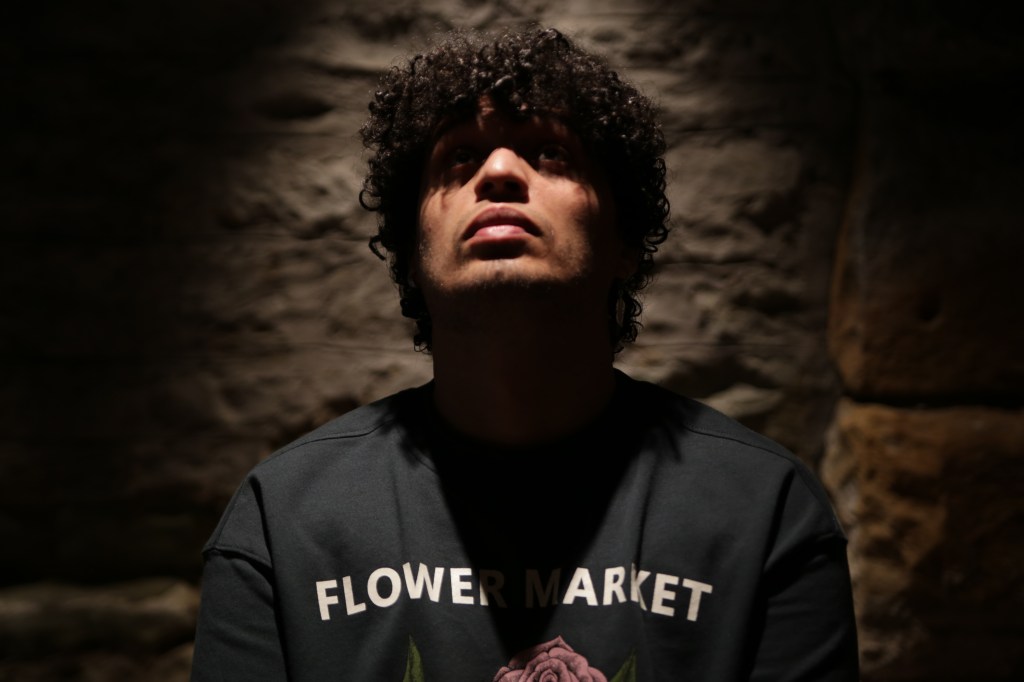
Anouar Rahmani
I had a place in America before I set foot in John F. Kennedy Airport in New York. Here, in Uncle Sam’s country, I found that I had a space that was made for me in advance on this land before I came to it, an inalienable space that existed before me, and my role was to fill it without nodding my head in refusal. This small space resembles me physically, and suits a person with my features: somewhat tall, somehow dark-skinned, gay, and from a Muslim background, Berber as we are called in Algeria, and Arab by virtue of the political and cultural position of the country I came from. But despite all these correct physical projections, whether related to my body or the geography I came from, this space was hateful, full of racism, misconceptions, and injustice in its ugliest forms, on a journey I initially thought was a journey of salvation, but which later became a project of burial and erasure in this arrogant West, whose peoples have finally become aware of their historical crimes against other peoples, except for those crimes against Arabs and Muslims, because there in the land of Arabs and Muslims, the war is still raging and continuing, and the victim there must remain condemned forever by the same previous colonial mechanisms, and he must remain in the image of the degenerate, the evil, the criminal, so as not to gain the sympathy of the inhabitants of this Western part of the earth.
In this article, I will present my personal analyses of the stereotypes about my body and how they affected my relationships in the United States. But I will also not deprive myself of making other stereotypes about American society. These stereotypes, in turn, are not necessarily 100% true; they exist to illustrate the feelings I have experienced rather than to be indisputable general truths.
1- The Arab Muslim body in airports and the Western social institution:
It started at Charles de Gaulle Airport in Paris, as I was boarding an Air France flight to New York. Because of my Algerian passport, I was questioned by airport workers about “the reason for my trip to America.” They did this to me alone, not to the others. Before boarding the plane, right in front of the door, I was once again placed on the sidelines. There, I was searched again, unlike the others. Me and two other people, with the same brown skin color and seemingly from the same background—perhaps Arab, Muslim, or perhaps also from Latin America in another case—despite the manual search and the scanners we passed through at the airport, we, unlike the Americans and Europeans, had to remove our shoes again, be searched a second time, and have samples taken from us by a scanning device. I don’t know if it was a DNA testing device or what exactly, but it looked like some kind of technology. The others, mostly white, boarded the plane comfortably, with smiles and simple greetings. It was clear, direct discrimination based on skin color, although Black Americans were spared scrutiny because, and I am proud of this, they fought to the last breath to win their rights in America. The brown-skinned human being remained reduced to the idea of ” the terrorist who blows himself up,” “the man who oppresses women,” “the backward brown man,” “the barbaric brown pirate who kills innocents,” “the greatest evil on earth.” It was very clear that there was no need for that inspection after all the stages of inspection we had gone through at the airport. If there was really a need to inspect us, they should have explained the reason to us out of respect, but this did not happen. If the inspection and search at the airport were not enough, they should have inspected everyone, and this also did not happen. So perhaps the whole process was just psychological, to make us adapt from the beginning, from the plane gate, to the world we were going to, where we were condemned to be lowly beings as “brown men of Arab or Muslim background,” and that we had to accept this lowly place from the beginning. And when I arrived at John F. Kennedy Airport, I was inspected again, unlike the others, at the exit gate, which is the same gate for entering America.
These Orientalist projections about me as a man who came from the East are not a product of the present. What I have lived and am still living is a manifestation of a continuous process of distorting the image of the Arab Muslim man as a rabble-rouser, extremist, hateful, and evil person. I could not have taken any other position in the story except this despicable position, because this is what is intended for us here. Even I, after all that I contributed to creating in Algeria in terms of awareness among the Algerian public, through my defense of freedom of expression, human rights, religious and atheistic rights, and LGBT rights, as I was the first Algerian to demand the legalization of same-sex marriage, and I defended openly and alone for women’s rights, to the point that I dedicated one of my novels to my mother’s vagina and breasts on the first page of the book, which provoked the anger and disapproval of many men in Algeria, and I tried a lot through my novels to establish the rights of women and homosexuals and to train the collective Algerian and Arab mind to accept others, many described me as being radical in the defense of human rights, especially in the defense of women, to the point that I rewrote a new Algerian constitutional model and a model of family law, and many international newspapers in Europe and the Arab world praised me, and the largest LGBT magazine in Europe interviewed me. I gained international recognition because of all this, yet neither this nor that helped me in America. I always remained the “Eastern man, brown-skinned, difficult to deal with, who kills innocents and oppresses women.”
More than once in America, I felt like I was at war to drop these accusations against me without any wrongdoing on my part, except that my name is Arabic, a surname that suggests I am Muslim even though I am agnostic. And more than once, I had to explain to the same people why I don’t drink alcohol and why I fast during Ramadan, as if I were in a continuous investigation to prove that I am not a “Muslim”. I tried more than once to explain that there is a difference between culture and religion, and that both are freedoms as long as no harm is done to others, but to no avail. Many people deliberately tried to hurt me psychologically and put me in an interrogation situation more than once, even if it was just as a “joke,” or by attaching some ready-made accusations to me as an Eastern man. I heard this a lot, to the point that I was hospitalized twice because of this. Obscene terms or insinuations, sometimes that I am an “Islamic extremist” because I fast during Ramadan, “Taliban” because I shaved my head completely, “Al-Qaeda” because I don’t drink alcohol, “against women’s rights” because I am an Eastern man by nature, “sexually disturbed,” and this hurt me more than any other insinuation, because I am gay. I have repeatedly tried to debunk these slanders and trivializing stereotypes. At first, I took it as ignorance and spoke objectively, explaining the difference between this and that, between these slanders and stereotypes and the truth. I did not take it personally, but over time, it became unbearable, and without the slightest protection, I found myself in a constant state of defense. To prove that I am just a human being like everyone else. And there I understood that no matter what I did or who I was, I would always be subject to questioning, whether in Algeria or in America.
2- Exploiting stereotypes about men, the Eastern man, and the dark-skinned man:
One of the things you will quickly understand here, especially if you are a refugee writer in an organization to protect writers with another group of writers, is that “natural” competition can sometimes turn into “unethical” competition, and we, who were once victims of the machinery of oppression, turn into oppressors in turn, exploiting in turn stereotypes, ready-made templates, and the history of “the image” in the West and the relationship of body shape to the class of “oppressor/victim” to distort the other competitor in order to maintain the role of the victim by hunting for mistakes, slips, or even manipulation and tricks in order to accuse each other of serious accusations. And in America, I learned the lesson well. Nothing is by chance. I am a tall, large-bodied man, and I gained a lot of weight in America, which reinforced the “power” hypothesis. I am brown-skinned, and this gives an easy impression of me as a “dangerous threat,” whether against the opposite sex, against the person of the other skin color (white), against the shorter and smaller person, etc. Hollywood, Western cinema, and Orientalist paintings have worked to create a distorted mental image of us as Eastern men in the West, portraying us as human monsters, huge and tyrannical, with no mercy or humanity in us. I have stood more than once in front of the mirror and asked myself, “Am I really ugly?” “Am I a monster?” “Why are they afraid of me?” “Why don’t they give me the right to defend myself?”, Dozens of questions came to my mind, some realistic and others perhaps just obsessive thoughts, “Why do they hate me?”, “Why don’t they respect me?” “And why should I ask? Why are they afraid of me, even though I am friendly?” And because I never found the answer, I resigned myself to the fact that I am perhaps ugly, very ugly, to the point that they do not listen to me, do not give me the right to defend myself. Also, as an Eastern man and gay at the same time, I am an “unclear” person in the system, not easily categorized. Also, I am a person who thinks a lot and is full of questions, and therefore, they do not really know me. “Who is this strange, tall, dark, fat, deviant creature, who plays the role of the white intellectual without shame?” I was a suspect being. They are not sure if I am really gay or heterosexual, playing the role of gay to win privileges (the joke of the era). Was I really good or another tyrannical Eastern man? Was I really for women’s rights, or was I hiding a hatred of women like other Eastern men? Was I really progressive and avant-garde or was I just playing a despicable role in order to obtain asylum and get to stay in USA and do my taxes every February and pay my tax return to the software? Everything in my body and mind was subject to doubt. As a man who came from Algeria, I had to leave my testicles at the airport, cut my knees before getting off the plane to look shorter, be Asexual and opinionless, be a pure angel, and prove daily my loyalty, my morality, and my disavowal of my culture. I was the villain, the fanatic, the radical, the extremist. I had to bear the weight of the entire world’s morality, and be perfect and without fault, or I was the devil. In the name of competition, to prove the moral superiority of some over others, some activate the characteristic of the absolute victim, and they always look for someone who meets the conditions of the absolute oppressor, and usually he must have some ideal qualities to suit this role: First, to be a man or a strong-bodied woman, to be Eastern, to be brown or black, to be tall and broad-shouldered, to be geographically close to the possible ‘victim’, and they exploit some of this and that to keep you in the same image to please the white master, just as Frantz Fanon explained in one of his theories.
3- Disguised homophobia against homosexuals
Homophobia, however, has donned a different mask here. In America, the latter is very clever and does not readily name itself. For example, some people usually use indirect methods to justify their undeclared hatred against homosexuals, or perhaps, to avoid exaggeration, their sensitivity to homosexuals and not necessarily hatred, and sometimes even my fellow Arabs, in if they work in the same place as a homosexual known for his pro-LGBT ideas, or that their name is associated with him because of the place of residence or employment, to avoid sensitivities and protect the reputation, they slander the homosexual person and distort his image and reputation so that they can later incite public opinion against him, whether in the workplace or outside of it, by belittling him, questioning his history, or even attacking his morals, including his sexuality, in line with the original element of hatred in the first place, by questioning the sincerity of intentions, as if the homosexual cannot think logically, but is merely a lustful person, and has one day a year to participate in Pride, as an annual carnival. In reality, homosexuals and LGBT intellectuals in the West are restricted by clear frameworks and cannot transcend them, scientifically, literarily, and intellectually. Homosexuals must remain attached to their sexual topics and not deviate from them, as major intellectual topics are the exclusive domain of “white heterosexual men” to the exclusion of other women and LGBT individuals. Therefore, it is easy to attack homosexuals, their morals, and to symbolically abuse them, especially if the guilt is collective and can be shared.
5- Scapegoat mechanisms
My size, height, gender, body, skin color, religious and linguistic background, and even my precarious economic status as an immigrant all contributed to making me an easy target for framing as the persecuted person, through fabrication, accusation, scapegoating, trickery, manipulation, and several other things. And it made me easy prey for victimhood hunters, or for racists, immigrant haters, and homophobes. by manipulating ‘opposites’ to build a believable system of oppression: “man-woman” because Americans view men as the traditional oppressor, “rich-poor” because Americans are a capitalist society that prefers the rich over the poor, “citizen-immigrant” because the immigrant is considered an alien element, “short body-tall body” because the taller body is stronger in the public imagination, etc. All of this reinforces the scapegoat theory, where human groups find an individual in the group to project their negative feelings onto almost instinctively in the name of the group, where the guilt is shared and collective, the guilt disappears, and the person easily becomes a scapegoat and a hated person in the group, whether due to jealousy or for no reason at all.
When I came to America, I found a world of images that transcended me as a person, and I could not transcend it. The image of me as a man coming from the East alone was enough to shatter all my history of struggle and thought in my country, and make my history worthless, as if I had never existed. Despite dozens of statements and articles about me from major international human rights organizations, this was never enough. My history was questioned to my face because perhaps I did not meet the conditions, or I should have been confined to two images with no third option in this country: the image of the unique, rational victim who survived the den of vipers in her homeland, where the savages and the mob reside, or the image of the savage mobster, the radical extremist. As for someone like me, with my physical characteristics, who holds avant-garde ideas that are more progressive than most American intellectuals, this does not serve the supremacist system. Therefore, this model must disappear, must be destroyed, by provoking the worst in man, sowing doubt and stripping man of his self-confidence, and keeping the person hostage to fear and oppression in order to disable his cognitive functions and make him sink deeper into his absolute “sin”. Or it could push a person to become truly extremist by planting seeds of hatred within him. And this is, of course, something I will not allow in my life, even if they marginalize me, even if someone tries to distort my image, even if I am placed in a lowly position in the system, I will always remain Anouar, the defender of LGBT, the defender of women, the defender of progressive rights and conservative procedures, the thinker, the intellectual. I will never forget who I am. I am not an angel, and I am not a devil. I am a human being. I may make mistakes; I may be right; I may wrong someone without realizing it; and I may also be wronged. But I will never hold a grudge, take revenge, or harm anyone in return. I maintain my freedom of expression and my right as a human being. I love life, and I will live it despite everything, and I will not harm anyone, whether a woman or a man. And I will remain free as long as I live, despite all the stereotypes surrounding me, whether in Algeria or in America, because I am: I am a tall, fat, brown-skinned, gay, immigrant man of Arab-berber Muslim background, and I will never become an extremist, but will always remain a human being who seeks freedom and peace despite all the stereotypes about my body.


 Anouar Rahmani's Official Website
Leave a comment