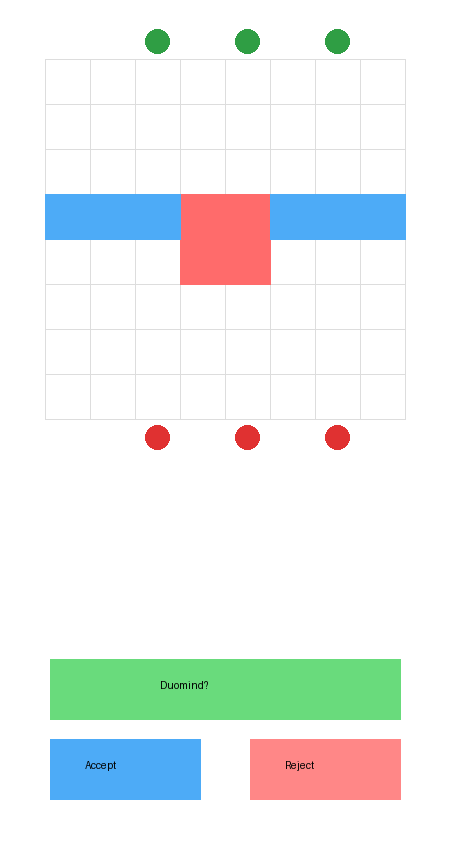
DoYouMind is a strategy-based board game inspired by chess, designed to develop negotiation skills through a combination of knowledge, decision-making, and psychological interaction. The game takes place on an 8×8 grid, where the ultimate objective lies at the center of the board, a contested zone that both players must reach and control. On each side of this central area, special blue squares introduce additional layers of strategy, offering opportunities that can shift the balance of the game.
Each player controls three circular pieces and begins from opposite sides of the board, one from the bottom and the other from the top. The progression of the game is driven by a combination of answering questions and negotiating outcomes. Players take turns responding to questions that may be system-generated or custom-created, and each correct answer allows them to advance one of their pieces forward based on Pre-negotiation outcomes.
What distinguishes DoYouMind is its negotiation system. Before answering, a player may initiate a negotiation with their opponent, proposing strategic advantages such as moving a piece multiple squares forward, pushing an opponent’s piece backward, or protecting one of their own pieces. These agreements must be accepted, rejected, or countered by the opponent, transforming each turn into a psychological exchange where trust, manipulation, and timing play a crucial role.
Players can choose between advancing their own position or disrupting their opponent’s progress, but only one piece can be affected per turn through negotiation. In the early phase of the game, pieces remain vulnerable and can be pushed back through strategic agreements. However, once a player successfully moves their first piece into the initial central zone, that piece becomes permanently protected and can no longer be forced backward, while the remaining pieces remain exposed. This creates a shift in strategy, encouraging players to balance risk, protection, and timing. However, if the opponent put his 3 pieces in a row in the blue squares can negotiate to move the opponent first piece from the center.
The objective is to move all three pieces into the central zone and organize them in a stable formation before the opponent does. Victory is achieved not only through correct answers, but through strategic thinking, negotiation skills, and the ability to anticipate and influence the opponent’s decisions.
Duomind transforms learning into a competitive and psychological experience where intelligence is not only measured by knowledge, but by the ability to negotiate, adapt, and outmaneuver and learning through negotiation.
I chose the name DoYoumind for multiple reasons. it is also a playful transformation of the English question “Do you mind?” At the same time, the word “mind” directly reflects the core of the game, which revolves around thinking, strategy, and negotiation.
During gameplay, especially in moments of interaction and negotiation, this idea becomes part of the mechanic itself. Players are constantly prompted to engage with one another through a simple, repeated question. When a player proposes a move, such as advancing their piece multiple squares or pushing an opponent’s piece backward, they initiate the negotiation by pressing a button labeled: DoYoumind?
The opponent is then presented with a clear choice:
- Accept the offer
- (Reject the offer)
This turns the name into a functional and immersive element of the game, where language, meaning, and gameplay are fully integrated.
How is played:
In DuoMind, two players face each other across an 8×8 board, each controlling three pieces starting from opposite sides. The goal is to advance all pieces into the central zone before the opponent, but movement is not automatic, it is negotiated. On each turn, one player becomes the questioner and selects a question from a given set. Before revealing it, they propose an offer: a set of consequences tied to whether the opponent answers correctly or incorrectly. For example, “If your answer is wrong, I move forward three squares; if you’re right, I move back two: Duomind? The opponent can accept, reject, or counter with a new offer, adjusting the stakes. Once both agree, the question appears with multiple-choice answers. The outcome is then applied exactly as negotiated, creating a dynamic where knowledge, risk, and strategy are constantly intertwined. As the game progresses, players must balance advancing their own pieces, protecting key positions, and negotiating wisely, turning each round into a live exchange of intelligence, intuition, and psychological play rather than a
simple test of memory This game allows the users to learn a wide range of subjects, including mathematics, physics, general knowledge, and even languages. It can be played online against unknown opponents, against the computer, or with someone the user already knows through the platform.
The game is also highly adaptable for different age groups and learning contexts. It can be used to teach children, as well as adults and university students, helping them memorize dates, facts, and mathematical rules in an engaging and interactive way. At the same time, it develops negotiation skills and reinforces learning through play, making the process both effective and enjoyable.
Simpler versions of the game can be created by using a question-by-question approach. The game can also be expanded to cover multiple subjects, and while it can be made more complex, it can just as easily be simplified.
2-learning through Negotiation:
Today, many universities teach negotiation as a discipline, including Harvard University, due to its positive impact on cognitive abilities. Negotiation helps develop social skills, improves communication, enhances analytical thinking, and strengthens the ability to find effective solutions at the right moment. These are essential skills for students, not only throughout their academic journey but also in everyday life.
However, this game does not aim merely to teach negotiation skills, it takes them to an entirely new level by introducing the concept of learning through negotiation.
The game has the potential to significantly enhance memory, particularly in retaining and recalling acquired knowledge. In this case, the knowledge comes from what users learn on Duolingo. The system can categorize learners based on their level within the platform and match players of similar proficiency, allowing them to review and reinforce their knowledge through negotiation-based gameplay.
This approach encourages learners to test their knowledge without feeling as though they are being formally examined. Instead, they engage in a dynamic and interactive game environment where learning goes beyond simple recall. Players are not only retrieving information, but doing so through negotiation, strategic thinking, and real-time decision-making.
Anouar Rahmani


Leave a comment