contact: anouarrahmaninovelist@gmail.com
Anouar Rahmani was Shortlisted for the index on Censorship Freedom of Expression Awards, London 2021; honored by the German Bundestag’s protection (Parliamentarians for Parliamentarians), Berlin 2021, recognized as exiled writer by Pen America, supported by Pen International, Pen America, Pen Canada, Pen France, Frontline defenders, Human rights Watch since 2016. Named the pen against the inquisitions by L’Humanité newspaper Paris, France.
Anouar Rahmani is an Algerian novelist, writer, journalist, and internationally recognized defender of freedom of expression. His work occupies a rare intersection between literature, human rights, and public ethics, where writing is not treated as a decorative cultural act but as a form of intellectual resistance. Rahmani’s literary and public trajectory has positioned him as one of the most visible contemporary Algerian voices confronting censorship, religious and moral authoritarianism, and the criminalization of imagination. His case has become emblematic of the risks faced by writers in restrictive environments, transforming his literary practice into a global freedom-of-expression concern.
Rahmani’s writing spans novels, essays, and hybrid literary–philosophical texts characterized by symbolic density, narrative audacity, and a sustained interrogation of power. His works challenge imposed moral orthodoxies, expose the violence of legal and religious dogmatism, and center marginalized bodies and silenced identities. Critics and journalists have repeatedly emphasized that his literature refuses neutrality: it is an unsettling, confrontational body of work that dismantles false consensus and interrogates the mechanisms through which societies discipline dissent. Lebanese newspaper Al-Akhbar famously referred to him as “the Algerian Kafka,” highlighting the absurd legal and moral labyrinths that permeate both his writing and lived experience.
Beyond literature, Rahmani has been a consistent public advocate for freedom of expression, freedom of belief, and the rights of minorities, including LGBTQ+ communities in the Arab world. These positions were not abstract commitments but public stances that exposed him to prosecution, threats, and sustained harassment. As a result, his name has appeared repeatedly in international press and human rights discourse as a case illustrating the use of blasphemy laws, morality charges, and legal intimidation to silence writers. His trajectory demonstrates how literary production can become a political act when the state seeks to police thought and language. Drawing on his legal background, Rahmani proposed a constitutional model for Algeria aimed at rethinking the foundations of the state through the rule of law, judicial independence, separation of powers, equal citizenship, and the constitutional protection of fundamental freedoms. His constitutional work sought to move Algeria beyond the legacy of the police state by imagining a democratic legal order grounded in dignity, accountability, and the protection of individual rights. longside his constitutional work, Rahmani publicly defended the right of families of those forcibly disappeared during Algeria’s civil conflict of the 1990s to truth, justice, and accountability, arguing that genuine national reconciliation cannot be achieved without acknowledging victims and confronting the past. He is also widely recognized as the first Algerian to publicly call, from a legal and constitutional perspective, for the legalization of same-sex marriage in Algeria, framing marriage equality as a matter of equal citizenship, constitutional rights, and human dignity rather than religious doctrine or social convention.
Rahmani’s international visibility has been reinforced by extensive coverage in global media outlets, including Le Monde, El País, Al Jazeera, International Business Times, TÊTU, and others. The French daily L’Humanité described him as “a pen against the Inquisition,” framing his work and persecution as part of a broader struggle against modern forms of ideological and moral repression. Such descriptions have contributed to his recognition not merely as a novelist, but as a symbolic figure in contemporary debates on censorship, conscience, and artistic freedom.
Institutionally, Rahmani has received sustained recognition and protection from major international bodies. He was shortlisted for the Index on Censorship Freedom of Expression Award, one of the most prestigious global distinctions in the field. He has also received honorary political and honorary support from the German Bundestag through the Parliamentarians for Parliamentarians network, acknowledging his commitment to constitutional values, human rights, and democratic principles. His name has appeared in statements and documents linked to the European Parliament, alongside references within international human rights frameworks connected to the United Nations system. Global organizations such as PEN International, Human Rights Watch, and Front-Line Defenders have publicly supported him, framing his case as a matter of international concern.
In the United States, Anouar Rahmani has been formally recognized as a writer in exile, notably through PEN America, which acknowledges him on its official platforms as part of its commitment to protecting persecuted writers worldwide. He has benefited from international solidarity across the global PEN network and its national chapters. His presence in the American academic landscape has been equally significant: he has been invited to speak, read, and participate in discussions at numerous universities and cultural institutions, where his work is approached as both literature and testimony.
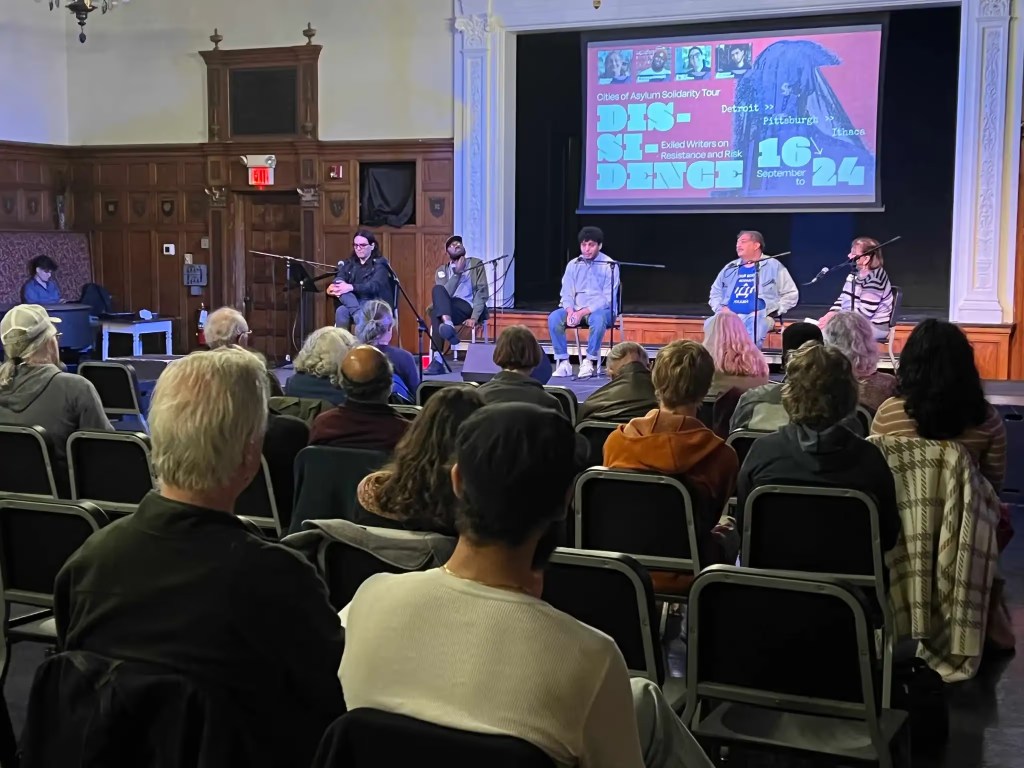
Rahmani has been hosted by or engaged with institutions such as Indiana University of Pennsylvania, the University of Pennsylvania, Cornell University, Ithaca College, the University of Pittsburgh, Carnegie Mellon University, Slippery Rock University, as well as secondary schools and cultural centers. In these spaces, he has been presented as a writer whose work bridges literature, exile studies, freedom of expression, and contemporary political ethics. American universities have consistently framed his interventions as intellectually rigorous and pedagogically vital, valuing his ability to articulate the lived consequences of censorship while maintaining a high literary and philosophical standard.
Some External Links about Anouar Rahmani:
Proposed University Lectures, Talks, and Creative Writing Workshops
Anouar Rahmani
Lectures and Public Talks
1. The Salman Rushdie Attack: When a Literary Threat Becomes a Physical Scene
A lecture reflecting on the attack on Salman Rushdie and the terrifying moment when a decades-old threat against a writer materialized in a public literary space. The talk examines how writers imagine such violence before it happens, how the scene can be represented through writing and visual imagination, and what the attack revealed about the continuing vulnerability of writers, even in spaces assumed to be safe.
- Witnessing the Attack on Salman Rushdie: When a Threat Against a Writer Became Reality
I was an invited guest at the Chautauqua Institution when Salman Rushdie was attacked on stage in August 2022. I witnessed the immediate aftermath of the attack, documented the scene through photographs and video, and helped bring visual documentation of what had happened to the media.
This lecture offers a rare first-person account of a historic attack on a writer. It explores what it means to witness violence against literature become physically real, the responsibility and ethical dilemmas of documenting such a moment, and the relationship between witnessing, journalism, memory, and freedom of expression. Drawing on my own experience as a writer who has faced censorship and prosecution, I also examine the deeper symbolism of being present when a threat against another writer, carried across decades, suddenly became an act of physical violence.
2. The Banned Book: What Happens to a Writer When a Book Becomes a Crime?
Drawing from my own experience of having literary work banned and facing legal consequences because of writing, this lecture explores censorship from the inside. What does it mean psychologically, politically, and artistically when a state decides that a novel is dangerous? The lecture also examines the paradoxical afterlife of banned books and the relationship between prohibition, fear, curiosity, and literary power.
3. From Algeria to Exile: The Story of a Writer Who Refused to Stop Writing
A personal and political account of my journey from writing under censorship in Algeria to becoming an exiled writer in the United States. The lecture explores prosecution, surveillance, censorship, exile, displacement, and the complicated experience of rebuilding a literary and intellectual life in another country.
4. The Writer After Rescue: What Happens After an Artist Reaches Safety?
International protection programs often focus on rescuing writers and artists from immediate danger. But what happens afterward? This lecture examines the less visible realities of exile: economic precarity, professional displacement, identity loss, institutional dependency, and the difficult transition from being a “writer at risk” to building an independent life.
5. LGBTQ+ Rights in the Arab World: Between Law, Silence, and the Politics of Visibility
Drawing on my experience advocating for LGBTQ+ rights and becoming one of the first public voices to legally argue for the recognition of same-sex marriage in Algeria, this lecture examines the legal, political, cultural, and strategic challenges facing LGBTQ+ advocacy in Arab and Muslim-majority societies.
6. Who Owns Free Speech? Freedom of Expression in the Age of Polarization
Freedom of expression is increasingly claimed by radically different political movements, sometimes to protect dissent and sometimes to justify attacks on the dignity and rights of others. This lecture asks whether the meaning of free expression itself is now becoming a political battlefield and how we can defend freedom of expression without emptying it of ethical responsibility.
7. Free Speech Inside Universities and Cultural Institutions
Universities and cultural institutions often present themselves as spaces of intellectual freedom, but they are also structures of power, reputation, funding, hierarchy, and institutional risk. This lecture examines the tensions between genuine intellectual freedom and the informal mechanisms that can silence people without officially censoring them.
8. Censorship Without a Censor: How Institutions Silence Without Banning
Modern censorship does not always require a government order, a prison sentence, or a banned book. It can operate through exclusion, reputational pressure, gatekeeping, social isolation, funding decisions, and fear of controversy. This lecture explores the emerging forms of “soft censorship” that exist within democratic societies and cultural institutions.
9. The Right to Be Misunderstood: Writers, Reputation, and the Age of Permanent Judgment
What happens when a writer loses control over the public interpretation of their own identity? This lecture explores reputation, controversy, social media, institutional narratives, and the growing pressure on writers and public intellectuals to become simplified, morally legible characters rather than complex human beings.
10. Writing Against the Police State: Literature, Law, and Constitutional Imagination
Drawing from my background in law, literature, and constitutional advocacy, this lecture examines how writers and legal thinkers can challenge authoritarian systems not only by criticizing existing institutions but by imagining alternatives. It discusses my experience proposing constitutional and legal reforms for Algeria and the relationship between political imagination and literary imagination.
11. The Missing and the Unfinished Past: Memory, Justice, and Algeria’s 1990s
A lecture on enforced disappearances, collective memory, and the unresolved legacy of Algeria’s civil conflict during the 1990s. The talk explores my advocacy concerning the missing, the politics of national forgetting, and the difficult question of whether reconciliation is possible without truth.
12. Literature as Evidence: Can Fiction Say What Politics Cannot?
Fiction often enters territories that journalism, law, and political discourse cannot easily reach. Through symbolism, ambiguity, unreliable characters, and imagined worlds, literature can expose systems of violence without reducing human beings to political categories. This lecture explores fiction as an alternative form of testimony and intellectual resistance.
13. The Writer as a Constitutional Imagination
What happens when a writer begins designing laws, constitutional models, and alternative political systems? Drawing on my experience in both literature and law, this lecture explores the unexpected relationship between constitution-making and fiction: both begin with the question, “What kind of world could exist instead?”
14. LGBTQ+ People and the Politics of the Scapegoat
Why do societies repeatedly transform minorities into explanations for larger social anxieties? This interdisciplinary lecture examines scapegoating through law, religion, politics, literature, and social psychology, with particular attention to LGBTQ+ communities and the political production of the “dangerous other.”
15. Exile Is Not the End of Censorship
Leaving an authoritarian country does not necessarily end fear, surveillance, self-censorship, or political pressure. This lecture examines how censorship can travel with the exiled writer through family pressure, diaspora politics, digital harassment, reputational attacks, and the internalized memory of punishment.
16. The Writer as a Public Threat: Why Are Governments Afraid of Novels?
Why can an invented story frighten a government? This lecture examines the political anxiety surrounding fiction and asks why authoritarian systems often treat imagination as a form of disobedience. Drawing on my own experience, the talk explores the strange power attributed to writers by the very institutions that attempt to silence them.
17. Dystopia Is Already Here: Writing Fiction in an Age of Crisis
From pandemics and surveillance to authoritarianism, displacement, ecological fear, and attacks on minority rights, contemporary reality increasingly resembles dystopian fiction. This lecture examines how writers can create dystopian literature without merely reproducing the news and how speculative fiction can reveal structures that realism sometimes cannot.
Creative Writing Workshops
18. Building a Dystopian Novel: From One Disturbing Question to an Entire World
An interactive workshop on developing a dystopian novel from an initial “What if?” question. Participants will learn how to construct the central crisis, political system, social rules, characters, symbols, conflicts, and internal logic of a fictional world. The workshop emphasizes the difference between a dystopia that merely describes catastrophe and one that reveals something profound about the present.
19. Writing the Dystopian Short Story: Building a World in Limited Space
A practical workshop on creating powerful dystopian short fiction. Participants will work on compression, world-building through detail, symbolic objects, atmosphere, character motivation, and endings that expand the meaning of the story beyond its final sentence.
20. From Idea to Short Story Collection: Creating Many Stories That Speak to One Another
A workshop for writers interested in developing a coherent short story collection. Participants will explore how independent stories can be connected through recurring themes, places, historical events, symbols, characters, or philosophical questions. The workshop will help writers design a collection that functions both as a group of individual stories and as a larger literary architecture.
21- let’s write a constitution together
 Anouar Rahmani's Official Website
Leave a comment