in this Semi-Fiction SF Story/Article I am trying to imagine and invent a new ‘universe and life’ in a form of a cube (Rubik’s Cube), questioning randomness and constancy in an alternative universe. wrriten by Anouar Rahmani.
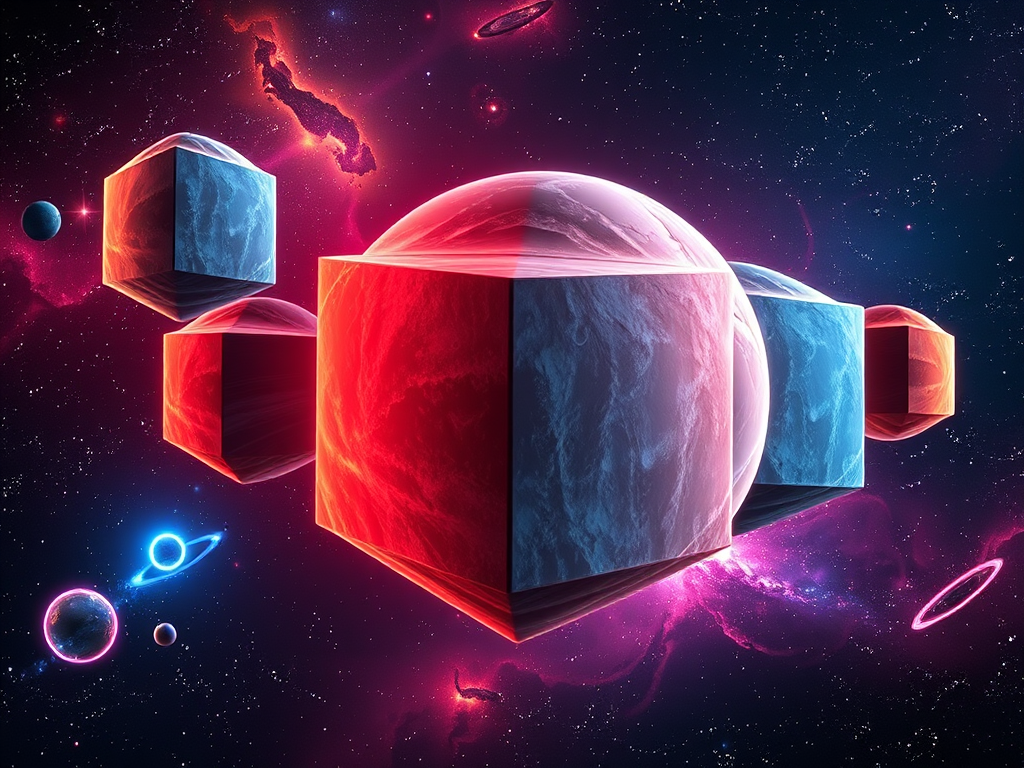
What if we lived in a cubic world in which the cube was the origin of all shapes and movement? It may seem absurd, but it seems that explaining existence and the living experience that exists in it is easier by building another solid, perhaps more complex in its appearance and faster in its formal development. To understand, simplify, and explain concepts, this cubic conception of the world will generally allow us to envision more effective patterns of functioning of the universe, life, death, language, society, thought, and systems. Political law in a random world in which all possibilities are infinite. While this perception allows us to build a cubic model of the universe, it also refers us to questioning randomness and understanding it in its near-absolute context and puts us before many problems, such as the relativity of time, the relativity of space as well, and the relativity of existence in general. The Rubik’s Cube model that I propose is not an alternative to understanding our world, but it presents us with a new imagination that can deconstruct the complexities of the world in which we live.
1
Rubik’s Cube world
Change is the only principle in the world of the Rubik’s Cube. In this world, where things change constantly and randomly: let’s imagine things to be the same as our world, houses, cars, cities, mountains, maps, countries, animals, plants, people… the liquid element such as water is also made of cubic atoms, and they function in the same way as Rubik’s cube however there cubic atoms are not tightly bound together which makes the cubes move faster and the Rubik’s cube game in water is not apparent.
In the same way, and just like our own world, planets and stars move towards a radial attraction, however the cubic spacetime will constantly reshape itself to make the planets and the stars look like they move in straight lines to form cubic rotations instead of circular rotations, they move backward, forward, up and down, left and right, a constant movement of straight lines. With their movements, planets and stars keep forming virtual moving cubes which makes the space time in this model vibratory. This constant vibration cause elements to behave in a constant vibration.
Space-time in this random space is just an optical illusion, as there is no place for the rules of normal physics. Here in this quantum world, natural phenomena and living organisms, or as I call them in this case, living cubes, act as free ‘electrons.’ Everything is a mirror of other things, and absurdly, it is inconceivable without dismantling the four dimensions and understanding them outside their sensory field, but rather in their atomic field, which in this case and this imagined world is a cubic experiment: here one can extend their leg while walking forward and backward at the same time, and no North of the compass, and there are no coordinates for places except through awareness. Consciousness, which here does not comply with individual cognitive accumulation but rather with random (cubic) cellular crowding, and I will explain this later.
The world of the Rubik’s Cube seems absurd, complex, and difficult to understand if we consider understanding to be nothing but an experience passed from one living cube to another beyond our understanding of personal experience that does not exist in this case. But this world exists in a way that cannot be felt or understood individually or collectively but randomly. The inhabitants of this world see that change as an absolute and constant act. Therefore, everyone lives with a pattern of awareness that does not allow an understanding of constancy and stability. The only constant is change, and the only variable is constancy.
Everything changes with continuous action as if things were created to be scattered and continuous. Today is the same as yesterday and tomorrow. Even time is part of the Rubik’s game. The time can be eight in the morning and six in the evening at once, where what matters is not the numbers on the clock, but rather the time itself. Here, Time is determined by the speed of probabilities and the rotation of Rubik’s cubes. In a world of constant change, stability cannot exist except due to change. As for time, it is a purely emotional state, and in our cubic world, there are no emotions.
There are no names in this world. Human beings are changing entities in form and content. Let’s refer that to our own understanding of time: At nine o’clock, the left eye is blue, and the right eye is black. At ten o’clock, the right eye is green, and the left eye is blurred. Half of the hair is curly, and the other half is straight, a quarter of the skin is black, a quarter is white, and half of the skin is brown, the colors are always changing, so the concept of skin color here is not important. Faces change partially every time, and therefore, in the world of the Rubik’s Cube, there is no racism. The concept of race and ethnicity here is non-existent because there is no original constant in skin color, and life is just random experiments where there is no place for absolutes.
2
Life, death, and consciousness…
Everything is a direct embodiment of the Rubik’s Cube, individuals are, in turn, a toy of rotations of small cubes. The planet is also a cube, and in this case, the universe is also a cube. The age of humans here is not calculated in years or by the movement of the planets and their rotation around the sun but rather by the speed of rotation of the cubes in the bodies. Therefore, the feeling of the time dimension differs between each conscious cube to another according to the speed of the cube rotation. As a person grows older, the speed of rotation of the cubes increases until he reaches a level of awareness that allows him to shrink, then close the Rubik’s Cube that represents and embodies him. But as soon as someone approaches the solution, his cube dies, and his wrong cube begins a natural rotation process by returning to the group of life cubes and completing its rotation series.
I know very well that this is very complicated, but you can understand it in this simplified way: Let us assume that you are a Rubik’s Cube, and with you are three people who are also Rubik’s Cubes, and you live in one small room that is the whole world. The room is a Rubik’s cube, too; the furniture is a Rubik’s cube, and even the air atoms are an invisible Rubik’s cube as well, and everything around you is a Rubik’s cube trying to understand itself. The Rubik’s cubes revolve in you and around you automatically to reach the solution. Your Rubik’s cubes are not complete but rather scattered. In each of you, there are cubes of people and things around you. The consciousness of each one of you tries to move and exchange the cubes through the scattered parts of consciousness. The mind, in this case, is a deterministic group. Of the cubes of your consciousness and the awareness of others, each cube understands itself through its relationship with other cubes, and in this case, there is no individual independence and no independence of consciousness.
The cubes try hard to move randomly from person to person, and in the person himself, to order existence and search for complete individual existence. Let us assume that the speed of transferring these cubes from one person to another accelerates as the number of attempts increases. The speed doubles as the cubes of consciousness come closer to understanding themselves and uniting with the cubes appropriate to them. As the speed increases, the closer the person approaches his old age, awareness increases, energy runs out, and the living cube (the person, for example) dies with every approach to finding the solution to closing the cube. Man dies, the dead cubes merge with the world of inanimate objects, while the false cubes continue their cycle in other cubic beings. This is what makes the process of death and life an inevitable embodiment of right and wrong since error, in this case, is life. Considering the inanimate object is the act that approaches the truth, while the living is the scattered form and an infinite number of rotational possibilities for the small cubes inside the large cube and other cubes.
This is a simple example in a room of four people. Now imagine that this process does not only include the cubes of consciousness (the mental cells in the biological state) but also the cubes of the body (the physical cells and the cells of the internal organs). Imagine that the process occurs within a complex qualitative society numbering billions of cubes, living together in a state of harmony of random consciousness, in this state, the speed inevitably increases, but the ages also increase as the number of infinite possibilities of turning the Rubik’s cubes increases. In this case, speed is also time, and the number of desired possibilities before finding the solution is the physical mass of the living cube. The analysis of the data for each cube is his consciousness, while the wrong analyses and shocks of the random movement of the cubes on this path are his subconscious.
Death, life, and consciousness in the Rubik’s Cube world are completely different from what is usual in our world. Here, the cubes behave like electrons. Their location cannot be predicted, as they pass randomly from one place to another, but with the increase of experiments and attempts at arrangement, the living experience gains its meaning and approaches its inevitable end, and awareness is formed between that and that.
In the world of the Rubik’s Cube, the younger ones are the most scattered and random, and the older ones are the most organized and regular, but without reaching the final solution of the cube. In the chronological sense of age, the younger ones are the slowest even though they have more energy in their cubes, while the older living cubes behave strangely and are faster not because there is more energy but simply because the cube is closer to the end. More simply, imagine that you have a vertical spiral hole that is very deep and with a gravitational force centered at the bottom. Now, throw a ball into the hole starting from its mouth. In this case, the speed of the ball increases as it approaches the bottom (gravitational force). In space-time, gravity is formed by masses and the curvature they embody on it, as there must always be a larger mass to attract smaller masses. Therefore, for example, in the solar system, the speed of planets’ rotation around the sun increases due to two factors: their proximity to the sun and their size. Since the sun is the largest mass, it is the center of the group and has the greatest gravity (gravitational field). Now, let us imagine that in the world of the Rubik’s cube, the greatest gravity is the one of inanimate objects. The largest cube, or the parent cube has the biggest gravity. Most of the cubes in the world of the Rubik’s cube are the cubes of the universe in its inanimate nature. As for the living cube, it is a small part of this larger cube, and therefore, it is attracted to it, so the speed increases. The arrangement of the cubes, awareness increases, and speed also increases until death, and death, in this case, is only a normal and inevitable part of the Rubik’s Cube World game.
3
Photo-construction of language
In the Rubik’s Cube world, language is the hardest thing to invent. The random systems of consciousness make the construction of unified oral or written languages difficult to achieve. As soon as the conscious cube builds the rules and vocabulary of a specific language, it becomes fragmented in another circle of rotation to line up with a group of other cubes in another cube. In this case, we are faced with three main possibilities. Still, it is not limited to them: The first possibility is that all humans (the conscious cubes) will be able to understand and speak all languages, or at least in a relative way. The second possibility is that no human being will be able to speak any language completely. The third possibility, which is the possibility that I think is most likely, is that the vocabulary and grammar of the spoken and written language are merely an apparent body, and that the real language is the logical foundation of the language, which, even if they differ from one language to another, remain relatively the same foundations. Therefore, the natural development of the human being in the world of the Rubik’s Cube will enable them to dismantle the true foundations of language and then re-understand languages through the root foundations and rules of languages.
Since the language in the world of Rubik’s Cube is relative and random, it must have a permanent communication system that is not read with vocabulary or sounds but rather with a huge linguistic network of light spectra in all its degrees. In the world of the Rubik’s Cube, I propose that the photon is the substitute for the letter in the written language and that the language is encoded using rays of light that can be understood and extrapolated through a set of uncountable rules. In this case, the light language will be more complex and developed than the oral and written language because it is unlimited, as the light degrees can be divided into smaller and smaller degrees, which brings us to an infinite number of possibilities. In our real world, we use the language of light in a very simple way, such as traffic lights, festive light displays, emergency lights, car lights, or even shadow plays, which are a form of this light expression. Now imagine having an infinite light-based coding system where you could “write” and “read” an infinite amount of information in the blink of an eye using light and sight.
‘Optical’ linguistic perception allows us to understand the mechanisms of faster linguistic and communication transmission across the universe and individuals. What is written in the real world in volumes can be summarized in a beam of light. It seems that the matter is difficult to achieve, but the new photo-construction of language can be an alternative solution for the inhabitants of the Rubik’s Cube world.
4
Political power in the Rubik’s Cube world
To understand the formation of political or legal authority, there must be a linguistic system, and to place this system in a state of historical development, let us currently assume that there were prior attempts to invent an oral or written language to record knowledge outside the photo-construction of language, and if the invention of the complex optical language was based on historical development. In this case, I suggest this narrative:
At the beginning of the emergence of intelligent life in this world, it was difficult to limit and expand knowledge as long as conscious experiences could not be framed, but while there was always continuity and movement of consciousness cubes from one conscious cube to another, even within the framework of randomness, consciousness cubes with great knowledge became able to to find cubes similar to them through let say ‘telepathy’, and this was an inevitable result of the evolution of life in its cubic form. The smartest cubes were later able to arrange themselves and communicate knowledge through colors, as it was difficult to preserve knowledge in books. The idea at first was to place knowledge in the form of symbols on colored parts of paper, then collect this knowledge in books by collecting colors and forming paper cubes. They were later called books to ensure that they would not be lost in the event of cubic fragmentation and transfer to other solids. Historically (symbolically), the conscious cubes were able to create a system for ‘hoarding’ and preserving knowledge, and they did so by creating schools that are not based on gradual indoctrination but rather on forced self-instruction, and this is what allows all the conscious cubes to gradually preserve knowledge and then recycle it as needed. Thus, the roles were distributed to people, not by personal awareness, but by randomly transferring the knowledge cubes from one individual to another, then finding the roles through telepathy, as the conscious cube can be a doctor for four days, a builder for three days, and an engineer for an hour and a half. It is not about meritocracy but about the random shifting of the cubes of consciousness. It is not possible to talk here about collective consciousness or individual consciousness. In the collective consciousness, everyone is aware of the same knowledge, memories, feelings, etc., and harbors the same fears. In the case of individual consciousness, individuals are aware of everything in and around them independently. In the world of the Rubik’s Cube, consciousness is random, neither individual nor collective, but rather based on probability, just like a game of dice.
A) Optical-computers and Light-technology:
The oldest consciousness cubes were able to develop the knowledge treasure system by being able to create technology that enables a central installation of knowledge through a huge optical computer that optically processes information, that is, it translates knowledge into light and then light into language. Light was the only solution to form a huge technological system that did not obey the laws of cubes. The optical computer was able to create a legal and political system that governed the random world through light. The system of government was eternal because persecution is not possible in a world with a random structure and where individuals cannot be identified and punished. As for crime, it is divided into two types. The first crime is abstention from knowledge. The second crime is preventing the highest conscious awareness cube from controlling the decisions of the rest of the awareness cubes in the conscious cube. These two crimes were rare, and no conscious cube would attempt to rebel against the optical computer system as long as it served the greater interest of all.
In this case, knowledge is the most important thing that authority possesses and is essentially its goal. In the world of the Rubik’s Cube, knowledge is order.
B) DNA and the birth of the constant:
In the Rubik’s Cube world, DNA also functions as a cube and is random, but because of the chain of amino bonds, its cubes recognize their counterparts in the random field of division. DNA cubes come together only through precise, non-random identification of the living species. Meaning, for example, human DNA cubes do not stick together with cat DNA cubes or bird DNA cubes with fish DNA cubes. In this case, the DNA cubes work to automatically and selectively recognize each other. Even randomness, in this case, must have fixed rules that enable it to create an ecosystem. The absolute randomness in the Cubist conception of the world cannot create life.
In the world of the Rubik’s Cube, humans are born with a huge collection of random cubes, some new and some old, which makes the child, in this case, randomly conscious, as the age stages, including childhood, have nothing to do with the degree of awareness. In this case, the child does not necessarily need all the attention that one usually receives in our world. Most children here are born with a fair degree of awareness. While the world of cubism is random, the birth of children is not based on gender because gender is not understood in the cubist state. Children are born through structural errors in the internal cubes. They are like cancer in our world but in a positive way.
Now, let us imagine the birth of a child who does not have cubic characteristics in a world like this. Let us call this child “the constant.” What would be the impact of this on the cubic matrix? The constant, in this case, for the rest of the being, is a variable. The political system will deal with it as a problem, even though the entire universe operates based on change. The constant child, in this case, represents a difficult problematic change, as it threatens the ‘stability’ of the system.
The constant is born, like other human beings, in the world of the Rubik’s Cube from the bowels of a conscious cube. However, its composition does not resemble the cubic composition of others. It appears to be a blank slate and needs care, just like our children. Let us imagine that this constant is you. You are in a big dilemma here. First, you cannot automatically adapt to society because a random society cannot understand individual needs and does not have anything that enables it to build social sympathy that would allow it to care for you. Your only chance of survival in this case is to be the subject of study. The cognitive curiosity of conscious cubes is your only lifeline.
The real problem that your existence as a constant creates chaos, not only in your existence but in the existence of the Rubik’s Cube world in general, as your existence as a constant will help achieve a unified awareness of you on the part of all conscious cubes, and make you a common consciousness, or a collective mind. It is your presence in the Rubik’s Cube world that will facilitate the process of solving the Rubik’s Cube in intelligent organisms as a landmark or starting point. In our prior understanding of death in the Rubik’s Cube world, the process of understanding and arranging the cubes of every human being (a conscious cube) will be faster and more accurate because of the presence of this common factor, which is you. In this case, the constant results in two important possibilities: either the final understanding and complete solution to the Rubik’s Cube problem will result in a new world that is more organized and less random, and in this case, there will be no death at all, or intelligent life, in general, will end, given that what drives its intelligence may perish with the presence of the solution to the ultimate problem of infinite randomness.
Conclusion:
The randomness and infinite possibilities in the world of Rubik’s Cube led us to the necessity of having an original constant that works like a parameter to find a final solution to the dilemma. All random factors may find themselves in an organized framework to create life. The linguistic structure in a world as random as the probability system of a Rubik’s Cube cannot be as simple as our human language. For this reason, I proposed a more complex optical, photo-constructed language. The DNA system of life in the Rubik’s Cube world is also quasi-random. The issue of the relativity of time in the Rubik’s Cube world is clearer than in the real world.
Anouar Rahmani
 Anouar Rahmani's Official Website